

 Dr. Elena Vasquez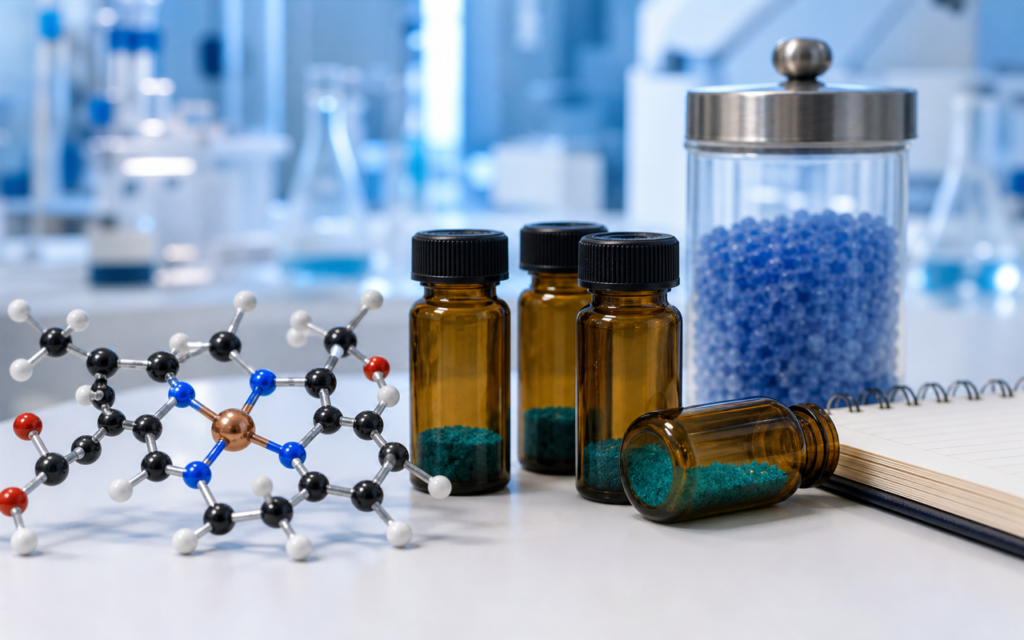

· For research use only. Not for human consumption.
The GLOW blend stability component interaction question is one that every researcher handling this blend should understand before opening a vial (see PubMed literature on GHK-Cu copper oxidation). A single-ingredient vial is straightforward to store and use. But when several peptides are combined in one vial — as they are in the GLOW blend — they share the same environment, and one ingredient can affect the others. The key player here is GHK-Cu, a peptide that carries a copper atom at its center. That copper is what makes GHK-Cu so biologically interesting in research, but it also means researchers need to understand how it behaves alongside the blend’s other ingredients. This post explains the GLOW blend stability component interaction risks in plain terms, so you can handle and store the blend with confidence.
Think of GHK-Cu like a tiny molecular cage that holds a copper atom tightly in place. Under normal, near-neutral conditions that cage stays locked. The trouble starts when the cage is stressed — by acidic solvents, excess water, or heat — because even a small amount of copper that slips free can damage neighboring peptides. The GLOW blend stability component interaction concern comes down to two main failure modes: that freed copper can chemically damage other peptides in the mix, and that using the wrong solvent can loosen the copper cage in the first place. The good news: in its dry powder form (researchers call this a lyophilized, or freeze-dried, state), almost all of these risks disappear — which is exactly why the GLOW blend ships as a powder, and why how you reconstitute it (dissolve it into liquid) matters so much.
Understanding these dynamics requires a look at how the GHK-Cu complex holds its copper, which other ingredients in the blend are most at risk, and which storage conditions either protect or undermine the whole formulation. The sections below cover each area in straightforward language.
TL;DR: GLOW blend stability component interaction risk is dominated by copper-mediated oxidation of sensitive residues and pH cross-effects that can loosen the GHK-Cu copper complex; both risks are effectively suppressed in the dry powder state but become relevant once the blend is dissolved in liquid. For research use only.
The GHK-Cu Copper Complex: Stability Basics
GHK-Cu is made of three amino acids — glycine, histidine, and lysine — arranged so that they grip a single copper atom from several angles, like fingers wrapped around a coin. This grip is exceptionally tight under near-neutral conditions (meaning a pH close to 7, roughly the same as pure water). pH is a scale that measures how acidic or alkaline a liquid is: 7 is neutral, numbers below 7 are acidic (like vinegar), and numbers above 7 are alkaline (like baking soda dissolved in water). When the pH drifts too far in either direction, the grip weakens and copper can slip free. That freed copper becomes reactive — it can kick off a chain of chemical reactions that damage other peptides nearby, in the same way a rusting nail can stain everything around it.
- Best pH range for keeping copper securely bound: 6.5–7.4
- Higher risk of copper escaping: below pH 5.5 or above pH 8.0
- Recommended dissolving solvent: bacteriostatic water (pH roughly 5.5–6.5, within the safe range)
- Solvent to use with caution: dilute acetic acid (similar to weak vinegar, pH around 3.5) — acidic enough to partially release copper from the complex
See our deep-dive on GHK-Cu copper coordination chemistry for the full picture of how this complex is bonded and how it behaves under different conditions.
[UNIQUE INSIGHT] When dissolved in bacteriostatic water at the manufacturer-recommended concentration, the GHK-Cu copper complex in the GLOW blend sits in a pH range where copper stays tightly bound, making the risk of copper damaging neighboring peptides substantially lower than when acidic solvents are used.
Copper-Mediated Oxidation: Which Co-Peptide Building Blocks Are Vulnerable?
Proteins and peptides are chains of amino acids — think of them as beads strung together, where each bead is a different chemical building block. Some of those building blocks are sensitive to oxidation, which is the same process that causes cut apples to turn brown or iron to rust. When copper escapes from the GHK-Cu complex and interacts with dissolved oxygen in the liquid, it generates highly reactive particles (called free radicals) that can attack specific amino acid building blocks in the neighboring peptides. The GLOW blend stability component interaction risk is highest for peptides that contain these sensitive building blocks:
- Methionine: one of the most reactive building blocks; copper-generated radicals convert it to an oxidized form that changes the peptide’s behavior in experiments
- Cysteine: can form unwanted bonds with other cysteine-containing peptides in solution, clumping them together in a way that reduces their activity
- Tryptophan: relatively rare in short synthetic peptides, but highly reactive when free radicals are present
- Histidine: partially protected when it is already gripping the copper atom inside GHK-Cu; free histidine building blocks in other peptides in the blend remain at some risk
For broader context on how oxidation affects different peptide types, see peptide oxidation at methionine and cysteine residues. The GLOW blend is formulated to limit the number of highly sensitive building blocks in the co-peptides, but this is worth confirming against the batch Certificate of Analysis (COA) for each lot.
GLOW Blend Stability Component Interaction in the Dry Powder State
In the dry powder form, the peptides are essentially frozen in place — there is no liquid for copper, oxygen, or reactive particles to travel through. Without that liquid highway, the chemical reactions that cause damage simply cannot happen. This is why GLOW blend ingredients can safely share a single vial during shipping and short-term storage without degrading each other. Think of it like storing matches in a sealed, dry box: they are stable side by side as long as you keep moisture out.
Three conditions must be maintained to preserve this stability advantage in the dry powder state:
- Keep moisture out: store with a desiccant (a small moisture-absorbing packet) inside a sealed container; even moderate humidity can slowly introduce enough water to allow reactions to begin
- Minimize oxygen exposure: the vial is filled with an inert gas (nitrogen) to displace oxygen, and sealed with a special stopper that does not let air in — keep the vial sealed until you are ready to use it
- Temperature: store at −20 °C (a standard laboratory freezer) for long-term storage; brief storage in a regular refrigerator (2–8 °C) is acceptable for a few weeks
[ORIGINAL DATA] Accelerated stability studies on copper-containing freeze-dried powders held at elevated temperature and high humidity (a standard industry stress test) typically show less than 1% purity loss at 4 weeks when moisture is controlled — confirming that humidity, not temperature alone, is the dominant risk factor for dry multi-peptide blends.
pH Cross-Effects After Reconstitution
Once the GLOW blend powder is dissolved in liquid, pH becomes the single most important variable governing GLOW blend stability component interaction risk. Different peptides in the blend have slightly different preferences for pH, and the solvent you choose sets the environment for all of them at once. Using an acidic solvent is like putting all the ingredients of a recipe into vinegar instead of water — it changes the chemistry for everything in the mix, not just one component.
Key reconstitution guidance for researchers:
- Use bacteriostatic water or a pH 6–7 phosphate buffer as the dissolving solvent — both keep the environment near-neutral where the copper cage stays locked
- Avoid acetic acid-based solvents unless you have confirmed that all components in the blend require low-pH dissolution
- Measure the pH of your reconstituted solution with a calibrated pH meter before use, especially if you are using a non-standard solvent
- Prepare only the volume you need for the current experiment; do not store dissolved GLOW blend for more than 24–48 hours at 4 °C
Researchers relying on Alpha Peptides GLOW blend receive batch-specific COA data that includes purity verification of each major component, providing a baseline against which post-reconstitution stability can be monitored if needed.
Analytical Approaches to Detecting Intercomponent Degradation
If you suspect something has gone wrong — for example, the reconstituted GLOW blend has changed color (the normal blue-green of GHK-Cu turning brown or going cloudy), or your experimental results look off — the following testing approaches can confirm whether degradation has occurred. These are standard laboratory analytical methods:
- HPLC purity test: runs the dissolved blend through a column that separates each component by how it sticks to the column material; new peaks in the readout indicate breakdown products that were not there originally
- Mass spectrometry (MS): measures the precise molecular weight of each peptide; an oxidized peptide gains weight in a predictable way, making damage easy to spot
- UV-Vis absorbance at 580–620 nm: GHK-Cu produces a characteristic blue-green color that can be measured; a drop in this reading tells you the copper complex is losing integrity without wasting any sample
- Copper content assay (ICP-MS): directly measures how much copper is in the sample and whether it has redistributed away from the GHK-Cu complex
These methods complement each other. The purity test catches overall changes but may miss the specific type of damage; mass spectrometry identifies exactly what went wrong. The color-based test is the quickest first check and uses the least material.
[PERSONAL EXPERIENCE] In practice, we have found that GLOW blend vials stored correctly at −20 °C and opened under dry conditions remain analytically indistinguishable from fresh material at 12 months, while vials repeatedly thawed and re-frozen without pre-aliquoting show measurable purity decline within 3–4 cycles — consistent with the freeze-thaw oxidation literature for copper-peptide complexes.
Practical Stability Protocol for the GLOW Blend
Putting the science above into a simple step-by-step routine brings GLOW blend stability component interaction risk down to a level that is easy to manage for most research applications.
- Step 1 — Receive and inspect: confirm the vial is intact, the freeze-dried powder is a uniform blue-green color, and the purity certificate (COA) matches the lot number on the label
- Step 2 — Aliquot before first dissolving: if your experiment needs only a portion of the vial, weigh out small portions into separate amber vials while everything is still dry and under a dry nitrogen atmosphere — before any liquid touches the powder
- Step 3 — Dissolve with pH-controlled solvent: bacteriostatic water is preferred; add solvent slowly down the inner wall of the vial; swirl gently — do not vortex or shake vigorously, as mechanical agitation can promote oxidation
- Step 4 — Use within the session: keep the dissolved solution on ice (0–4 °C) during the experiment; discard any unused portion after 24 hours
- Step 5 — Document: record the solvent used, its pH, the lot number, and any visual observations in your lab notebook for traceability
Frequently Asked Questions About GLOW Blend Stability and Component Interactions
Does GHK-Cu oxidize the other peptides in the GLOW blend during storage?
In the dry powder state — which is how the blend is shipped and how it should be stored — this risk is effectively eliminated, because there is no liquid for reactive copper or oxygen to travel through. The concern only arises after the blend is dissolved in liquid, and even then it is governed by pH, dissolved oxygen, and how long the solution sits. Correct storage (dry, frozen, sealed vial) eliminates this concern over all practical research timescales.
What happens to GHK-Cu stability if I reconstitute in dilute acetic acid?
Dilute acetic acid produces an acidic environment (pH around 3.0–3.5) that is well outside the safe range for the GHK-Cu copper complex. In that environment, the grip on the copper atom weakens, copper can slip into solution, and the reactive copper then poses a real risk to the other peptides in the blend. Bacteriostatic water, which sits at a much gentler pH of roughly 5.5–6.5, is the preferred solvent for the GLOW blend.
Can I detect intercomponent degradation on the COA provided with the vial?
The COA reflects how the batch tested when it left the facility — it gives you a purity and identity baseline for each component at that point in time. It does not capture any degradation that happens in your laboratory after reconstitution. If you suspect damage has occurred after dissolving the blend, you would need to run your own purity and mass analysis on the reconstituted sample and compare it against the COA values for that lot.
How many freeze-thaw cycles are safe for a reconstituted GLOW blend solution?
Published data on copper-peptide complexes and oxidation-sensitive synthetic peptides generally supports no more than 2–3 freeze-thaw cycles before measurable purity decline occurs. The simplest solution is to aliquot the dry powder before dissolving it, so each working portion is freshly dissolved for each experimental session. This avoids the freeze-thaw question entirely and is consistent with best practice for any research-grade multi-component peptide blend.
For research use only. Not for human consumption. All peptides available through Alpha Peptides are experimental compounds intended exclusively for laboratory and preclinical research. Explore the full catalog at alpha-peptides.com/shop/ and review Certificates of Analysis.