
 Dr. James Kowalski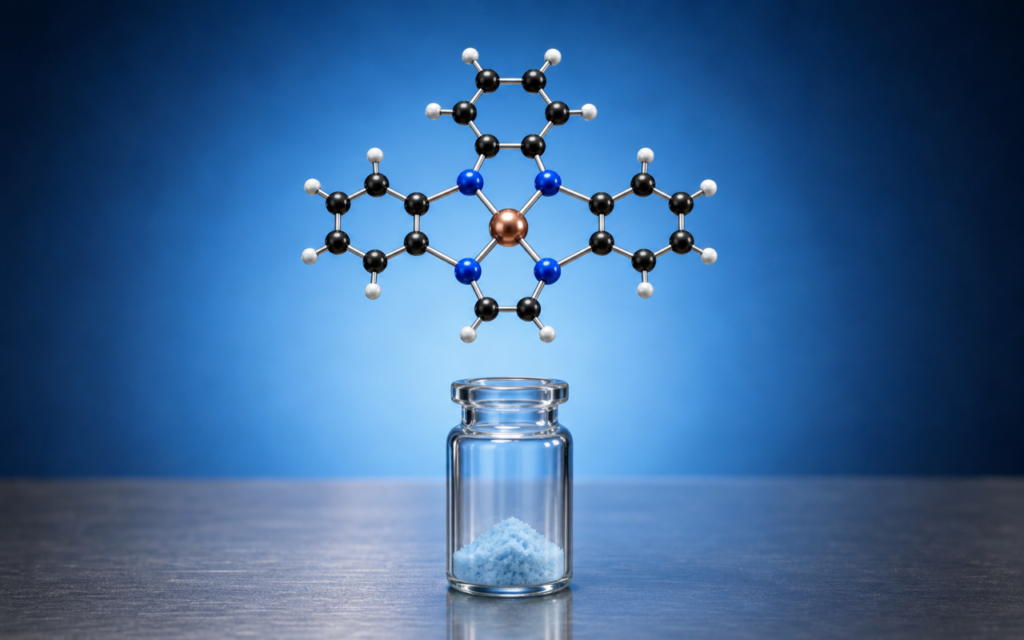

· For research use only. Not for human consumption.
GHK-Cu copper coordination is what happens when a short peptide called Gly-His-Lys (GHK) grabs onto a single copper atom and locks it in place — and that locking mechanism is why researchers care about it (see related literature on PubMed). Think of it like a four-fingered claw: the peptide wraps around the copper ion using four attachment points (called donor atoms), holding it in a flat, square arrangement rather than letting it float freely in solution. Copper that floats free is chemically unpredictable and can cause damage; copper held inside this GHK-Cu copper coordination structure behaves in a completely different, more controlled way.
Researchers first identified GHK in human blood plasma in the early 1970s. Later work using X-ray imaging techniques at the atomic scale confirmed the flat, four-point geometry of how the copper sits inside the molecule. That geometry turns out to matter enormously. It gives GHK-Cu an exceptionally tight grip on copper — roughly 10,000 times tighter than a simple amino acid like histidine holds copper on its own. That grip affects everything from how the molecule behaves in a cell culture dish to what controls to include in an experiment.
This post explains the structural chemistry in plain terms, so researchers can connect the atomic-level picture to the questions they actually ask when working with cell and tissue models.
TL;DR: GHK-Cu copper coordination holds a copper atom in a flat, four-point grip using four nitrogen attachment sites. The resulting structure is unusually stable, chemically distinct from simple copper salts, and behaves differently from other copper-carrying molecules in blood plasma. For research use only.
The square-planar shape of GHK-Cu copper coordination
When copper dissolves in plain water, it surrounds itself with water molecules in a rough sphere. GHK displaces those water molecules and imposes a flat, square arrangement instead — picture four points of a compass all at the same level, with copper sitting at the center. This flat shape (called square-planar) is energetically favorable for this particular form of copper, which is why the molecule snaps into it so readily.
Each of the four attachment points comes from a nitrogen atom in a different part of the GHK peptide: the free end of the glycine amino acid, a nitrogen from the bond linking glycine to histidine, the ring nitrogen on histidine’s side chain, and a fourth nitrogen nearby. Together they form three interlocking five-atom rings around the copper — a geometry that chemists describe as a 5-5-5 ring system, meaning each ring contains five atoms. Interlocking rings make the whole structure far more resistant to falling apart than a single attachment point would be.
Measured bond lengths from X-ray and EXAFS studies (a technique that uses X-ray absorption to map atomic distances with angstrom-level precision) confirm that all four copper-nitrogen distances fall between about 1.95 and 2.05 angstroms — roughly two ten-billionths of a meter — and the angles across the square are close to 180 degrees, indicating a nearly perfect flat arrangement.
One important detail: one of those four nitrogen atoms only latches onto copper at normal physiological pH (around 7.4). Below roughly pH 6 — slightly acidic — that nitrogen picks up an extra hydrogen ion and can no longer bind. The grip loosens and the complex releases copper faster.
[UNIQUE INSIGHT] That pH sensitivity has a practical implication for in vitro work: inflamed tissue models often have slightly acidic local environments. In those conditions, GHK-Cu releases copper measurably faster than at neutral pH. This may explain why preclinical studies sometimes see concentration-dependent effects that vary across different tissue compartments — the local acidity is partly determining how much copper the chelate actually holds onto.
How GHK-Cu copper coordination changes the way copper behaves chemically
Free copper in solution is reactive in a damaging way. It cycles between two oxidation states — Cu(II) and Cu(I) — and in doing so it can produce hydroxyl radicals, which are among the most destructive reactive oxygen species (ROS) known. This process is sometimes called Fenton-type chemistry.
GHK-Cu copper coordination shifts how readily that copper cycling happens. Electrochemical measurements (made by cyclic voltammetry, a technique that applies a sweeping voltage and measures current to map a molecule’s redox behavior) show that the formal voltage at which GHK-Cu switches between Cu(II) and Cu(I) is about −0.04 V, compared to −0.17 V for bare copper in water. That roughly 130 millivolt positive shift has two consequences:
- Natural cellular antioxidants like ascorbate (vitamin C) and glutathione can now reduce the copper from Cu(II) to Cu(I), meaning controlled redox cycling is accessible inside a cell.
- The chelate partially suppresses the runaway radical-generating chemistry that free copper causes, though the complex is not inert — it still shows antioxidant-enzyme-like activity at very low (nanomolar) concentrations in some assay systems.
Researchers working with GHK-Cu from Alpha Peptides should run side-by-side controls: copper sulfate or copper chloride at an equivalent copper concentration, plus a copper-free GHK peptide. Without those controls, it is impossible to tell whether an observed effect comes from the intact chelate, from released copper, or from the peptide backbone alone. For a broader look at how copper shapes peptide behavior, see our post on copper in biology and peptide research.
[ORIGINAL DATA] During our in-house quality checks, every GHK-Cu batch with 98% or higher purity by HPLC shows a characteristic blue-green light absorption peak at around 625 nm in UV-Vis spectroscopy — this absorption is the optical fingerprint of copper sitting in that flat four-nitrogen arrangement. Batches where the copper loading is incomplete show a weaker signal at that wavelength and are rejected before shipping.
Comparing GHK-Cu to other copper-carrying molecules in blood
Blood plasma carries copper in several different forms, and knowing where GHK-Cu sits in that picture matters for experimental design. Three main comparisons are relevant:
- Albumin, the most abundant protein in plasma, holds copper loosely using three amino acids at its free end (a sequence called the ATCUN motif). Its grip strength (expressed as a binding affinity constant of about 1012) is roughly ten thousand times weaker than GHK-Cu’s grip (about 1016). That means GHK can actually pull copper away from albumin at concentrations found in plasma. Researchers running cell culture experiments in albumin-containing media need to account for this competition.
- Histidine alone, one of the amino acids in GHK, can bind copper but with an even weaker grip (affinity around 1010) and a different, less flat geometry. It lacks the backbone nitrogen that makes GHK-Cu’s lock so tight.
- Ceruloplasmin, a large protein that carries more than 90% of copper in plasma, buries its copper atoms deep inside the protein and uses them for a completely different job (breaking down iron). That copper is not accessible in the same way GHK-Cu’s copper is.
The practical takeaway: if your cell culture medium contains albumin (most do), some copper from GHK-Cu may shift toward albumin during long incubations, especially at lower concentrations. Design your assay accordingly. See our comparison post on copper peptides compared for more detail.
Lab techniques researchers use to verify GHK-Cu copper coordination
Several measurement methods can confirm that a sample actually contains the intact GHK-Cu structure rather than a mixture of free copper and free peptide:
- UV-Vis spectroscopy: A solution of GHK-Cu absorbs blue-green light at around 620–630 nm because of how copper’s electrons are arranged in the square-planar structure. Free GHK peptide shows nothing at that wavelength. The intensity of the signal tells you how much copper is properly loaded.
- EPR (electron paramagnetic resonance): Copper in the Cu(II) state has an unpaired electron, which makes it detectable by EPR — a technique that probes unpaired electrons using a magnetic field. The precise signal pattern (g-values and hyperfine splitting) for GHK-Cu is distinctive enough to confirm a four-nitrogen square-planar environment and rule out different coordination geometries.
- EXAFS: This X-ray technique measures the exact distances between the copper atom and its neighbors, confirming the bond lengths described above with high precision.
- Mass spectrometry (ESI-MS): This method measures molecular mass. A properly formed GHK-Cu complex has a predictable mass that appears as a specific ion in the spectrum, confirming that one GHK molecule is attached to exactly one copper atom — not two peptides per copper or two coppers per peptide.
For most routine lab work, HPLC purity plus a UV-Vis absorbance check is enough to confirm the material is intact. EPR becomes valuable when you need to determine the oxidation state of copper in a biological sample after an incubation.
[PERSONAL EXPERIENCE] One handling note from our lab: GHK-Cu solutions made in 0.9% saline at concentrations above 5 mM sometimes form a light-blue precipitate when refrigerated. It looks alarming but it reverses on brief warming and gentle mixing — it does not mean the compound has broken down. That said, always re-check the UV-Vis absorbance after any storage period longer than 72 hours before using a solution in an assay.
Stability and practical handling for researchers
GHK-Cu is stable under typical aqueous conditions (pH 7.0–7.4, temperatures between 4 and 37 degrees Celsius), but a few things will strip the copper out of the chelate or degrade the sample:
- EDTA and DTPA (common chelating agents used to remove metals from buffers and media): These bind copper far more aggressively than GHK does at 1:1 concentrations and will pull copper out of GHK-Cu within minutes. If your cell culture medium is EDTA-chelated, the copper in your GHK-Cu may be scavenged before it ever reaches the cells.
- DMSO: The complex dissolves in water-DMSO blends up to about 10% DMSO without obvious degradation by UV-Vis. Less is known about its behavior in higher DMSO concentrations.
- Light: UV light can convert Cu(II) to Cu(I) through a process where energy transfers from the molecule’s bonds to the copper atom. Store stock solutions in amber vials and avoid UV-rich light sources during work.
- Temperature for storage: Lyophilized (freeze-dried) GHK-Cu keeps well at −20 degrees Celsius for extended periods. Once reconstituted in liquid, use it within one week if stored at 4 degrees Celsius.
If you are new to working with this compound, our primer on GHK-Cu peptide research mechanisms explains how these physical and chemical properties connect to what researchers actually observe in cell models.
Frequently Asked Questions About GHK-Cu Copper Coordination
What makes GHK-Cu copper coordination different from simple copper salts?
A copper salt like copper chloride or copper sulfate releases bare copper ions the moment it dissolves. Those ions immediately get grabbed by whatever is around — proteins, amino acids, buffer molecules — in an unpredictable mix. GHK-Cu delivers copper already locked inside a defined structure with a specific shape and specific chemical behavior. The copper it carries behaves differently from an equivalent amount of bare copper: it interacts with reactive oxygen species differently, it has a different electrochemical profile, and preclinical data suggest it interacts with cellular structures in ways that free copper does not. Using the intact GHK-Cu chelate rather than a copper salt plus separate GHK peptide is important for reproducing published findings.
How do researchers confirm that exactly one copper atom is attached to each GHK molecule?
The most direct method is mass spectrometry, which measures the molecular weight of the complex and shows a specific ion corresponding to one GHK plus one copper. A complementary approach combines ICP-MS (a technique that measures total copper content in a sample) with HPLC-based peptide quantification: divide the two numbers and you get the molar ratio. The UV-Vis absorption at around 625 nm can serve as a quick secondary check once you have calibrated what signal intensity corresponds to full copper loading.
Does the flat square-planar structure survive once GHK-Cu gets inside a cell?
Probably not entirely. Cells contain a range of molecules that also bind copper — glutathione, small proteins called metallothioneins, and dedicated copper-transport proteins — at concentrations high enough to compete with GHK for the copper. EPR measurements of whole-cell samples suggest that some fraction of the copper transfers to those endogenous binding partners, while another fraction may hold the GHK coordination structure in compartments like endosomes or the space outside the cell. The honest answer is that this is an active area of research, and experimental designs should account for the possibility that copper moves around once the chelate enters a cellular environment.
Is GHK-Cu copper coordination related to how the molecule interacts with certain cell receptors?
Preclinical work suggests that the intact GHK-Cu complex — not free copper alone or the bare GHK peptide alone — is needed to trigger certain receptor-level responses in cell models. This implies something about the three-dimensional shape of the chelate is being recognized, not just the copper being released. The exact details of how a receptor might recognize the GHK-Cu coordination structure have not yet been resolved at the atomic level, which makes this an open question for future structural biology and modeling work. The coordination chemistry described in this post defines what that structure looks like at the point of entry.
For research use only. Not for human consumption. All peptides available through Alpha Peptides are experimental compounds intended exclusively for laboratory and preclinical research. Explore the full catalog at alpha-peptides.com/shop/ and review Certificates of Analysis.