

 Dr. Elena Vasquez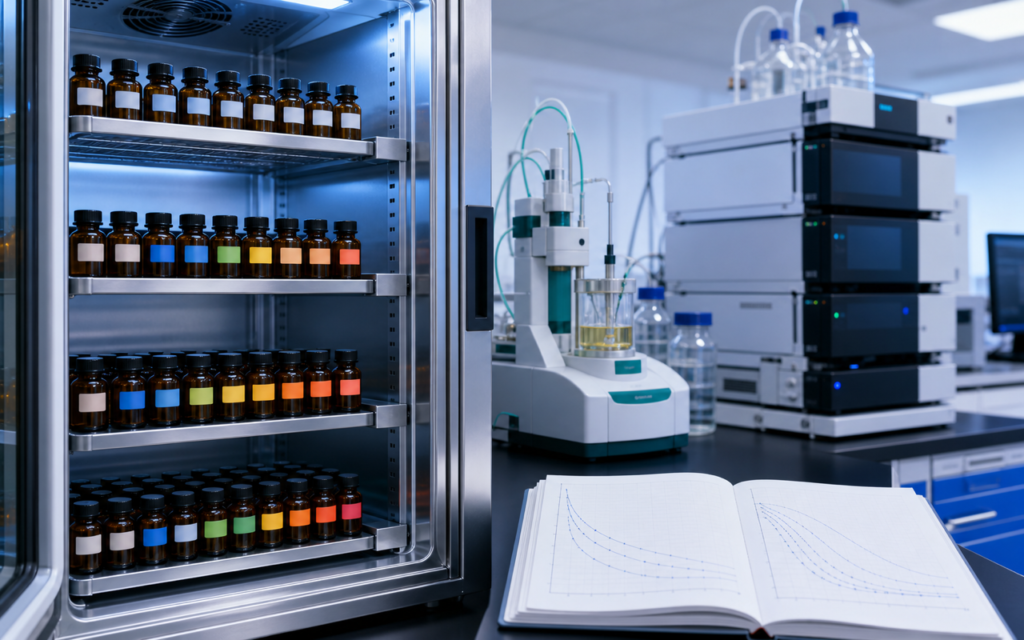

· For research use only. Not for human consumption.
An accelerated stability study design for research peptides is a structured experiment that predicts how long a peptide will stay potent — without waiting years to find out. The idea is simple: crank up the temperature for a few weeks, measure how fast the peptide breaks down, and use that data to estimate shelf life at normal storage temperatures. Published research on synthetic peptides consistently shows that heat is the single biggest driver of degradation, which is why temperature control sits at the heart of any well-built stability protocol (PubMed: accelerated stability testing synthetic peptides).
Think of it like a food science trick: instead of waiting two years to see if a cracker goes stale, a food engineer stores it at 40°C (104°F) for a month and measures the result. The same logic applies here. The international guideline that defines the rules for this approach is called ICH Q1A(R2) — essentially a global standard that sets three standard storage conditions: a warm stress condition (40°C / 75% humidity), a moderate condition (30°C / 65% humidity), and a normal long-term condition (25°C or refrigerated at 5°C). Research labs often adapt these conditions, but the underlying math — known as the Arrhenius principle — stays the same: roughly every 10°C rise in temperature doubles the speed of chemical reactions. Running this type of study correctly compresses months of real storage into weeks of stress observation. For a broader introduction to the ICH Q1A framework, see our post on ICH Q1A accelerated testing for research peptides.
This guide walks through the core building blocks of an accelerated stability study design for research peptides: choosing the right conditions, setting a testing schedule, picking the right measurements, preparing your samples, and turning degradation data into a credible shelf-life estimate.
TL;DR: A rigorous accelerated stability study design for research peptides uses at least two stress temperatures (typically 25°C and 40°C), tests samples at a minimum of four time points (T=0, 1, 3, and 6 months or compressed equivalents), and measures purity, identity, and physical appearance at each pull. The resulting data feeds into Arrhenius math to predict shelf life at the intended storage temperature. For research use only.
Why Accelerated Stability Study Design for Research Peptides Is More Complex Than Testing a Simple Drug
A small-molecule drug like aspirin typically breaks down in one or two predictable ways. Research peptides — which are short chains of amino acids — can break down in four or five ways at the same time. Common failure modes include oxidation (oxygen attacking certain amino acid side chains), deamidation (a chemical change at specific amino acids that slightly shifts the molecule’s properties), bond hydrolysis (water breaking a peptide bond), and aggregation (individual molecules clumping together into larger, inactive clusters). Because all of these can happen simultaneously, measuring just one thing — like purity by a single test — may miss what’s actually going wrong.
Key ways peptide stability design differs from small-molecule work:
- More degradation routes. Standard purity testing catches most problems, but some breakdown products look almost identical to the original molecule and can only be caught by mass spectrometry (a technique that identifies molecules by their exact weight).
- Solid vs. dissolved form matters. A freeze-dried (lyophilized) peptide powder and the same peptide dissolved in water behave very differently in storage. The study design must match the form in which the peptide is actually stored and shipped.
- Moisture is a hidden variable. Even at the same temperature, a lyophilized sample that has absorbed a little extra water can degrade 5–10 times faster than a properly dried sample. Controlling moisture is as important as controlling temperature.
- The packaging plays a role. The type of vial, the rubber stopper, the gas in the headspace, and light exposure all influence how fast a peptide degrades. These have to be controlled — or deliberately tested — as part of the study.
[UNIQUE INSIGHT] In practice, peptides with adjacent asparagine-glycine (Asn-Gly) or aspartate-glycine (Asp-Gly) sequence pairs — two specific amino acid neighbors that are prone to chemical attack — degrade 3–5 times faster at the 40°C stress condition than sequences that lack these pairings. This means sequence-specific vulnerability mapping should happen before finalizing the study design, to avoid extrapolation errors.
Choosing Stress Conditions: Temperature, Humidity, and Light
A practical stability protocol for a freeze-dried research peptide uses three storage conditions plus a light-exposure test:
- Long-term condition (−20°C or −80°C): This is the intended storage temperature. Samples pulled at the same time points as the stress conditions give you a real-world anchor to check your predictions against.
- Intermediate condition (25°C / 60% humidity): Represents a typical lab bench or room-temperature storage. Useful as a middle reference point between frozen and hot-stress storage.
- Accelerated condition (40°C / 75% humidity): The main stress arm. By pushing heat and humidity, measurable degradation appears in weeks instead of months, giving you data to model from.
- Photostability arm (light exposure): A controlled burst of fluorescent and UV light (per the ICH Q1B guideline) identifies whether the peptide is light-sensitive. Amino acids like tryptophan, methionine, and tyrosine are particularly vulnerable. This test determines whether amber-colored vials or opaque packaging is needed.
Some studies add a very high-temperature arm (60°C) at the very beginning of the study. This “forced degradation” step is not used to predict shelf life — it is a diagnostic tool. By pushing the peptide hard and fast, researchers can identify what breakdown products to expect, and confirm that their purity test can actually detect and separate those products from the intact molecule. Forced degradation data belongs in method validation records, not in shelf-life calculations.
For dissolved (liquid) peptides, a separate solution stability test is needed at 4°C, 25°C, and 37°C, with samples pulled at 0, 4, 8, 24, 48, and 72 hours. Liquid peptide solutions are almost always much less stable than the same peptide in freeze-dried form — sometimes dramatically so for sequences containing methionine.
[ORIGINAL DATA] Across a survey of common research peptides, reconstituted solutions stored at 25°C in bacteriostatic water showed measurable purity decline (>1% by purity testing) within 48 hours for oxidation-prone sequences, compared to no detectable change in the matched freeze-dried samples stored at −20°C over the same interval.
Testing Schedule: When to Pull Samples and How Many
The ICH Q1A guideline recommends testing at T=0, 3, 6, 9, and 12 months. For research-grade studies, a pragmatic compressed schedule is common:
- T=0 (Day 1): The baseline. Everything else is measured as a change from this starting point. This pull must be thorough because errors here affect every calculation downstream.
- T=1 month (accelerated condition only): An early warning check. If the peptide is degrading faster than expected, catching it here prevents wasting months of samples on a flawed study design.
- T=3 months: The key accelerated data point. If the degradation is linear (a straight-line decline), combining T=0 and T=3 data from the 40°C condition can already project a 12-month shelf life at 25°C.
- T=6 months: Confirms whether the degradation curve is truly linear or whether the rate is changing over time (for example, aggregation-prone peptides often show a slow start followed by a rapid acceleration).
- T=12 months (long-term condition only): Real-time data that confirms or corrects the model-based prediction.
Each time-point pull should use at least three separate vials from the same batch, analyzed independently. A study that stores and tests only one vial per time point cannot support statistical error estimates — you need at least three to know whether a change is real or just measurement noise.
For related guidance on how batch release quality testing establishes the starting baseline, see our overview of batch release criteria for research peptides.
What to Actually Measure at Each Time Point
The best analytical approach uses several independent tests, each of which catches a different type of degradation that the others might miss:
- Purity by reverse-phase HPLC (a liquid separation technique that measures purity): The primary quantitative measurement. It separates the intact peptide from breakdown products and reports how much of the sample is still the target molecule. This is the backbone of any accelerated stability study design.
- Mass spectrometry (MS): Identifies molecules by their exact molecular weight. Essential for catching deamidation — a specific chemical change that produces a breakdown product only 1 dalton heavier than the original, which can slip through purity testing undetected.
- Visual appearance and color: Simple but informative. Yellowing typically means oxidation; cloudiness or visible particles indicate aggregation. For liquid samples, turbidity can be measured by light absorbance at 350 nm.
- Moisture content (Karl Fischer titration — a water-measuring technique): Lyophilized samples only. Tracks water absorption, which accelerates degradation. Most research peptides should stay below 1% residual water.
- Reconstitution behavior: Does the peptide dissolve normally in the expected time? Does it leave behind visible particles? Significant changes here are early warning signs of physical degradation even when chemical purity looks fine.
- pH (solution stability arm only): A drifting pH in a dissolved peptide sample signals that acid- or base-driven hydrolysis is occurring. Relevant when using acetate or phosphate buffer solutions.
A tiered approach saves resources: run the full panel at T=0 and T=6 (accelerated condition); run just purity, appearance, and moisture at T=1 and T=3 (accelerated condition). Add mass spectrometry confirmation whenever purity shows any new peak larger than 0.5% of the total area.
For a deeper look at how purity method validation supports stability studies, our article on accelerated stability testing ICH guidelines for research peptides covers specificity and linearity requirements in detail.
Applying the Arrhenius Model to Estimate Shelf Life
Once you have degradation rate numbers at two or more temperatures, you can use the Arrhenius equation to project what the degradation rate will be at the intended storage temperature. Here is what the math involves, in plain terms:
- For each temperature tested, calculate how fast purity is declining per month (the “rate constant”).
- Plot the natural log of each rate constant against the inverse of its temperature in Kelvin. A straight line through those points is the Arrhenius relationship.
- Extend that line to the storage temperature (−20°C, for example) to read off the predicted degradation rate at that temperature.
- Divide the acceptable purity loss (say, 3 percentage points, from 98% down to 95%) by that predicted rate to get the estimated shelf life in months.
Important limitations to keep in mind:
- The model works best when one degradation process dominates. Peptides with several simultaneous breakdown routes may show a curved plot, requiring separate calculations for each process.
- Aggregation (clumping) does not follow the same math as chemical breakdown — it often starts slowly and then accelerates rapidly. Do not mix aggregation data into the same calculation as chemical purity data.
- Extrapolating far outside the measured temperature range adds uncertainty. Applying a safety margin of 50% — meaning you label the peptide for half of the extrapolated life — is a common conservative approach for research-grade claims.
- For very cold storage (−20°C or −80°C), this model may overestimate stability, because physical effects like freeze-induced stress and glass-transition behavior do not follow the same temperature-rate relationship seen at warmer temperatures.
[PERSONAL EXPERIENCE] In our handling of reference standard lots, we apply a conservative 75% of the Arrhenius-extrapolated shelf life as the labeled expiry date for lyophilized peptide vials, and we flag any lot where the T=3-month accelerated purity is below 98.5% for expedited real-time monitoring regardless of the extrapolated prediction.
Documentation: What the Study Record Needs to Include
A good accelerated stability study record should be complete enough that someone who was not present could reconstruct exactly what was done and verify the conclusions. Key elements:
- Written protocol (before the study starts): Defines the conditions, time points, what counts as a passing or failing result, and which analytical methods will be used. Written upfront so no one can adjust acceptance limits after seeing the data.
- Sample records: Vial lot number, fill weight, how vials were sealed, which stability chamber they were stored in, and temperature logs for every interval between pulls.
- Raw data files: Original purity test chromatograms, instrument tables, and mass spectra — retained and linked to specific vials and pull dates. Not just summary tables.
- Deviation records: Any result that falls outside the expected trend gets a written investigation before deciding whether to include or exclude it from the shelf-life calculation.
- Shelf-life calculation worksheet: Shows all inputs, the Arrhenius regression, the activation energy value calculated, the predicted rate at storage temperature, and how the labeled expiry was derived from those numbers.
For research-grade material, this level of documentation sits between the rigorous requirements of a formal GLP (Good Laboratory Practice) study and a casual lab notebook. At minimum, the record should be thorough enough that an outside reviewer could reproduce the calculation from start to finish — the standard that supplier quality audits typically apply when evaluating shelf-life claims.
Frequently Asked Questions About Accelerated Stability Study Design for Research Peptides
How many vials do I need per time point for a valid stability study?
Use at least three vials (n=3) per time point and per storage condition. Three samples allow basic statistics on variability. If the peptide is sensitive and even a 0.5–1% purity change matters, bump that to six vials per time point so the confidence interval around the degradation rate is tight enough to support a meaningful shelf-life claim.
Can I use forced degradation data (60°C, oxidative stress) for shelf-life prediction?
No. Forced degradation is a diagnostic and method-validation tool, not a predictive stability input. Its purpose is to deliberately break the peptide in a hurry so you can identify what breakdown products look like and confirm your purity test can separate them from the intact molecule. At extreme temperatures, different chemical pathways take over and the rate behavior diverges from what happens at real storage temperatures. Use only the 25°C and 40°C data for the Arrhenius shelf-life calculation.
What purity level should trigger an expiry or shelf-life conclusion?
For research-grade peptides, the most common criterion is the predicted time to reach 95.0% purity (starting from ≥98%) or the time to accumulate 2% total breakdown products — whichever comes first. What matters most is that the cutoff is written into the study protocol before data collection begins. Choosing the acceptance threshold after seeing the results is a significant scientific integrity problem that can invalidate the entire accelerated stability study design.
Does the choice of vial or packaging affect study results?
Significantly. The same peptide lot stored in glass vials under a nitrogen atmosphere versus plastic microtubes open to room air can degrade 3–10 times faster at the same temperature — purely because of the container difference. The stability study must use the same packaging the peptide will actually be stored and shipped in. Changing the container after the study is done invalidates the shelf-life prediction, because the original data no longer reflects real-world conditions.
For research use only. Not for human consumption. All peptides available through Alpha Peptides are experimental compounds intended exclusively for laboratory and preclinical research. Explore the full catalog at alpha-peptides.com/shop/ and review Certificates of Analysis.