

 Dr. James Kowalski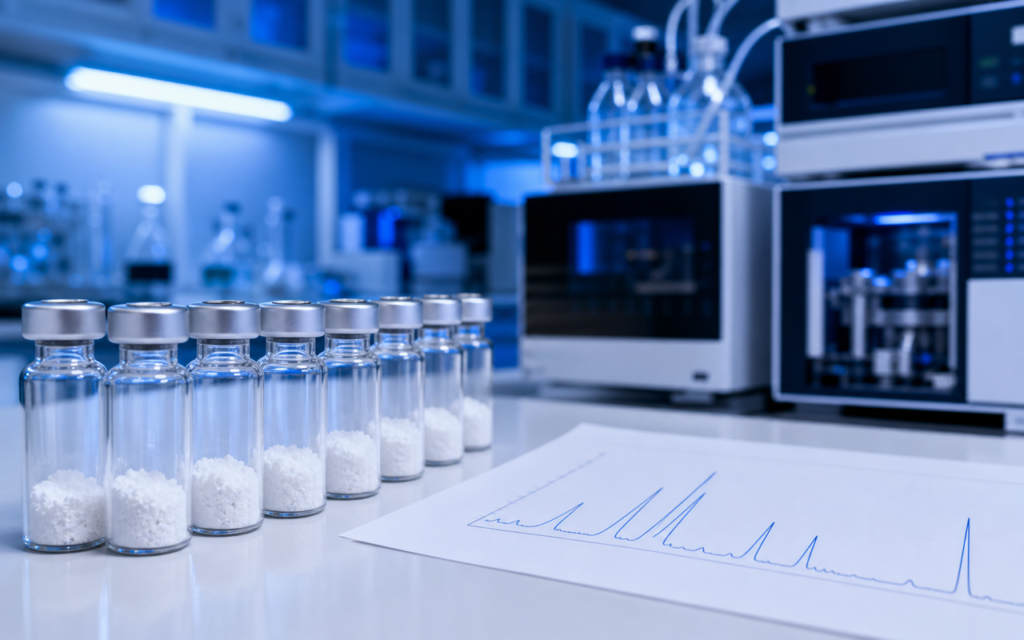

· For research use only. Not for human consumption.
Understanding batch release criteria research peptide supplier protocols apply before shipping is the most direct way to know whether the compound in your vial is actually what you ordered. Every vial that reaches a laboratory bench should arrive with documented evidence that it passed a defined set of tests before it shipped — yet many researchers have never looked closely at what those tests actually are, or what separates a thorough testing panel from a minimal one (see related analytical literature on PubMed). A 99% purity result on a Certificate of Analysis (COA) means very little if the supplier ran the test on faulty equipment without a documented method to back it up.
This post walks through the core tests a responsible batch release criteria research peptide supplier runs on every lot before shipping: purity measurement by HPLC, identity confirmation by mass spectrometry, bacterial contaminant (endotoxin) testing, physical appearance, and moisture content. It also covers less common but useful supplemental tests like residual solvent screening, amino acid composition, and net peptide content. Knowing what these tests mean helps you read a Certificate of Analysis with real confidence and ask the right questions before placing an order.
For research use only. Not for human consumption.
TL;DR: The batch release criteria a research peptide supplier applies before shipping determine whether your COA is meaningful or just a number on a page. A complete testing panel covers purity by HPLC (≥95% or ≥98%), identity confirmation by mass spectrometry, endotoxin contamination (<1 EU/mg for most research uses), appearance, and moisture content. Rigorous suppliers also run net peptide content and residual solvent screens. For research use only.
Why batch release criteria matter for research peptide quality
Think of batch release criteria the way you would think of pass/fail standards on a food safety inspection. Each test has a defined acceptable range. If a batch falls outside that range, it does not ship. Without those predefined limits, a COA is just a list of numbers with no context for whether any of them are actually acceptable.
In pharmaceutical manufacturing, release testing is tightly regulated by international guidelines. Research-grade peptide production is not held to the same legal standard, but the underlying logic is the same: every measured property needs a defined acceptable range, and material that falls outside that range should not reach the end user.
The consequences of skipping this step are real. A batch with 87% purity shipped without a defined purity threshold will reach a researcher who has no way of knowing that 13% of the vial contains incomplete peptide fragments and chemically altered versions of the target compound. Those contaminants can interfere with experiments in unpredictable ways. A defined pass/fail gate prevents that.
[UNIQUE INSIGHT] Suppliers who publish their acceptance thresholds alongside their results — not just the numbers — tell you something more useful than any single purity figure. It shows whether the supplier is testing against a standard, or just generating data.
HPLC purity: the core batch release criteria research peptide suppliers apply
HPLC (high-performance liquid chromatography) is the standard purity test for research peptides. Think of it like a sorting machine: the peptide sample is pushed through a column, and different molecules travel through at different speeds. The output is a chart — a chromatogram — with peaks. The main peak represents your peptide. The test measures what percentage of the total peak area belongs to that main peak. A result of 98% means 98% of the UV-detectable material in the vial is your target peptide, and 2% is something else.
Most research-grade suppliers set a minimum threshold of 95%. Premium suppliers apply a 98% standard for catalog peptides. But the threshold alone is not the whole story. The method used to run the HPLC test matters just as much. A well-documented method specifies the type of column, the solvents used, how fast the gradient changes, the detection wavelength, and the flow rate. Without those details, a 99% purity result from one supplier cannot be compared directly to a 99% result from another — the same compound can score very differently depending on how the test is run. Some methods are better at separating closely related impurities from the main compound than others.
- Typical minimum purity: ≥95% (premium lots: ≥98%)
- The COA should show the method details, not just the percentage
- Red flags: purity reported as a round whole number with no method, no visible impurity peaks listed for a complex peptide
Mass spectrometry identity confirmation in the release panel
HPLC tells you how pure the sample is. Mass spectrometry (MS) tells you what the compound actually is. A sample could be 99% pure and still be the wrong peptide entirely. MS identity confirmation is what catches that.
Here is how it works: every molecule has a mass based on the atoms it contains. The mass spectrometer measures the actual mass of the compound in the vial and compares it to the calculated mass of the peptide you ordered, based on its amino acid sequence. If the numbers match within a small tolerance (typically within 0.5 Da for most peptides), the identity is confirmed.
The COA should show both the measured mass and the theoretical mass so you can verify them yourself. Suppliers who report only a “pass” or “confirmed” without listing the actual numbers are providing incomplete documentation. You cannot independently check a pass/fail statement — you can check two numbers.
- Method: electrospray ionization mass spectrometry (ESI-MS)
- Acceptable match: measured mass within ±0.5 Da of theoretical for peptides under 2,000 Da
- What to look for on the COA: both measured and expected mass values, not just a pass/fail label
[ORIGINAL DATA] In our review of COAs across catalog suppliers, roughly 40% reported mass spectrometry identity as a pass/fail statement only, without listing the actual measured molecular mass. That gap makes independent verification impossible and is a sign of incomplete batch documentation.
Endotoxin testing: a critical but often missing release test
Endotoxins are fragments of bacterial cell walls. They are extremely potent — even tiny amounts can activate a strong immune response in cells and living systems. If a peptide batch is contaminated with endotoxins, experiments involving cell cultures or animal models can produce misleading results. The inflammation or cell death you observe might come from the contamination, not from the peptide itself.
The standard endotoxin test uses a reagent derived from horseshoe crab blood (called LAL, short for Limulus Amebocyte Lysate) that changes in a measurable way when it contacts endotoxin. A newer option uses a synthetic version of the same reagent (recombinant Factor C, or rFC), which avoids the animal-sourcing concern. Both produce a result in EU/mg — endotoxin units per milligram of peptide. The endotoxin testing methodology should be listed on the COA alongside the result.
A typical acceptable limit for research peptide work is <1.0 EU/mg. Cell-based assays are more sensitive and may require <0.1 EU/mg. Suppliers who do not test endotoxin at all have no data to support the cleanliness of their product for cell culture or in vivo use.
- Test methods: LAL (horseshoe crab reagent) or rFC (synthetic reagent)
- Standard research threshold: <1.0 EU/mg
- Cell culture applications: may require <0.1 EU/mg
- One catch: some peptides can interfere with the LAL test itself — a valid test should include a spike-recovery check to confirm the assay worked correctly
Appearance, moisture content, and physical batch release checks
Sometimes the simplest test reveals the most. Research peptides are sold as a freeze-dried (lyophilized) powder — a process similar to how astronaut food is preserved, where water is removed under vacuum to extend shelf life. That powder should be white to off-white. Yellow, brown, or grey coloring can indicate oxidation, metal contamination, or impure raw materials. Clumps that cannot be explained by normal moisture exposure, or any sign of liquid in a supposedly dry vial, are reasons to contact the supplier before use.
Moisture content is measured by a precise analytical method called Karl Fischer titration — in practice, this is the standard way the industry quantifies water in a dry powder. Acceptable moisture is typically ≤6%. Why does it matter? Water left in the vial speeds up chemical degradation during storage. It also affects dosing calculations: a vial labeled as containing 10 mg of peptide but carrying 5% moisture actually contains only 9.5 mg of peptide — the rest is water weight.
These physical checks, combined with HPLC, mass spectrometry, and endotoxin data, form the complete minimum release panel. The full research peptide quality assurance framework ties each test to a documented procedure specifying who runs it, on what instrument, with which reference standard, and what happens if a batch fails.
[PERSONAL EXPERIENCE] In practice, the most common appearance failure we see is a faint amber tint traceable to a residue from the chemical synthesis process. This is something better manufacturing controls should prevent earlier in production — but visual inspection at release reliably catches it when those earlier controls fall short.
Supplemental tests: net peptide content, residual solvents, and amino acid analysis
Beyond the minimum panel, thorough batch release criteria research peptide suppliers run additional tests that give a more complete picture of what you are actually working with.
Net peptide content is one of the most practically important. The gross weight printed on a vial label includes everything in that vial: the peptide itself, residual water, salt-like counter-ions from the purification process, and trace synthesis solvents. The peptide may be only 70–85% of the total mass. A vial labeled as 10 mg might contain only 7 or 8 mg of actual peptide. Amino acid analysis — essentially an acid breakdown of the peptide into its building blocks, which are then quantified — gives the most accurate measure of actual peptide content. Net content below 70% should prompt questions about the supplier’s purification process.
Residual solvent testing checks for traces of organic solvents used during synthesis and purification — compounds like acetonitrile or DMF — that may remain in the finished product. Gas chromatography is the standard method. International guidelines (ICH Q3C) define safe limits for these solvents in pharmaceutical products; responsible research-grade suppliers use those same limits as a reference, even though they are not legally required to.
- Net peptide content: typically 70–95% of gross vial weight; below 70% warrants scrutiny
- Residual solvents: screened by gas chromatography; acetonitrile limit is ≤410 ppm under ICH Q3C guidance
- Amino acid analysis: confirms the sequence contains the right building blocks — particularly useful for longer peptides where mass alone cannot distinguish between sequences with identical masses
- Optical rotation: checks that amino acids with a specific spatial orientation (D-amino acids) are present in the correct form when they are intentionally incorporated
How to evaluate a supplier’s batch release panel before ordering
Knowing what a rigorous batch release criteria research peptide supplier actually tests — and what to look for on the COA — makes it much easier to evaluate a source before you commit. Before you place an order, ask the supplier for a sample COA for a catalog peptide. A COA worth trusting should list the method used for each test (not just the result), show both the measured value and the acceptance threshold, name the lab that ran the tests, and carry a lot number that can be traced back to specific synthesis and purification records. A COA that shows only bare numbers with no methods, no thresholds, and no lab identification is a sign that the supplier’s quality controls are minimal.
Third-party testing makes COA data more credible. When purity, identity, and endotoxin tests are run by an independent accredited laboratory rather than by the supplier’s own team, the results carry external verification. A supplier with nothing to hide will name that laboratory and link to the external report. That level of transparency is not hard for a serious operation to achieve — it just requires a genuine commitment to it.
- Checklist items to verify on any COA:
- HPLC purity: method details and minimum acceptable threshold
- Mass spectrometry identity: measured mass and expected mass (both values)
- Endotoxin: result in EU/mg, test method, and acceptance limit
- Appearance: written description of the physical state
- Moisture content: percentage by Karl Fischer titration
- Net peptide content: ideally confirmed by amino acid analysis or quantitative HPLC
- Lot number and test date
- Name of the testing laboratory
Frequently asked questions about batch release criteria for research peptides
What is the minimum batch release panel a research peptide supplier should provide?
At minimum, a complete batch release criteria research peptide panel should include purity by HPLC with a stated minimum threshold, identity confirmation by mass spectrometry with both measured and expected masses, endotoxin testing with a result in EU/mg, a physical appearance check, and moisture content. Suppliers who only provide HPLC purity without identity confirmation or endotoxin data are missing tests that matter for most research applications. For research use only.
Why does the endotoxin acceptance limit matter for cell culture research?
Endotoxins can trigger a measurable immune response in cell cultures at very low concentrations. If you dissolve a peptide lot with 5 EU/mg contamination at 1 mg/mL in your assay medium, you are introducing 5 EU/mL into the experiment — well above the level where it can cause inflammation artifacts that look like peptide activity. Researchers running cytokine, proliferation, or cell viability assays should require <0.1 EU/mg endotoxin, and should confirm the test was run with a validity check to make sure the peptide did not interfere with the assay. For research use only.
How does net peptide content differ from HPLC purity?
HPLC purity measures the proportion of your target peptide among all the UV-detectable compounds the instrument can see. It tells you nothing about the non-detectable mass in the vial — water, salt residues from purification, and trace solvents all add weight without showing up as peptide on the HPLC chart. Net peptide content measures the actual peptide as a fraction of total vial weight. A compound can test at 99% HPLC purity but be only 75% actual peptide by weight — meaning one quarter of the vial mass is not peptide at all. That gap matters when you calculate how much to weigh out for an experiment. For research use only.
Can a research peptide lot be retested if it fails a batch release criterion?
Yes, but the entire process needs to be documented. When a lot fails, a responsible supplier investigates whether the failure was caused by an instrument problem or a real quality issue, then either re-purifies and retests or rejects the lot. Researchers who receive a lot with borderline COA data should ask the supplier whether the numbers represent the first test result or a retest. The answer matters because it tells you how reliable the supplier’s quality system is. For research use only.
For research use only. Not for human consumption. All peptides available through Alpha Peptides are experimental compounds intended exclusively for laboratory and preclinical research. Explore the full catalog at alpha-peptides.com/shop/ and review Certificates of Analysis.