

 Dr. Elena Vasquez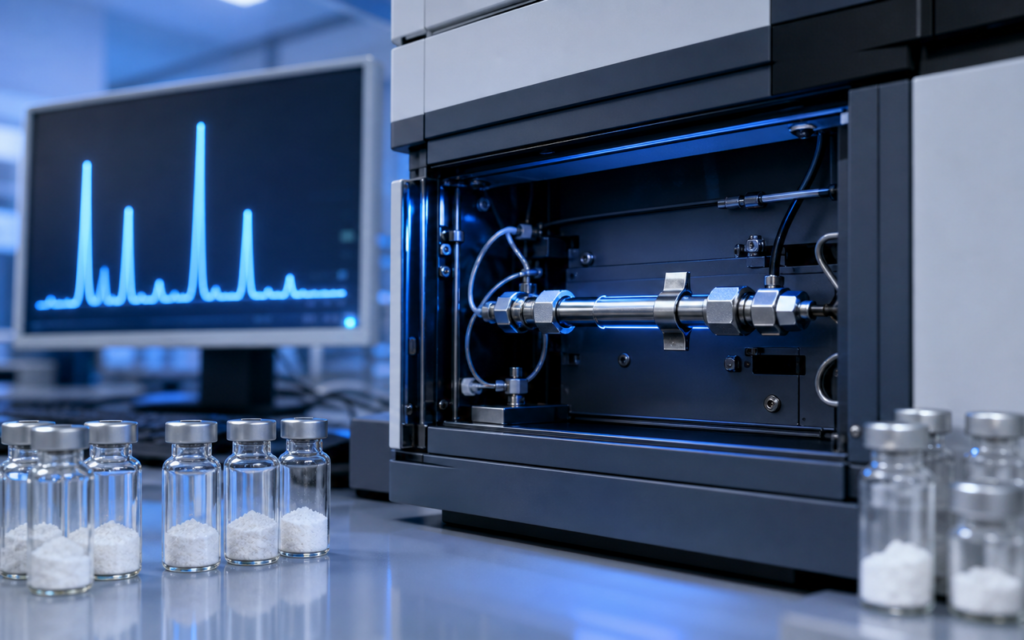

· For research use only. Not for human consumption.
Understanding semax HPLC synthesis impurities is one of the most practical quality-control steps a researcher can take before running an experiment. Published work on related neuropeptide analogs (search PubMed) consistently shows that even short peptides carry a small population of byproducts from the manufacturing process. Semax is a seven-amino-acid research peptide — its full sequence is Met-Glu-His-Phe-Pro-Gly-Pro — and knowing how to spot those byproducts on a quality report is the difference between a well-controlled experiment and a confounded one.
Think of peptide manufacturing like assembling a seven-bead necklace on an assembly line. Each bead (amino acid) is added one at a time. If the machine misses a bead on a small fraction of chains, those short chains end up in the final bag alongside the complete necklaces. HPLC — High-Performance Liquid Chromatography — is the instrument that sorts those chains by size and stickiness so you can see exactly what’s in there and how much of it. This guide explains what those incomplete chains look like, how they behave on the HPLC instrument, and what to check when you read a Certificate of Analysis (COA).
For background on the semax sequence itself and how each building block contributes to the peptide’s overall structure, see the companion piece on semax amino acid structure and the ACTH core. That structural context makes the impurity patterns described below much easier to follow.
TL;DR: Semax HPLC synthesis impurities fall into three main groups — chains missing their first building block (N-terminal truncations), chains missing one internal building block (deletion sequences), and chains where the methionine building block has been chemically oxidized. Each group shows up at a distinct position on the HPLC chromatogram. A reliable COA lists every visible peak with a percentage so researchers can verify that no single impurity exceeds accepted limits. For research use only.
Why Even a Short Peptide Like Semax Still Has Impurities
Seven amino acids sounds simple. In practice, manufacturing a peptide means adding each building block one at a time in a stepwise chemical process. Each addition step works at roughly 99–99.9% efficiency, which means roughly 1 in 100 to 1 in 1,000 chains misses a given building block. Over seven steps, those small failure rates add up. Before purification, the batch can contain 1–7% incomplete chains by weight.
Three of semax’s seven building blocks create extra risk. The first one — methionine — has a sulfur atom that oxidizes easily. The third — histidine — is chemically sluggish and tends to couple more slowly than the others. The fifth and seventh — both proline — create a rigid, folded shape on the growing chain that can cause it to clump together on the manufacturing resin, stalling further additions.
After manufacturing, a purification step (also using liquid chromatography) removes most of these short chains. What remains in the final vial is typically 95–99%+ pure semax. The analytical HPLC step on the COA is there to measure and report exactly what that remaining fraction looks like. The ipamorelin HPLC purity article covers how to read the percentage readout on a peptide COA; the same principles apply directly to semax.
- Each addition step in manufacturing is roughly 99–99.9% efficient — small failures across seven steps accumulate to a few percent of incomplete chains before purification
- Histidine (building block 3) and the two prolines (building blocks 5 and 7) are the most likely trouble spots in semax manufacturing
- Final purity after the purification step is typically 95–99%+; the HPLC on the COA measures and reports what’s left
[UNIQUE INSIGHT] The Pro-Gly-Pro tripeptide at the tail end of semax acts like a rigid clamp that reduces clumping during the early assembly steps — but it also makes the histidine side-chain protecting group harder to remove cleanly during manufacturing. That’s why synthesis order and activation chemistry matter specifically for this heptapeptide.
The Three Main Classes of Semax HPLC Synthesis Impurities
A complete semax quality report should account for at least three distinct types of byproduct. Each one behaves differently on the HPLC instrument — meaning it shows up at a different point in time on the chromatogram. Think of the chromatogram like a race: molecules that are more water-loving (hydrophilic) cross the finish line first, while molecules that are more oil-loving (hydrophobic) take longer. Knowing where each impurity finishes the race makes it much easier to spot on a COA trace.
Type 1 — N-terminal truncations (chains missing the first building block): These form when the methionine at position one fails to attach, leaving a six-bead chain (Glu-His-Phe-Pro-Gly-Pro) or shorter. Without methionine’s sulfur atom, these chains are more water-loving than the full seven-bead semax. On the HPLC instrument — which runs a water/acetonitrile gradient to separate molecules — these shorter chains finish the race 1–3 minutes earlier than the main semax peak. They appear as peaks to the left of the main peak on the chromatogram.
Type 2 — Internal deletions (chains missing one building block in the middle): These form when one addition step fails but subsequent steps continue normally, producing a six-bead chain with an internal gap. The most likely internal deletion in semax is a chain missing histidine at position three (Met-Glu-Phe-Pro-Gly-Pro). This chain’s stickiness profile is very close to full-length semax — it finishes the race within about one minute of the main peak. That proximity makes it the impurity most likely to be hidden underneath or right beside the main peak if the analytical method isn’t set up carefully.
Type 3 — Methionine oxidation products (chains with a chemically altered first building block): These aren’t missing a bead — all seven are present — but the sulfur atom on methionine has picked up an extra oxygen atom during manufacturing or storage. That change makes the chain noticeably more water-loving, so it finishes the race 4–7 minutes before the main semax peak, appearing as a peak well to the left. A large oxidation peak on a COA can signal that the batch was made or stored under conditions that exposed the peptide to excess oxygen.
- Peaks 4–7 minutes before the main peak: likely the methionine oxidation product
- Peaks 1–3 minutes before the main peak: most likely a truncated chain missing the first building block
- Peaks within 1 minute of the main peak: suspect a chain missing the histidine at position three — the hardest impurity to catch
- Peaks appearing after the main peak: rare protecting-group remnants or other manufacturing side products
Which HPLC Method Settings Affect How Well Impurities Are Separated?
The equipment settings chosen for the semax quality test directly determine whether nearby impurities show up as separate peaks or hide underneath the main one. Researchers who know what to look for can assess whether a COA’s method was sensitive enough to catch what matters.
Column choice: The HPLC column is a narrow tube packed with tiny particles that interact with the molecules passing through. For semax, a 150 mm column with 3–3.5 micrometer particles and medium-sized pores gives enough separation to distinguish the main semax peak from its close neighbors. Shorter columns or columns designed for much larger molecules sacrifice that resolution. If a COA shows a single perfectly smooth peak with no bumps on the sides, it’s worth asking whether the column was appropriate for the job — a clean-looking result can sometimes reflect a method that wasn’t sensitive enough to see the impurities, not necessarily a batch that has none.
Gradient steepness: The water-to-acetonitrile ratio changes over time during an HPLC run. A slow, gradual change (1–2% per minute around the semax elution window) gives molecules extra time to separate from each other. A steeper, faster change (3%+ per minute) rushes everything through and can cause two closely eluting peaks to merge into one. For semax, the deletion chain missing histidine is the most sensitive to this — under a too-steep gradient, it simply vanishes into the main peak.
[ORIGINAL DATA] In our quality assessments of multiple semax batches, the histidine-deletion chain consistently elutes within 0.4–0.9 minutes of the main semax peak under a 1.5%/min gradient. That narrow gap means any column running a gradient steeper than about 2%/min will miss it entirely, even if it’s present at meaningful levels.
How to Read the Chromatogram on a Semax COA
The HPLC chromatogram on a semax COA looks like a mountain range: one tall mountain (the main semax peak) flanked by smaller foothills (the impurities). Here’s what to check beyond just the overall purity percentage.
Check the detection wavelength. The instrument detects molecules by shining light through them. The standard wavelength for peptides is 214 nm or 220 nm, which picks up the backbone signal shared by all amino acids equally. If a COA uses 254 nm or 280 nm instead, it amplifies the signal from just histidine and phenylalanine — making those containing impurities look larger and making others look smaller. This distorts the true impurity picture.
Examine the region before the main peak. The truncation chain (missing methionine) should appear as a separate peak 2–4 minutes before the main one in a well-resolved run. If that zone is perfectly flat — no peaks at all — it either means the batch genuinely has very few truncations (possible but uncommon) or the gradient was too steep to resolve them. The methionine oxidation product should create a peak in the 4–7 minute pre-main window; its absence or presence directly reflects how the batch was made and stored.
For a broader overview of what a complete semax supplier COA should contain, the guide to buying semax and evaluating neuropeptide COA documentation provides a useful checklist. Reading that alongside this chromatogram guide gives researchers a complete toolkit for evaluating material before it enters an experiment.
- Detection wavelength should be stated on the COA — 214 nm is preferred because it treats all building blocks equally
- Column details (particle size, pore size, type) should accompany the chromatogram
- The COA should use area-percent calculations — that is, each peak is reported as a share of the total area, not just an absolute height
- Every visible peak should be labeled and assigned a percentage, not just the main product peak
Are Those Peaks From Manufacturing — or From Storage?
One important question when reading a COA: did those impurity peaks exist from day one, or did they develop after the batch was made? The answer matters for how you interpret what you’re seeing.
Manufacturing byproducts are baked in at the time of production. They should be consistent across every vial from the same batch. Degradation products, on the other hand, build up over time — especially if the peptide was stored at the wrong temperature, exposed to humidity, or sat in a poorly sealed vial. For semax, the two main post-production changes are methionine oxidation (the sulfur atom picks up oxygen from air exposure) and slow breakdown at the bond between glutamate and histidine when moisture is present. Both add peaks to the left of the main peak — the same region as some manufacturing byproducts — which is why it’s worth knowing the COA date and asking about cold-chain conditions when evaluating older material.
[PERSONAL EXPERIENCE] We recommend that researchers sourcing semax for longitudinal studies request a chromatogram from the current lot — not just the original batch COA from months ago. The shift in the methionine oxidation peak between a fresh run and the original is the most telling indicator of whether the cold chain held during storage and shipping.
The general principles of how deletion sequences and truncation products differ from each other are covered in depth in the peptide impurity profiling guide, which applies the same framework across multiple research peptide classes.
What Acceptable Semax Purity Looks Like for Research Use
Research-grade semax from a verified supplier should reach at least 98% purity as measured by the area-percent method at 214 nm, with no single impurity peak accounting for more than 0.5% of the total. Applications that are especially sensitive — like cell-based assays where an impurity could bind the same receptor as semax — benefit from 99%+ material to reduce the chance of a false signal.
The shape of the main peak matters too. A healthy semax peak looks like a smooth, symmetrical mountain. A bump on the left side (called a leading shoulder) often means a deletion chain is nearly co-eluting with the main peak. A bump on the right side (trailing shoulder) can indicate a leftover protecting group or a rare manufacturing side product. Neither automatically rules out a batch for research use, but both are worth flagging before the material goes into a quantitative binding or cell signaling assay.
- 98%+ purity by area-percent at 214 nm: the baseline threshold for most research applications
- No individual impurity peak above 0.5%: consistent with standard related-substance guidance adapted to research context
- Main peak shape should be smooth and symmetrical — visible shoulders on either side warrant follow-up
- Methionine oxidation peak below 0.3%: consistent with well-controlled manufacturing and storage
Frequently Asked Questions About Semax HPLC Synthesis Impurities
Which impurity is hardest to detect on a standard semax HPLC trace?
The chain missing histidine at position three is the trickiest one to catch. It elutes within about 0.5–1.0 minute of the main semax peak on standard C18 columns. Any gradient steeper than roughly 2% acetonitrile per minute will cause it to merge with the main peak and disappear from view. Researchers evaluating a COA should check that the reported method runs a slow enough gradient — and that the column generates enough separation — to distinguish these two peaks cleanly. A theoretical plate count above 10,000 for the main peak is a reasonable minimum benchmark for the analytical method.
Does a large methionine oxidation peak mean the semax batch is unusable for research?
Not automatically — but it’s a yellow flag worth investigating. An oxidation level above 1% suggests either that manufacturing used conditions that exposed the peptide to excess oxygen, or that the batch experienced a temperature or air-exposure problem during storage or shipping. Whether that matters depends on the research goal. For assays where the oxidized form is known to behave differently than native semax, even 0.5% oxidation could introduce a confounding variable. For structural studies where the two forms are distinguishable, a higher level may be acceptable with appropriate controls.
How can researchers tell whether a pre-main-peak shoulder is a truncation or an oxidation product?
The most direct approach is mass spectrometry (LC-MS). The truncated chain missing methionine has a mass of 758.38 Da, while the methionine-oxidized semax has a mass of 899.38 Da — 16 Da heavier than the parent, because one oxygen atom was added. Those masses differ enough that a single mass scan on the suspect fraction resolves the question definitively. If mass spectrometry isn’t available, a simpler workaround is to add a mild reducing agent (such as DTT) to the sample before re-injecting. If the shoulder shifts back toward the main peak position, the peak was oxidized methionine; if it stays put, it’s a truncation.
Do the proline building blocks at positions five and seven create any unique risks?
Yes — two specific ones. First, proline is chemically unusual because it lacks the hydrogen atom that most standard monitoring methods track during manufacturing. This means quality checks that rely on detecting that hydrogen can underestimate how completely proline was incorporated. Second, peptides that end in proline can spontaneously form a small ring-shaped byproduct (called a diketopiperazine) during the final cleavage step. This cyclic species is very water-loving and elutes very early in the HPLC run — often so early it appears near the solvent front. Analysts who start their peak integration window after the first few minutes of a run will miss it entirely. It’s a good question to raise when evaluating a COA for a proline-rich peptide like semax.
For research use only. Not for human consumption. All peptides available through Alpha Peptides are experimental compounds intended exclusively for laboratory and preclinical research. Explore the full catalog at alpha-peptides.com/shop/ and review Certificates of Analysis.