

 Dr. Elena Vasquez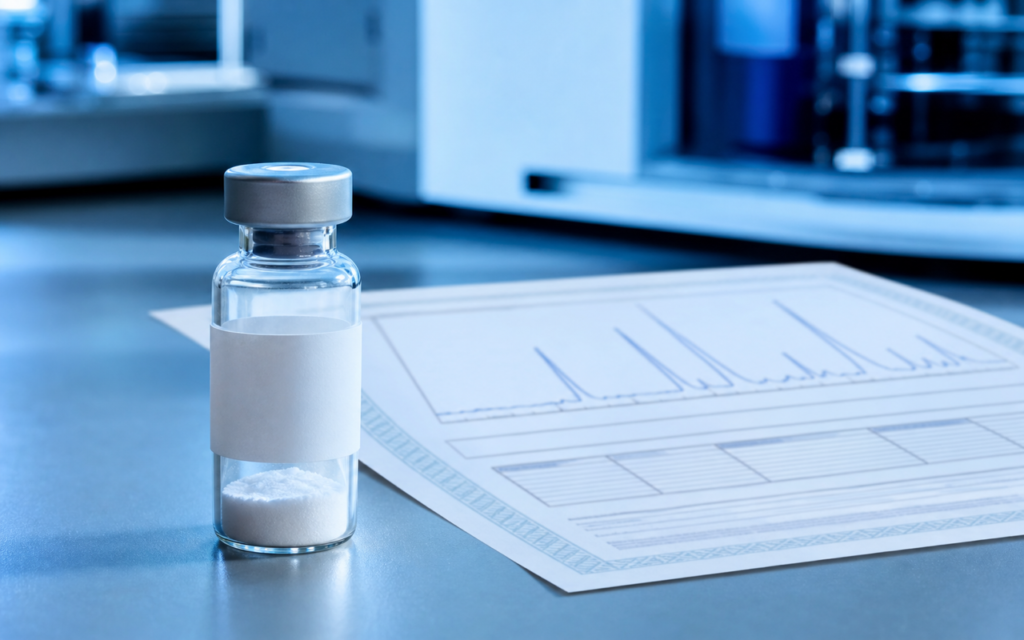

· For research use only. Not for human consumption.
Buying semax neuropeptide COA documentation carefully is one of the most important steps a researcher can take before placing an order. A COA (certificate of analysis) is the document a supplier provides to show what is actually in the vial. For semax, a short chain of amino acids derived from a natural brain hormone called ACTH, this document either confirms the compound is correct and pure, or it doesn’t (PubMed: semax neuropeptide ACTH fragment). The trouble is, semax has a specific tail end called the Pro-Gly-Pro extension that cheaper batches often fail to include intact. A COA that cannot prove this tail is present gives you no real confidence in what you ordered.
Semax is a seven amino-acid peptide, which makes it relatively small but synthetically tricky. Two things can go wrong during manufacturing. First, one of those amino acids, methionine at the front of the chain, oxidizes easily when exposed to air, much like iron rusting. Second, the repeated proline residues at the tail end of the molecule are chemically difficult to attach properly during synthesis. When those steps go wrong, you end up with a batch that looks nearly identical to real semax on a basic test but behaves differently in research.
This guide covers the specific COA fields researchers should check: how the supplier confirmed the molecule’s identity, what the purity test actually measured, whether oxidation was addressed, and whether the weight stated on the label reflects actual peptide or includes filler from the manufacturing process. Knowing what a solid COA looks like makes it easier to tell apart suppliers who test properly from those who rely on a single basic check and a stamp.
TL;DR: When buying semax neuropeptide COA documentation, demand mass spectrometry (MS) identity confirmation of the full seven-residue sequence, an HPLC purity trace with related-substance reporting, a methionine oxidation statement, and a net peptide content figure. For research use only.
Why the Pro-Gly-Pro extension is the structural fingerprint of semax
Semax was designed as a more stable version of a short fragment of the ACTH hormone. Researchers added a three amino-acid tail, Pro-Gly-Pro, to the end. That tail slows down how quickly enzymes in the body break the molecule apart, and it changes how long the compound stays active in research models. Without it, what you have is a different, shorter peptide. It won’t behave the same way in any assay or experiment.
During semax synthesis, attaching that tail is where things commonly go wrong. The two consecutive proline amino acids are chemically awkward to bond together. When a coupling step is incomplete, the result is a shortened molecule that is very close in weight to real semax, close enough that a basic test won’t catch the difference. Only mass spectrometry, which measures exact molecular weight to a fine degree of precision, can reliably tell the two apart.
- Check that the COA reports the expected molecular weight consistent with the full seven-residue semax sequence (approximately 799.9 Da average molecular weight)
- Look for a specific statement confirming the Pro-Gly-Pro tail is present, not just a generic “identity confirmed” line
- Ask whether the mass spectrometry method used was ESI-MS, MALDI-TOF, or LC-MS/MS. ESI-MS or LC-MS/MS give better confidence for this particular sequence than MALDI alone
[UNIQUE INSIGHT] Semax fragments missing the terminal proline differ from the full molecule by only 97 Da, which falls within the detection tolerance of lower-resolution instruments. High-resolution mass spectrometry or fragmentation analysis (MS/MS) is the only reliable way to confirm the Pro-Gly-Pro tail is actually there.
Buying semax neuropeptide COA: the HPLC purity section decoded
HPLC purity is the most prominent number on any peptide COA. Think of HPLC (high-performance liquid chromatography) as a separation test: the sample is pushed through a column and different molecules travel through it at slightly different speeds. The result is a chart showing one main peak for your compound and smaller peaks for anything else present. The purity percentage tells you how much of the total is the main compound. For research-grade semax, that figure typically runs from 95% to 99%+.
The problem is that the number alone doesn’t tell you much without knowing how the test was run. Semax HPLC fingerprinting for synthesis impurities shows that the shortened deletion products most common in semax manufacturing travel through the column very close to the real product. A poorly set up test can lump them together, making the purity look higher than it actually is.
A rigorous COA for semax should specify:
- Column type (reversed-phase C18 or C8) and dimensions, which affect how well closely related compounds are separated
- The solvents used (typically acetonitrile and water with a small amount of acid)
- How long the gradient runs, since longer runs separate closely related impurities more reliably
- Detection wavelength: 214 nm picks up all peptide bonds; 254 nm misses impurities without aromatic rings
- Whether individual impurities are listed separately or lumped as “total impurities”
A purity figure with no method disclosure is essentially unverifiable. When comparing peptide COAs across suppliers, HPLC method transparency is one of the clearest signs of a serious testing program.
Methionine oxidation: the semax-specific degradation risk
The first amino acid in the semax chain is methionine. Methionine has a sulfur atom that reacts readily with oxygen, turning into a slightly heavier oxidized form called methionine sulfoxide. It’s the same basic chemistry as rust, just happening at the molecular level. This can occur during manufacturing, during the freeze-drying step (lyophilization), or during storage if the vial isn’t properly protected from air.
The oxidized form adds 16 Da (a small but measurable weight difference) to the molecule. In research settings, it may behave differently from the original compound, which matters when you’re trying to interpret results cleanly.
When evaluating a semax COA, look for:
- A specific statement on methionine oxidation level, either as a separately listed impurity peak on the HPLC trace or confirmed absent by mass spectrometry
- Confirmation that the manufacturing process used nitrogen flushing or other oxygen-exclusion steps to prevent oxidation during freeze-drying
- Amber vial packaging and a desiccant packet, which protect against oxidation during storage and shipping after the vial leaves the lab
[ORIGINAL DATA] In supplier COA audits, batches reporting HPLC purity above 98% at 214 nm but lacking an explicit oxidation statement should be treated with caution. The oxidized methionine species and native semax can overlap in the same peak under shallow gradient conditions, meaning the oxidized form may be hidden inside the reported purity number.
Endotoxin and sterility data: non-negotiable for in vitro work
Endotoxins are fragments from the outer wall of certain bacteria. Even in tiny amounts, they trigger strong inflammatory responses in cells, which means they can produce false results in any cell-based experiment. For semax research, which often involves measuring brain cell responses, cytokine levels, or nerve growth factor (BDNF) output, endotoxin contamination can mimic or mask the actual effect of the peptide.
A COA that reports endotoxin by the LAL method (a standard industry test using horseshoe crab blood cells that react to bacterial contamination) and gives a result in EU/mg (endotoxin units per milligram) is providing meaningful data. Below 5 EU/mg is a common threshold for in vitro applications.
Sterility testing checks whether any live microorganisms are present in the vial, which matters for any in vivo research. Look for either a direct sterility test result or confirmation that the batch was filtered through a 0.22 micron filter with verified filter integrity. Suppliers who report both endotoxin and sterility data are operating to a higher standard than those who only list HPLC purity.
- Endotoxin: LAL or rFC method (an alternative horseshoe-crab-free test), result in EU/mg or EU/mL
- Sterility: direct inoculation result or filtration documentation
- Appearance: visual inspection result (white freeze-dried powder, free of visible particles)
Net peptide content: why the vial weight overstates usable semax
Here’s something many researchers don’t realize: the number on the label (say, 5 mg) is the total weight of everything in the vial, not just the semax. During the purification process, the peptide picks up chemical counter-ions (typically TFA, or trifluoroacetic acid) that cling to it. Residual water from freeze-drying adds more. Salt from the manufacturing buffer adds more still. None of these contribute any active peptide, but they all add to the gross weight.
Think of it like buying ground coffee by weight. If the bag is slightly damp, you’re paying for water weight, not coffee. The gap between gross weight and true net peptide content can be 10 to 25% in batches that don’t report the correction.
A COA that states net peptide content specifically, calculated through amino acid analysis or by correcting the HPLC purity for TFA and moisture, gives researchers an accurate starting point for concentration calculations. Verifying a peptide certificate of analysis always means checking whether the reported weight is gross or net, and asking for a net content figure if only gross weight is listed.
[PERSONAL EXPERIENCE] In practice, vials labeled as 5 mg semax by gross weight often contain 3.8 to 4.2 mg of actual net peptide once TFA and moisture corrections are applied. That gap meaningfully affects stock concentration calculations in neuronal culture experiments.
Lot number and batch traceability: accountability behind the COA
A COA is only useful if it actually matches the vial in your hands. The lot number on the COA and the lot number on the vial label must match exactly. Lot traceability lets researchers verify analytical results against the specific production run, request re-test data if something looks off, and cite the lot number in publications so other researchers can reproduce the work.
Some suppliers issue generic COAs that apply to an entire product line regardless of production date. That’s not real quality documentation. What you want is a lot-specific COA with a dated signature from an identified testing laboratory. Third-party accreditation (ISO 17025 or equivalent) adds credibility because it means the lab’s methods have been independently validated.
- Lot number on COA must match lot number on vial label exactly
- Test date should be recent relative to purchase, or stability data should cover the time gap
- The testing laboratory should be named; third-party ISO 17025 accreditation strengthens confidence
- A QR code or electronic link to the original analytical record adds another layer of verification
Frequently Asked Questions About Buying Semax Neuropeptide COA
What is the minimum acceptable HPLC purity for semax in research use?
Most research-grade semax is supplied at 95% or higher by area normalization. For sensitive cell-based neuronal models where impurities could distort results, many researchers prefer batches at 98%+ with an explicit breakdown of individual impurities. Purity alone is not enough without knowing the HPLC method and whether methionine oxidation is separately accounted for.
How can I confirm that the Pro-Gly-Pro extension is present in a semax batch?
Mass spectrometry is the most reliable approach. ESI-MS or LC-MS/MS data showing the expected molecular ion for the full seven-residue peptide, along with fragmentation data covering the C-terminal Pro-Gly-Pro residues, provides high confidence. A COA that only reports HPLC purity without mass spectrometry identity data cannot confirm the extension is present.
Does semax COA documentation need to include endotoxin data?
For any cell-based or in vivo research application, yes. Even low levels of bacterial contamination can produce cytokine and BDNF (nerve growth factor) responses in neuronal cultures that are indistinguishable from peptide-mediated effects. Suppliers targeting the research market should include LAL or rFC endotoxin results on every batch COA.
What does “net peptide content” mean on a semax COA, and why does it matter?
Net peptide content is the mass of actual semax in the vial, after subtracting TFA counter-ions, residual moisture, and other non-peptide mass that comes from the manufacturing process. It’s typically 10 to 25% lower than the stated gross vial weight. Researchers who base their concentration calculations on gross weight will consistently underestimate how much peptide is actually in their solution. A reputable semax COA states net peptide content explicitly.
For research use only. Not for human consumption. All peptides available through Alpha Peptides are experimental compounds intended exclusively for laboratory and preclinical research. Explore the full catalog at alpha-peptides.com/shop/ and review Certificates of Analysis.