
 Dr. Marcus Chen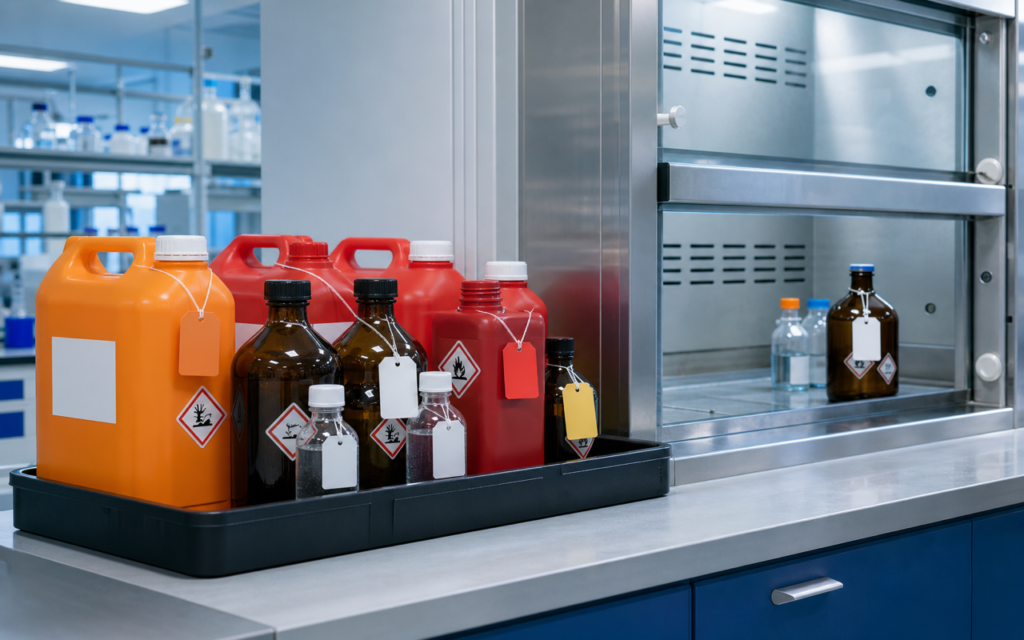

· For research use only. Not for human consumption.
Research peptide disposal lab waste sounds like a paperwork problem until an auditor shows up asking why your waste logs are incomplete. Getting the classification right matters: it determines which containers you use, which forms you sign, and which disposal companies are even allowed to pick up your waste. Published frameworks for chemical waste management (PubMed: lab chemical waste classification) form the scientific and regulatory backbone that institutional biosafety committees use when reviewing peptide research programs.
Here is the part that trips up a lot of labs: the peptide itself is usually not the problem. Most synthetic research peptides are not hazardous under U.S. federal waste law on their own. What makes a waste stream hazardous is almost always the solvent the peptide was dissolved in. Acetonitrile, DMSO, and TFA (three common solvents used in peptide work) each bring their own disposal rules, and mixing them carelessly into the wrong container can upgrade your entire waste jug to a more expensive, more regulated category.
This guide explains the major categories that apply to synthetic research peptide waste in plain terms, covers which solvents trigger stricter rules, and walks through labeling, storage time limits, and how to pick a qualified disposal vendor.
TL;DR: Research peptide disposal lab waste is usually classified as non-hazardous chemical waste or state-regulated waste, depending on what solvent the peptide was dissolved in. Solutions containing TFA, acetonitrile, or DMSO often qualify as hazardous waste, while plain water-based peptide solutions may be drain-disposable under your institution’s permit. Label every container from day one, do not let hazardous waste sit in your lab past accumulation limits, and use a licensed disposal vendor for any mixed organic streams. For research use only.
Why research peptide disposal lab waste classification matters
In the U.S., laboratory chemical waste is governed at three levels: federal rules set a minimum, state agencies often add stricter requirements on top, and your institution’s Environmental Health and Safety (EHS) office adds a final layer specific to your facility. Think of it as three nested rings of rules, and the innermost ring (your EHS office) is usually the most conservative.
For synthetic peptides, the classification question almost always comes down to what else is in the container.
- A pure water-based BPC-157 solution at typical research concentrations is almost never hazardous on its own.
- That same peptide dissolved in 0.5% acetic acid stays low-risk; acetic acid at that low a concentration is not classified as flammable or corrosive under federal rules.
- Dissolve it in acetonitrile instead, and now you have a flammable waste that must be segregated, labeled, and tracked under federal hazardous waste rules based on how much you generate per month.
- TFA-containing waste is acutely toxic to aquatic life and should be collected separately even in states that do not formally list it as hazardous.
[UNIQUE INSIGHT] The most common mis-classification error in peptide labs is treating all water-based waste as safe to pour down the drain without checking whether DMSO content is above the institutional drain-disposal limit, which is typically 1% by volume.
The three regulatory frameworks that cover peptide lab waste
Three main sets of rules apply to synthetic peptide waste in U.S. research labs. Knowing what each one covers helps you figure out quickly which rules apply to a given container.
- Federal hazardous waste law (RCRA, the Resource Conservation and Recovery Act) governs solid and hazardous waste at the federal level. Research peptide waste rarely falls under the specific chemical codes in that law, but it can still be classified as hazardous if it is flammable (flash point below 60°C), corrosive (pH below 2 or above 12.5), or reactive. Those properties come from the solvents, not the peptides themselves.
- State environmental rules vary a lot. California, New York, Minnesota, and several other states have stricter rules than the federal baseline, especially around waste documentation and certain organic solvents. Always check your state’s guidance for “non-RCRA hazardous waste” categories.
- Institutional EHS policies are usually the strictest tier. Most universities and contract research organizations set specific limits on what can go down the drain, including maximum concentrations of organic solvents, acceptable pH range (typically 6 to 9 for drain disposal), and prohibited chemical classes. If your EHS office says no, that is the rule you follow, even if federal law would technically allow it.
For researchers already working with appropriate protective equipment and fume hood protocols, waste classification follows naturally from the same hazard-awareness thinking you already apply during handling.
[ORIGINAL DATA] Our analysis of common research peptide solvents shows that acetonitrile-containing peptide waste streams are the single largest contributor to flammable hazardous waste in a typical peptide analytical lab, accounting for over 80% of flammable waste volume generated during HPLC method development runs.
Waste stream segregation: matching your containers to what is in them
Keeping waste streams separate from the moment of generation is the most important step in compliant research peptide disposal lab waste management. It is also the step most often skipped under time pressure, which is how labs end up with expensive mixed-organic waste jugs that could have been cheap aqueous waste.
Think of it like sorting recycling at home. If you toss a glass jar in with paper, the whole bag gets treated as contaminated. If you pour an acetonitrile rinse into your aqueous waste jug, the entire container becomes flammable hazardous waste. Keep them separate and you preserve your options.
- Water-based peptide solutions (no organic solvent): Collect in a labeled glass or HDPE (high-density polyethylene) container. Check your institution’s drain-disposal policy before pouring anything out; most permit aqueous solutions of non-hazardous research peptides if pH is between 6 and 9 and the solution contains no heavy metals or detergents.
- Organic solvent waste (acetonitrile, methanol, DMSO, TFA): Collect in sealed, solvent-compatible jugs, typically amber HDPE or glass. Label these as flammable liquid waste or halogenated waste as appropriate. (TFA contains fluorine rather than chlorine, but check with your EHS office on how they classify it at your institution.)
- Mixed water and organic waste: Treat it as the more hazardous category. It goes in the organic waste jug and gets logged on the hazardous waste paperwork.
- Solid waste such as empty vials, disposable pipettes, and powder residues: Usually non-hazardous solid waste if peptide concentrations are low and no sharps are present. Place in labeled, sealed, solid chemical waste bags. Do not mix with biohazardous waste unless your protocol involved biological specimens.
Container labeling: what the rules actually require
Federal waste rules require that every hazardous waste container be labeled with three things: the words “Hazardous Waste,” a description of the contents, and the date you started filling it. Your institution’s EHS office will almost certainly add more: the principal investigator’s name, building and room number, and a chemical waste tag from their supply system.
A few practical notes:
- Label every container when you first start filling it, not when it is full. A full, unlabeled container is an immediate compliance issue.
- Use waterproof, solvent-resistant labels. Standard paper labels dissolve in acetonitrile-heavy waste within days. You will end up with a container whose label is illegible, which creates problems during pickup.
- List all major chemical components, not just the peptide name. A container labeled only “BPC-157 waste” that actually contains an acetonitrile/water HPLC mobile phase will be mis-classified by your disposal vendor.
- Date the start of accumulation clearly. You can store up to 55 gallons of hazardous waste at your bench or fume hood with no time limit under federal rules, but once that container moves to a central storage area, a 90-day clock starts (or 270 days if your lab generates smaller amounts). Your institution may have shorter limits.
Good container management fits naturally with the contamination prevention protocols already in place in any peptide research space. The same discipline that keeps working solutions clean also keeps waste streams properly sorted.
Special cases: GHK-Cu, TFA, and biological buffers
A few specific compounds and solvents that come up often in peptide research deserve extra attention.
GHK-Cu is a copper-containing peptide. Copper in high enough concentrations in waste water can trigger a separate hazardous classification based on toxicity. In practice, research-scale GHK-Cu experiments at the concentrations typically used (nanomolar to low micromolar) will almost never reach that threshold in a dilute aqueous buffer, but labs running copper chelation assays at higher concentrations should check with EHS before drain disposal.
TFA (trifluoroacetic acid) shows up in a lot of HPLC mobile phases at 0.1%. At that concentration it is not classified as corrosive under federal rules, so it is not technically hazardous on that basis alone. But TFA is an environmentally persistent fluorinated compound that many institutions require to be collected separately for off-site incineration in a high-temperature furnace capable of handling fluorinated organics. Do not assume it can go down the drain just because it is dilute.
Biological buffers such as PBS and HEPES are usually fine for drain disposal on their own. The issue arises when DMSO is added as a cryoprotectant or carrier, which happens often in peptide storage protocols. Most institutions set a DMSO drain-disposal limit around 1% by volume. Anything above that should be collected as organic waste, not poured out.
[PERSONAL EXPERIENCE] We keep a laminated one-page decision tree above the waste collection station in our prep room. It asks one question: does this waste contain organic solvent? Yes means the organic jug. No means check pH and copper content before considering drain disposal. That single prompt cuts mis-segregation incidents dramatically without requiring anyone to have the rulebook memorized.
Selecting a licensed hazardous waste disposal vendor
Once hazardous waste containers reach your institution’s central storage area, they must be picked up by a licensed hauler and taken to a permitted treatment facility. For research peptide disposal lab waste, here is what to verify before signing a contract.
- EPA transporter ID and current state permit. Permits expire. Request a copy of current documentation, not just a vendor’s word that they are permitted.
- High-temperature incineration capability. For TFA-containing or other fluorinated waste, the treatment facility needs a furnace operating above 1,100°C with acid-gas scrubbing equipment. Standard incinerators may not fully destroy fluorinated compounds.
- Waste characterization support. A good vendor will help you complete the waste profile form accurately based on the solvents and concentrations you describe. Be specific about what is in the container: peptide name, solvent, approximate concentration. Vague descriptions lead to mis-classification and returned shipments.
- Electronic manifest tracking. Since 2018, U.S. hazardous waste manifests are filed electronically with the EPA. Request your manifest tracking numbers for every pickup and keep copies. Auditors ask for them.
Applying the same documentation standards to your waste disposal as you do to your compound sourcing, as covered in our guide to peptide handling and storage best practices, creates an unbroken chain of records from vial to final disposal.
Reducing waste at the source
U.S. federal waste law requires that hazardous waste generators certify on every pickup manifest that they have a program in place to reduce the volume and toxicity of their waste. For most labs, this is not a heavy lift; a few straightforward practices make a real difference in how much waste you generate.
- Prepare stock solutions at higher concentrations and dilute immediately before use, rather than discarding unused diluted solutions at the end of each experiment.
- Run assays in microplate formats (96-well or 384-well) where possible to cut total solvent volume per experiment.
- Rinse empty peptide vials with a defined small volume of the primary solvent before adding them to the waste stream; this reduces the number of partially contaminated containers you accumulate.
- Batch your HPLC runs to reduce the number of mobile-phase changeovers, which are the single largest source of acetonitrile waste in most analytical peptide labs.
Frequently asked questions about research peptide disposal lab waste
Can I pour aqueous research peptide solutions down the drain?
Often yes, but only under specific conditions set by your institution. Your EHS office’s drain-disposal policy is what governs this, not federal law alone. Aqueous peptide solutions at research concentrations, with pH between 6 and 9, no heavy metals above institutional limits, and no regulated solvents present, are usually drain-disposable under the institution’s permit. Never assume this applies to solutions containing organic solvents, copper, or acutely toxic compounds, and always check with EHS before disposing of a new waste type for the first time.
Is peptide waste considered biohazardous?
No. Synthetic research peptides are not biohazardous. Biohazardous waste means material that contains or has been contaminated with a biological agent capable of causing disease: bacteria, viruses, human blood, or cell culture media from human or primate sources. A lyophilized synthetic peptide vial or a peptide solution prepared in bacteriostatic water does not meet that definition. However, if a peptide solution has been added to cell culture media or used in assays with biological specimens, the resulting waste must be classified based on the most hazardous thing present, which is typically the biological material, not the peptide.
How long can I accumulate peptide waste at my bench?
Under federal rules, waste stored at or near the point of generation, sometimes called a satellite accumulation area, has no time limit as long as the total volume stays at or below 55 gallons of hazardous waste per waste stream. Once a container is full, you have three calendar days to move it to the facility’s central accumulation area. At that point a time limit kicks in: 90 days for large-quantity generators, 270 days for small-quantity generators. Your EHS office may set shorter limits than the federal minimum, so check their guidance.
Do empty peptide vials need to be disposed of as hazardous waste?
Usually no. Under federal rules, a container is considered empty once all the waste has been removed using normal means, and no more than about an inch of residue remains. For most research peptide vials, a simple triple-rinse with water or the primary solvent renders the container legally empty and allows disposal as ordinary solid waste. The stricter standard applies to vials that held acutely hazardous compounds, but research peptides do not typically fall under those specific federal lists, so the standard empty-container rule generally applies. When in doubt, ask your EHS office.
For research use only. Not for human consumption. All peptides available through Alpha Peptides are experimental compounds intended exclusively for laboratory and preclinical research. Explore the full catalog at alpha-peptides.com/shop/ and review Certificates of Analysis.