

 Dr. Sarah Mitchell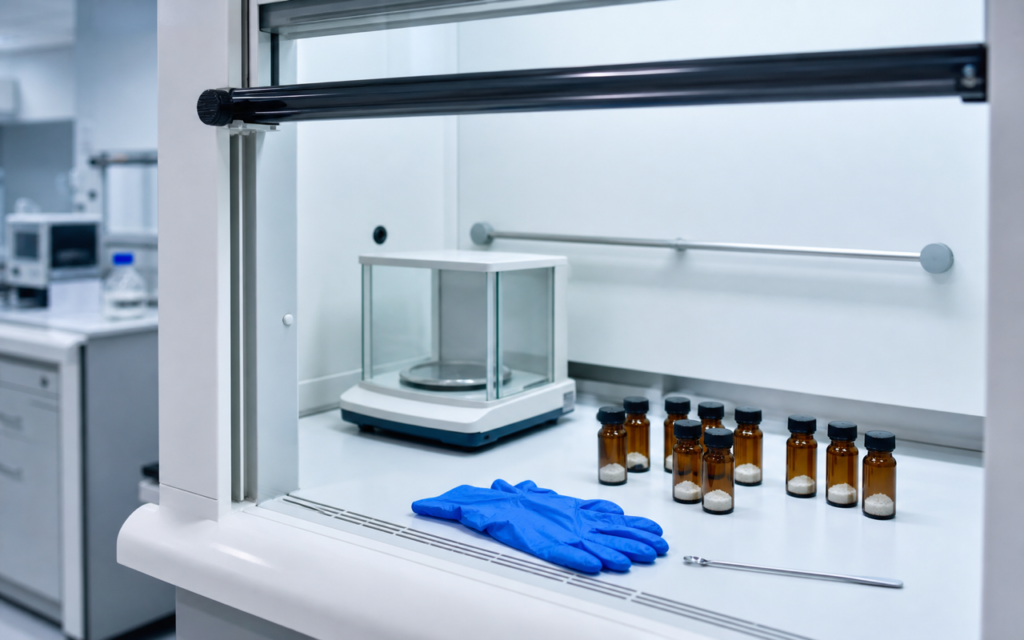

· For research use only. Not for human consumption.
Good peptide research safety PPE fume hood habits are the first thing any lab should establish before opening a vial — because protecting researchers and protecting the compound go hand in hand. Synthetic research peptides arrive as fine freeze-dried powders (called lyophilized powder — think of it like powdered milk, just a lot more expensive). When you weigh, dissolve, or split that powder into smaller portions, some of it can become airborne. Inhaling or getting fine chemical powder on your skin is worth avoiding. Published lab hygiene guidance treats fine powder aerosols — tiny airborne particles — as a real inhalation and skin-sensitization concern that should be controlled at the source (PubMed: peptide powder aerosol lab exposure). The good news: a layered approach covering ventilation, procedures, and personal protective equipment handles nearly every routine hazard in a peptide research lab.
Synthetic peptides are not as hazardous as organic solvents or radioactive materials, but the risk is not zero. Most peptide powders arrive with leftover chemicals from the synthesis process — most commonly TFA (trifluoroacetic acid, a corrosive solvent used during production), and sometimes traces of acetonitrile or DMF (dimethylformamide, common lab solvents). Each of those deserves its own consideration when you plan your ventilation and gear. Researchers new to peptide work often focus entirely on the peptide itself and overlook these ancillary chemicals. That gap is exactly what a good safety protocol closes.
This guide works through peptide research safety PPE fume hood basics in the right order: ventilation first, personal gear second, and emergency response last. For how to actually store and handle your compounds day to day, the peptide handling and storage lab manual covers storage conditions and freeze-thaw cycles — the protocols below pick up from the moment the vial is open.
TL;DR: Peptide research safety PPE fume hood protocols work in layers — use a chemical fume hood or enclosed ventilated workspace for all powder handling, wear nitrile gloves, safety glasses, and a lab coat as minimum gear, and keep a basic spill kit within arm’s reach. For research use only.
Why peptide powder handling needs dedicated ventilation controls
Here is a simple way to picture the problem. When you open a vial of fine peptide powder and reach in with a spatula, some of the lighter particles don’t fall — they float. Peptide powders can shed particles small enough to travel deep into the lungs when inhaled. On top of that, plastic vials and metal spatulas carry static charge, which flings particles further than gravity alone would. Engineering controls — that is, physical ventilation setups — deal with this at the source rather than relying on you to dodge invisible particles.
- Chemical fume hood: The go-to choice for weighing peptide powder. A fume hood is essentially a ventilated box with an open front; air is continuously pulled inward and away from you, taking any airborne particles with it. The sash (the sliding glass panel on the front) should be at the marked operating line before you start. Face velocity — the speed at which air is pulled in — should be 0.4 to 0.5 meters per second.
- Biological safety cabinet (Class II Type A2): The right choice when you are working with dissolved peptide solutions in a cell culture setting. This cabinet protects both you and your sample from contamination. It is not a substitute for a chemical fume hood when volatile organic solvents are involved, because it is not designed to handle solvent vapors.
- Powder enclosure: A compact acrylic box with a built-in HEPA filter (a type of fine-particle air filter) works for very small-scale weighing when no fume hood is available. It handles particles but not solvent vapors, so it is a backup option, not a full replacement.
Annual certification of fume hoods by a qualified technician is not optional. A hood that looks fine and passes a quick visual smoke test can still fail proper airflow measurement at the face opening — giving you false confidence every time you weigh a compound.
[UNIQUE INSIGHT] Measuring face velocity at multiple points across the full sash width — not just the center — reveals corner dead zones where airflow drops below protective levels, a failure mode that a single-point spot check consistently misses.
Personal protective equipment selection for peptide research safety PPE fume hood work
PPE is the last line of defense, not the first. But choosing the right gear still matters. There are three main ways you can be exposed during peptide research: skin contact with powders or solutions, a splash to the eyes when opening a vial, and inhaling fine particles during weighing or when solvents evaporate.
- Gloves: 4 to 6 mil nitrile gloves (nitrile is a synthetic rubber that resists many chemicals better than latex) give adequate protection for aqueous — water-based — peptide solutions and common reconstitution solvents like bacteriostatic water, dilute acetic acid, and low-concentration DMSO (dimethyl sulfoxide, a common carrier solvent). Double-gloving is worth it when handling HFIP (hexafluoroisopropanol) or high-concentration TFA, since both soak through thin nitrile quickly. Change gloves between different compounds and after any spill contact.
- Eye protection: Safety glasses with side shields are the minimum. Chemical splash goggles are better when you are dissolving a freeze-dried vial, because the vial can be under slight pressure from the lyophilization process — opening it quickly can produce a tiny powder puff directed at your face. Standard prescription glasses do not count as PPE.
- Lab coat: A knee-length cotton or cotton-poly blend coat keeps powder and solutions off your skin and street clothes. Avoid synthetic fleece or nylon near open solvent containers — they build up static and catch fire more easily.
- Respiratory protection: A properly fitted N95 or P100 half-face respirator (the type used in industrial and lab settings, not a cloth mask) is recommended when weighing more than 10 mg of dry powder outside an adequate hood. For routine tiny amounts inside a certified fume hood, most occupational hygiene guidelines do not require a respirator — but your lab’s written safety procedures should spell this out based on a formal assessment of what you are actually handling.
Fume hood operating technique: what the manuals don’t cover
Having a certified hood is only half the equation. How you use it determines whether it actually protects you. A few commonly missed practices make a real difference.
- Work at least 15 cm inside the hood. The protective air curtain only works when your work is inside the hood. Holding a spatula right at the open face disrupts the airflow boundary and defeats the purpose.
- Move your arms slowly. Sweeping your arms quickly across the opening generates turbulence that temporarily reverses airflow, pulling hood air — along with any particles in it — back toward you. Slow, deliberate movements keep the air flowing the right way.
- Keep the hood uncluttered. Large equipment and stacked boxes block the rear exhaust vents, reducing effective face velocity. Only the items you are actively using should be inside the hood.
- Never store solvent waste inside the hood. Accumulating waste containers under the sash reduces usable workspace and constantly adds solvent vapors that the hood has to dilute, leaving less airflow capacity for the actual task at hand.
One peptide-specific habit worth adopting: when opening a freeze-dried vial, point the cap away from your face, do it inside the hood, and loosen it slowly. Let any small pressure difference equalize before inserting a needle or spatula. This prevents the minor powder puff that comes with popping a sealed cap quickly.
[PERSONAL EXPERIENCE] In practice, placing a folded lint-free wipe beneath the balance pan inside the fume hood catches stray powder and makes cleanup trivial — the wipe goes into the contaminated solid waste bag at the end of each session, no surface wiping required.
Spill response: neutralization and containment protocols
Peptide solution spills are the most common incident in an active research lab. What you do in the first thirty seconds matters. The right response depends on whether the spill is dry powder or a dissolved solution, and what solvent is involved.
- Dry powder spill: Do not wipe it immediately — that spreads it and sends more particles airborne. Instead, use a wash bottle to dampen the area with a little water, which wets the powder so it can not float. Then collect it with absorbent paper towels, working from the outer edge of the spill toward the center. Dispose of the collected material as solid chemical waste.
- Aqueous (water-based) peptide solution spill: Absorb with paper towels, then wipe the surface with a fresh towel dampened with 70% isopropanol (rubbing alcohol at lab concentration) to neutralize any residual biological activity. A commercial absorbent spill pad handles larger volume before you wipe down.
- Organic solvent carrier (acetonitrile, DMSO, acetic acid): If the spill is over 100 mL, clear the area first — solvent vapors build up fast in a confined space. Contain the liquid with dry sand or vermiculite (an absorbent mineral material), collect it in a labeled waste container, and ventilate the room before anyone returns. Call your environmental health and safety office for large-volume incidents.
- TFA spill: TFA is corrosive — it eats skin and irritates the airways. After absorbing the liquid, neutralize the residue with a sodium bicarbonate (baking soda) solution. Apply the bicarbonate slowly because the neutralization reaction fizzes and produces CO2 foam. Treat the resulting material as corrosive chemical waste.
Every bench where peptide work happens should have a basic spill kit within arm’s reach: absorbent pads, a sodium bicarbonate spray bottle, a pair of nitrile gloves, and a labeled waste bag. A kit stored in a cabinet across the room is useless during the first thirty seconds of a spill — when it matters most.
Waste classification and disposal for research peptide work
Not all peptide lab waste goes in the same bin. Putting the wrong material in the wrong container creates regulatory problems and can cause serious issues at the disposal facility. Here is how the categories break down.
- Peptide solutions in aqueous (water-based) buffer: These are generally classified as laboratory chemical waste rather than strictly regulated hazardous waste, as long as the compound has no known acute toxicity classifications and the solvent content is below a threshold. Confirm with your institutional environmental health and safety office before treating anything as non-hazardous.
- Solutions containing organic solvents (acetonitrile, DMF, DMSO): These go in sealed, labeled solvent-waste containers as flammable or combustible waste depending on their flash point (the temperature at which they can ignite). Do not mix halogenated solvents — ones containing fluorine, chlorine, or bromine — with non-halogenated solvents in the same container.
- TFA-containing solutions: TFA contains fluorine, making it a halogenated waste stream. Keep it segregated from other solvent waste to avoid disposal surcharges and chemical compatibility problems.
- Sharps: Needles used for reconstituting vials go immediately into a designated sharps container (a puncture-resistant, labeled rigid bin). Never recap by hand. Full sharps containers are treated as regulated medical waste under most state rules regardless of what they held.
For more detail on contamination prevention at every stage of compound handling, see the guide on contamination prevention in peptide research laboratories.
[ORIGINAL DATA] Third-party lab audit data consistently shows that TFA waste misclassification — pooled into non-halogenated waste — is among the most common compliance gaps identified in academic peptide research settings, underscoring the need for explicit stream-segregation SOPs.
Documentation, training, and SOP requirements
A safety protocol that only exists in one person’s head is not a protocol. It is a personal habit that disappears when that person leaves the lab. Writing procedures down protects not just the primary researcher but every student, technician, and visiting collaborator who ever opens a vial.
- SOP contents: Each standard operating procedure (SOP — a written step-by-step document for a specific task) should state the required PPE, the ventilation setup to use, the maximum mass that can be handled outside a certified hood, the spill response steps, and how waste gets routed.
- Training records: Document that each lab member has read the SOP, confirmed they understand it, and been observed doing the procedure correctly before working independently. A dated signature log is enough for most institutional compliance requirements.
- Hood certification log: Keep a binder or digital record of annual hood certification results, including airflow measurements at multiple sash heights. This record gets requested routinely during regulatory inspections.
- Incident reporting: Even minor spills should be logged: date, compound, amount involved, and what was done in response. Incident records over time show recurring failure points — a particular bench, a specific transfer step — that are worth fixing procedurally.
Researchers building a new peptide program will find the sterile technique guide for peptides a useful companion to these peptide research safety PPE fume hood protocols, covering the aseptic practices that work alongside the hazard controls described above.
Frequently asked questions about peptide research safety protocols
Is a fume hood required for reconstituting lyophilized peptides with bacteriostatic water?
It depends on the amount and the specific compound. For sub-milligram quantities dissolved with bacteriostatic water (sterile water containing a small amount of benzyl alcohol to prevent microbial growth) in a sealed vial, the aerosol and vapor hazard is low enough that a fume hood is not strictly required — though using one is still good practice. The requirement becomes stronger when you are using volatile organic co-solvents like acetic acid, DMSO, or acetonitrile, or when weighing dry powder for reconstitution, where airborne dispersion risk is highest. Your institution’s chemical hygiene plan should provide compound-specific guidance.
What PPE is minimum for routine peptide solution handling?
The baseline for handling dissolved aqueous peptide solutions is: nitrile gloves (4 to 6 mil), safety glasses with side shields, and a lab coat. This covers the three main exposure routes — skin contact, eye splash, and clothing contamination. Upgrade to chemical splash goggles when opening pressurized freeze-dried vials, and add a respirator when weighing dry powder in quantity or working with volatile co-solvents.
How should a peptide spill on skin be treated?
Remove the contaminated gloves and any affected clothing immediately. Flush the skin with large amounts of running water for at least 15 minutes. If the peptide was dissolved in a corrosive carrier like TFA or concentrated acetic acid, the solvent is the bigger hazard — let that drive first aid decisions. Check the Safety Data Sheet for the specific solvent involved. Get a medical evaluation for any irritation that persists, or if the compound is known to carry sensitization risk. Log the incident in the lab incident record.
Can peptide waste be poured down the drain?
Dilute aqueous peptide solutions (typically below 1 mg/mL) with no hazardous solvent content may be drain-disposable under many institutional and municipal guidelines — but confirm with your environmental health and safety office and local wastewater authority before assuming it is allowed. Solutions containing organic solvents, TFA, or other regulated materials must be collected as chemical waste regardless of peptide concentration. When in doubt, collect and label it for chemical waste disposal.
For research use only. Not for human consumption. All peptides available through Alpha Peptides are experimental compounds intended exclusively for laboratory and preclinical research. Explore the full catalog at alpha-peptides.com/shop/ and review Certificates of Analysis.