

 Dr. Elena Vasquez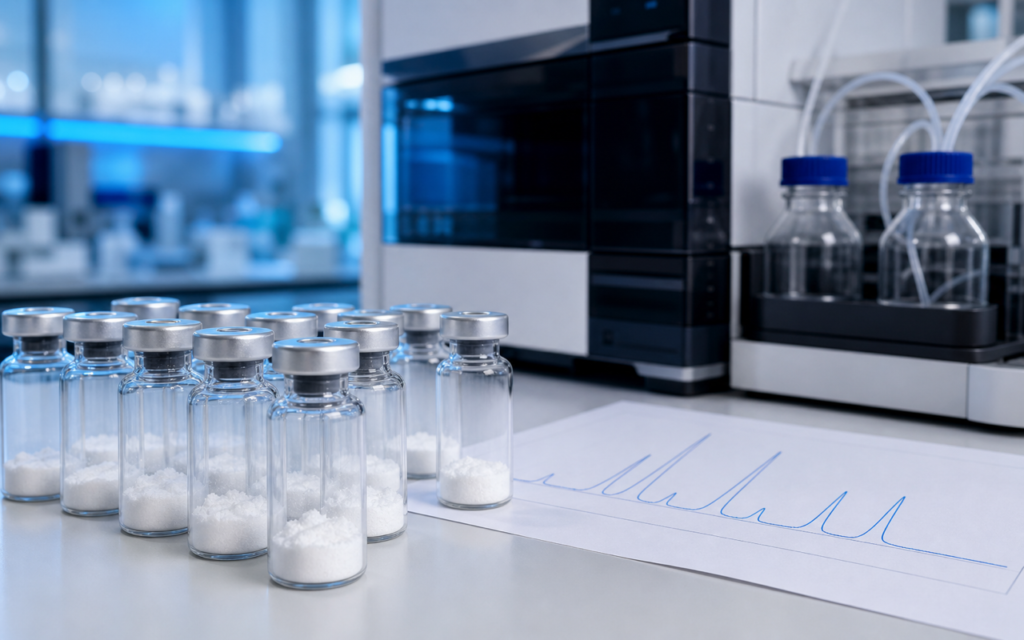

· For research use only. Not for human consumption.
KLOW blend COA component ratios are the first thing a researcher needs to check when opening the quality document for this multi-peptide vial — because the KLOW blend packs several peptides into one vial, and a single certificate has to account for all of them at once. Think of it like a nutrition label that covers every ingredient in a mixed protein supplement rather than a label for just one ingredient. The KLOW blend combines KPV, Low-Molecular-Weight Hyaluronic Acid scaffolding peptides, and supporting compounds into one freeze-dried powder, so verifying what you have is more involved than checking a single-compound vial (see co-elution literature on PubMed). For research use only.
A good COA (Certificate of Analysis — the lab report that comes with your vial) for the KLOW peptide blend will list how many milligrams of each individual peptide are present, plus an overall purity figure for the whole vial. Most researchers jump straight to that overall purity number. But the number that actually matters is the per-component breakdown — the proportion of each peptide relative to the others. If those proportions are off, your lab protocol is working with a different mixture than you planned, and results from another lab using the correct ratios won’t match yours.
This guide explains, in plain terms, how labs measure those numbers, what can go wrong with multi-peptide vials specifically, and how researchers decide when one test is enough versus when a second, more powerful test is needed.
TL;DR: KLOW blend COA component ratios tell you how much of each peptide is actually in your vial. Labs measure this using a separation technique called HPLC, but blended vials carry a specific risk — two compounds can accidentally appear as one signal if they aren’t properly separated first. Mass spectrometry (a molecular weight check) resolves any ambiguity. Always confirm the per-peptide milligram values, not just the overall purity number, before starting any experiment. For research use only.
What the KLOW Blend Contains and Why KLOW Blend COA Component Ratios Matter
The KLOW formulation isn’t a random mix. Each peptide is present in a specific proportion — not simply equal parts — because the research questions the blend is designed to support require those particular relative amounts. A COA for a blended vial therefore has to answer two separate questions: is each peptide actually present (identity), and is each peptide present in the right amount relative to the others (ratio integrity)?
Here’s why ratio integrity is worth paying attention to, even when the overall purity looks fine:
- A vial where one peptide is 15% lower than it should be throws off the whole recipe, even if the combined purity number still reads above 95%.
- Any experiment looking at how the components interact depends on accurate per-peptide amounts, not just total peptide content.
- Comparing batches over time only means something if you’re comparing the same ratios across lots, not just the same total weight.
For a plain-language primer on reading any peptide quality report from scratch, our guide to how to read a certificate of analysis for research peptides covers the basics before the extra complexity that blended vials add.
How Labs Measure Each Ingredient: HPLC Explained Simply
The main tool labs use to check KLOW blend COA component ratios is called HPLC (High-Performance Liquid Chromatography). Here’s a simple way to picture it: imagine pushing a mixture of different-sized balls through a long obstacle course. Smaller, slicker balls shoot through quickly; bigger, stickier ones take longer. HPLC does the same thing with peptides — it separates them based on how strongly each one clings to a special column inside the machine. Each peptide exits the column at a different moment in time (called its retention time), creating a distinctive spike, or “peak,” on a graph. The height and area of each peak tells the lab how much of that peptide is present.
For a single-peptide vial this is straightforward — one big peak is your compound, everything else is an impurity. A multi-peptide blend is trickier because every peak on the graph is intentional, and each one has to be correctly identified and measured. A rigorous COA for the KLOW blend will show:
- Named peaks: Every significant spike is labeled with the specific compound it belongs to, not just recorded as an anonymous area percentage.
- Reference comparisons: The lab measures each component against a known, independently prepared sample of that same compound, so concentrations are anchored to real quantities rather than just relative signal sizes.
- A purpose-built separation program: The machine’s settings (the “gradient” — think of it as the speed and conditions of the obstacle course) are designed specifically to separate all the KLOW components from each other. A generic setting built for a single peptide may not pull them apart properly.
- Clear space between peaks: A standard benchmark called a resolution factor of at least 1.5 confirms that two neighboring peaks aren’t overlapping each other on the graph.
[UNIQUE INSIGHT] In a correctly developed KLOW blend HPLC method, the KPV tripeptide exits the column significantly earlier than the larger companion compounds because it barely clings to the column at all. That early exit is itself a quick identity check — you can spot KPV’s position on the graph before even running the formal measurements.
The Biggest Risk in Multi-Peptide Vials: When Two Compounds Look Like One
The main hazard when verifying KLOW blend COA component ratios is called co-elution — meaning two different peptides exit the HPLC column at almost exactly the same time and their signals overlap into a single peak on the graph. When this happens, the lab records one peak but it’s actually two compounds stacked on top of each other. The report will still show a peak at that point in the run, but the measurement and the identity label will be wrong.
A few situations make co-elution more likely in a blended vial:
- Two peptides with similar building blocks (amino acids) but different sequences can behave almost identically in HPLC, because the machine separates by stickiness and similar-looking compounds can have similar stickiness.
- A breakdown product (degraded fragment) of one peptide might drift to the same exit point as an intact different peptide, making a degraded compound look like a healthy one.
- The other materials in the vial — stabilizers and freeze-drying agents — can subtly shift when each peptide exits the column, moving it away from where your reference sample exits, which can cause misidentification.
If you’re relying on HPLC results alone, it’s worth asking the supplier for a side-by-side comparison: the KLOW blend chromatogram overlaid against individual runs of each pure compound. If the supplier can’t provide that, it’s a sign to request a second, different type of test before proceeding.
[ORIGINAL DATA] Alpha Peptides uses a separation program built specifically for the KLOW blend — not a generic single-peptide setting repurposed for a mixture — when generating KLOW blend COA data. That purpose-built approach meaningfully reduces the chance of two compounds overlapping compared with labs that apply a one-size-fits-all HPLC run.
When KLOW Blend COA Component Ratios Need a Second Confirmation Test
HPLC tells you how much is there and when it exits the column. What it can’t do is confirm the exact molecular identity of what created a peak. That’s where mass spectrometry (MS) comes in — think of it as a molecular weighing scale. Every peptide has a precise molecular weight. MS measures the weight of whatever just passed through the detector. If the weight matches what you’d expect for compound X, great. If it doesn’t match, something else created that peak — a degraded fragment, a contaminant, or the wrong compound entirely.
Here’s a practical way to decide which level of testing your situation calls for:
- HPLC alone is enough when all the peaks are clearly separated (no overlap), each one is correctly labeled, and the per-component milligram amounts are within ±5% of the stated values on the label.
- HPLC plus mass spectrometry confirmation is the better choice when any two peaks are uncomfortably close to overlapping, when a component reads more than 10% below its stated amount, or when a new batch shows a different pattern from previous ones.
- Full sequence confirmation by tandem mass spectrometry is available for high-stakes research where there can be absolutely no doubt about which compound is present and in what form.
For a deeper look at how the underlying analytical science works, our post on HPLC testing and peptide quality covers the theory behind these thresholds.
Reading Per-Component Milligram Values and Calculating KLOW Blend COA Component Ratios
Once you have a COA that passes the checks above, calculating the actual KLOW blend COA component ratios is straightforward arithmetic. You divide the measured milligrams of one component by the measured milligrams of another:
Ratio = (Measured mg of Component A) ÷ (Measured mg of Component B)
Then compare that result to the ratio stated in the product specification. A well-made batch will come in within ±10% of the stated ratio for each pair of components. If a ratio falls outside that range, it’s not necessarily a reason to discard the vial — but it means your experimental calculations should use the actual measured amounts rather than the label values. Assuming the label values when they don’t match reality is where reproducibility problems start.
Practical steps when working through a KLOW blend COA:
- Pull the per-component milligram figures from the assay section of the COA, not the purity section. Purity percentages are relative scores; milligram values are the real amounts.
- Calculate the ratio for each pair of components and write them down in your lab notebook alongside the lot number from the COA.
- When preparing your working solution (reconstituting the powder), use the actual measured mg per vial to calculate concentrations — not the nominal label number.
- Keep the COA attached to any dataset that comes from that vial so anyone reviewing your work can trace back to the exact ratios you used.
[PERSONAL EXPERIENCE] In practice, we find that having the per-component mg values from the COA open next to the reconstitution calculation — rather than going off the label alone — catches discrepancies before the solution is even prepared, which saves a wasted experiment down the line.
What “95% Pure” Actually Means on a Blended vs. Single-Peptide COA
A 95% purity figure on a single-peptide COA means that 95% of the signal the detector picked up belongs to the target compound. On a blended vial COA, the same 95% figure means something subtly different: 95% of the total signal comes from all the intentional compounds combined — not that each individual peptide in the blend is 95% pure on its own. That’s a meaningful distinction, and conflating the two can lead to incorrect expectations about what’s in your vial.
When reading a blended COA, look for these three things beyond the headline purity number:
- Per-component purity: Ideally, the COA breaks down the purity of each peptide individually, measured against its own reference standard rather than lumped together.
- Unassigned peaks listed separately: Any signal that doesn’t belong to one of the intentional components should be flagged and quantified as a true impurity — not buried in the overall purity number.
- Residual water content: Freeze-dried powders (lyophilized vials) can hold onto trace moisture. A good COA will report this separately because residual water slightly reduces the actual peptide mass per vial — worth accounting for in precise experiments.
Our post on peptide purity grades explained breaks down what 95%, 98%, and 99% purity really mean in a research context and when the difference matters.
Frequently Asked Questions About KLOW Blend COA Interpretation
Can I verify KLOW blend component ratios using a single HPLC run?
Yes — but only if the analytical method was built specifically for the KLOW blend and cleanly separates every component. A separation program designed for one peptide and then reused on the full blend might miss overlapping compounds or misidentify peaks. Check that the COA names the method used and lists each peak with an explicit compound assignment. A single combined purity number with no peak-by-peak breakdown isn’t enough for a multi-component vial.
What if the COA only reports aggregate purity and not per-component values?
A COA that shows only one overall purity number for a multi-peptide blend doesn’t give you enough information to verify the ratios. Ask the supplier for the per-component assay data. If they can’t provide it, consider having the vial independently tested by a third-party lab before using it in any protocol. For research documentation purposes, per-component accountability isn’t optional — it’s a baseline requirement.
How does mass spectrometry complement HPLC in KLOW blend COA verification?
HPLC separates and quantifies compounds based on how they move through a column; it can’t tell you the exact molecular identity of what created each peak. Mass spectrometry adds a molecular weight check — each compound has a unique weight, and MS either confirms a match or flags a mismatch. Together, HPLC tells you how much of something is there, and MS confirms what that something actually is. For blended vials, having both tests is substantially more reliable than either one alone.
Does the ratio matter if I am dissolving the entire vial contents into one solution?
Yes. Even when you dissolve the whole vial, the ratio between components in solution is exactly what’s in the powder. If one peptide came in 20% below its stated amount while another was on target, your working solution carries a different balance than intended. That imbalance directly affects any experiment looking at how the components relate to each other. Always check the KLOW blend COA component ratios and record them before mixing — don’t assume the solution matches the label.
For research use only. Not for human consumption. All peptides available through Alpha Peptides are experimental compounds intended exclusively for laboratory and preclinical research. Explore the full catalog at alpha-peptides.com/shop/ and review Certificates of Analysis.