

 Dr. Sarah Mitchell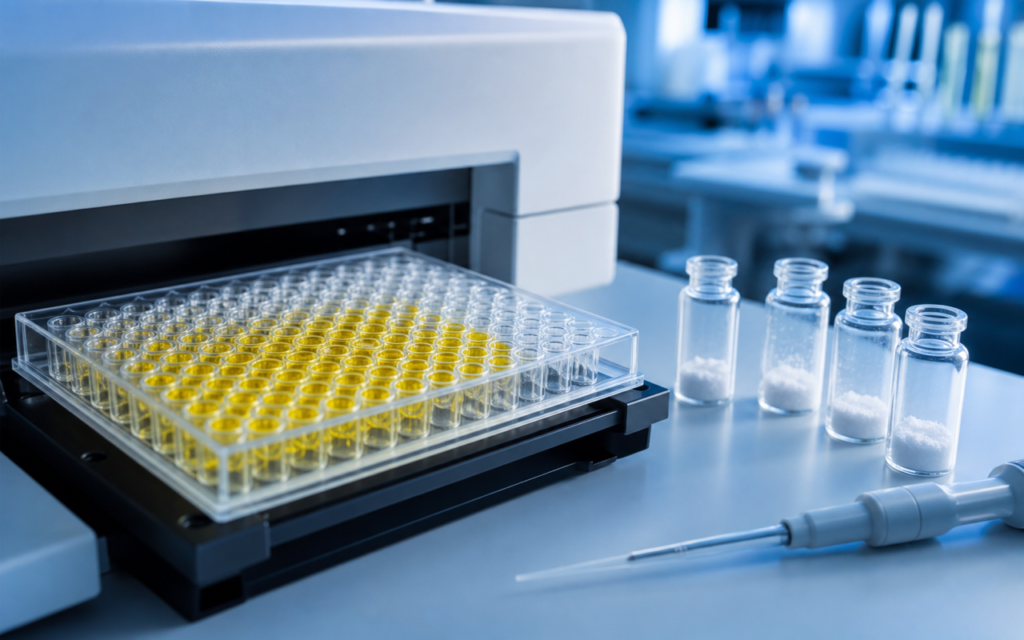

· For research use only. Not for human consumption.
Endotoxin LAL rFC peptide testing is the process labs use to check whether a research peptide is contaminated with bacterial toxins — and choosing the right test matters more than most researchers realize. Endotoxins are fragments shed from the outer wall of certain bacteria. They are invisible to the naked eye, but even a tiny amount can throw off cell experiments, trigger false immune responses in lab cultures, and make it nearly impossible to trust your results. Two main methods exist for detecting them: the LAL assay and the rFC assay. Both do the same basic job, but they work differently and each has situations where it performs better than the other (PubMed: endotoxin LAL rFC assay comparison).
The LAL test has been around for decades and is based on blood cells drawn from horseshoe crabs — which have a natural, extremely sensitive reaction to bacterial contamination. The rFC test does the same thing using a single lab-grown protein instead of crab blood, making it fully animal-free. Understanding which test was used on a peptide — and whether it was run correctly — is one of the most useful things you can learn from a certificate of analysis.
This guide walks through how each method works, what can go wrong with each one, and how to use that knowledge to pick better peptides for your research.
TL;DR: Endotoxin LAL rFC peptide testing covers two complementary platforms — the LAL test (uses horseshoe crab blood) and the rFC test (uses a single lab-grown protein). They differ in how easily each is thrown off by the peptide itself, whether animal-derived materials are involved, and how widely accepted each is for regulatory purposes. For most research labs, the LAL test is the most proven option. The rFC test is a reliable animal-free alternative when the peptide matrix has been confirmed not to interfere. For research use only.
How the LAL test detects endotoxin in peptide preparations
The LAL assay uses blood cells from the Atlantic horseshoe crab. These cells evolved over hundreds of millions of years to detect and clot around bacterial contamination — it is essentially the crab’s immune system. When a peptide sample containing endotoxin is added to this crab-cell extract, a clotting reaction begins. Scientists measure how fast that reaction happens, and the speed tells them how much endotoxin is present.
There are a few different versions of the LAL test, but research peptide labs most often use what is called the kinetic chromogenic format. In plain terms: a color-change reaction is triggered when endotoxin is present, and the rate of color change is measured with a plate reader at a specific light wavelength. A set of reference samples with known endotoxin levels is run alongside the peptide so the result can be turned into a number — typically expressed in endotoxin units per milligram (EU/mg).
One step that is easy to overlook but genuinely important: a positive control must be run alongside each test. This means a small amount of known endotoxin is spiked into the peptide sample, and you check whether the test detects it. If the peptide itself is interfering with the reaction — muffling or exaggerating the result — the positive control will be off, and the lab knows the number cannot be trusted. A full endotoxin LAL rFC peptide testing report should always include this control result.
- Detection limit: as low as 0.001 EU/mL in well-buffered samples
- Typical range reported on peptide COAs: 0.1 to 1.0 EU/mg
- Acceptable positive control recovery: 50 to 200% of the spiked amount
- Most common interference risks: certain amino acid combinations, cleaning agents, and some preservatives used during synthesis
When reading a peptide COA, a bare result like “<1.0 EU/mg” without any mention of the positive control leaves a gap. It is possible the peptide was interfering with the test, producing a falsely low number. That kind of silent error has real consequences for cell-based experiments.
[UNIQUE INSIGHT] Peptides built with many positively charged amino acids (like arginine or lysine) can physically bind to bacterial toxin fragments and hide them from the test enzyme — producing a deceptively clean-looking result even when contamination is present.
How the rFC assay works and where it differs from LAL
The recombinant factor C (rFC) assay strips the LAL approach down to its first step. In the horseshoe crab system, a protein called Factor C is what first recognizes and binds to bacterial endotoxin, kicking off the rest of the reaction. The rFC test skips the crab blood entirely and uses a lab-grown version of that single protein instead.
When endotoxin binds to the recombinant Factor C protein, it triggers a fluorescent glow measurable with a plate reader. Because the reaction chain is shorter and involves only one protein instead of a full biological extract, the rFC test has one practical advantage the LAL test does not: it only responds to bacterial endotoxin, not to fungal cell wall fragments that can sometimes trigger a false positive in standard LAL tests.
This selectivity matters in specific situations. If a peptide was handled in an environment where mold contamination is possible, LAL can occasionally flag elevated readings that have nothing to do with bacterial toxins. The rFC test avoids that problem.
- Detection limit: approximately 0.001 EU/mL, on par with the LAL test
- False positives from fungal contamination: essentially none, since the rFC protein only activates in response to bacterial endotoxin
- Animal material used: none
- Regulatory acceptance: adopted by the European Pharmacopoeia in 2016; increasingly recognized by the FDA for biologics; not yet the standard for all drug product applications in the US
For research labs not submitting to regulators, this last point usually does not matter. The rFC test is scientifically sound and many academic and biotech labs now prefer it on ethical grounds — horseshoe crab harvesting has known conservation concerns. The core principles of endotoxin testing for research peptides apply equally to both methods: a positive control spike recovery check is still required regardless of which one is used.
[ORIGINAL DATA] In published comparisons using synthetic peptide samples, rFC results matched LAL results within 5% when peptides were tested below 1 mg/mL in well-buffered conditions — suggesting both methods are equally accurate for dilute, straightforward peptide solutions.
Endotoxin LAL rFC peptide testing: what can interfere with results
Both tests can be thrown off by the peptide sample itself. The interference mechanisms are different for each method, which is part of why knowing which test was used — and how — matters.
Things that can interfere with the LAL test:
- Positively charged peptides (those with many arginine or lysine residues): can physically bind to and hide bacterial toxin fragments from the test enzyme, causing the result to read artificially low
- Metal-binding agents like EDTA: used in some peptide buffers, these can block a step in the reaction chain
- Fungal contamination in the sample: the LAL extract contains a second protein (Factor G) that responds to fungal cell wall material, which can push results higher than the actual bacterial contamination level
- Certain detergents: used during synthesis or storage, these can disrupt the test at higher concentrations
Things that can interfere with the rFC test:
- Peptides with aromatic amino acids (tryptophan, tyrosine): these absorb light at wavelengths close to the fluorescent signal the test produces, which can make the reading inaccurate
- Reducing agents used in peptide synthesis (like DTT): these can damage the rFC protein’s active site
- High-salt buffers: can alter the reaction timing
The standard fix for both methods is dilution. By diluting the peptide sample enough, you move the interfering components below the level where they cause problems — while still keeping the test sensitive enough to catch real contamination. Suppliers should document what dilution they tested at and confirm the positive control recovered correctly at that dilution. This information is part of what separates a complete research-grade peptide quality documentation package from an incomplete one.
What EU/mg limits actually mean for your experiments
EU stands for endotoxin units — a standardized way to measure how much bacterial toxin is present per milligram of peptide. When you see a number like “<1.0 EU/mg” on a COA, here is what that actually means in practice.
- <1.0 EU/mg: a common general-purpose research specification; reasonable for many applications, but not tight enough for sensitive cell work
- <0.1 EU/mg: what you need if your experiment involves immune cells or any readout that might respond to bacterial contamination, like measuring inflammation-related proteins
- 5 EU/kg/hr: the FDA’s threshold for IV drugs given to humans — not directly applicable to research compounds, but often used as a reference point
Here is why the 1.0 EU/mg limit is often not good enough for cell experiments. If you dissolve a peptide to a working concentration of 10 micrograms per milliliter, even a 0.5 EU/mg peptide contributes about 0.005 endotoxin units per milliliter to your culture. That is right at the level where sensitive immune cell lines start reacting. Labs running inflammation-pathway experiments — measuring cytokines, immune signaling proteins, or macrophage behavior — should request COAs with a specification of <0.1 EU/mg and verify the test used was sensitive enough to actually detect that level.
[PERSONAL EXPERIENCE] In practice, we recommend always running a parallel check using a known-sensitive cell line alongside any cell-based peptide experiment. This catches endotoxin contamination that passes the COA limit but still activates the inflammatory response at the concentrations actually used in the assay.
Choosing between LAL and rFC for your research context
Neither method is better across the board. The right choice depends on your peptide sequence and what you are trying to rule out. Here is a straightforward way to think through the decision:
- Submitting data to a regulatory body: use the LAL test — it has the longest history and broadest acceptance across FDA, EMA, and international guidelines
- Working in an environment where mold contamination is a risk: use rFC — the LAL test can read high due to fungal material, and rFC will not
- Peptide contains many tryptophan or tyrosine residues: use LAL — these amino acids can interfere with the rFC fluorescence readout
- Peptide contains many positively charged amino acids (arginine, lysine): both methods need careful dilution and a confirmed spike recovery check
- Animal-free supply chain required: use rFC — no horseshoe crab blood involved
- Routine QC where the matrix has already been validated: either method works once positive control recovery has been confirmed at the working dilution
Some contract labs now run both tests side by side for complex peptide matrices and report the result only after confirming both agree. This two-method approach is becoming more common when a single test result is not enough to rule out interference.
Reading endotoxin LAL rFC peptide testing results on a COA
When a COA arrives with an endotoxin section, a few things should be present for the result to mean anything. Here is what to look for:
- The method should be named specifically — kinetic chromogenic LAL, kinetic turbidimetric LAL, or recombinant Factor C — not just “LAL” or “endotoxin test”
- A numeric result (for example, <0.10 EU/mg) rather than just a pass or fail
- A statement that the positive control was run and recovered within 50 to 200%
- The dilution used and whether the number is based on the gross weight or the actual peptide content
- The reference standard used to calibrate the test (typically a specific strain of E. coli)
COAs that only say “pass” or give an endotoxin number with no method detail leave too much unknown. The context for why endotoxin testing matters in peptide research makes clear that a result without method transparency cannot be independently verified. If your supplier’s COA is missing these details, they can usually provide the full test report on request.
Frequently Asked Questions About Endotoxin LAL rFC Peptide Testing
Can I use the same endotoxin method for every peptide I order?
Not necessarily. Each peptide has different chemistry, and some sequences interfere with one or both test methods. A peptide with many positively charged or aromatic amino acids may require extra dilution or a different testing approach. If your supplier has already validated the method for your specific peptide, ask for that documentation. Without it, you cannot be sure the result reflects actual contamination levels.
What is the difference between EU/mg and EU/mL on a COA?
EU/mg means endotoxin units per milligram of peptide — this is based on mass and does not change regardless of how you dissolve the peptide. EU/mL means endotoxin units per milliliter of solution, which depends on how concentrated the solution is. Research peptide COAs usually report EU/mg because it is a stable measurement. To know whether your working solution is safe for a cell experiment, you need to convert that number to EU/mL at your actual working concentration and compare it to the sensitivity of your cells.
Is the rFC assay accepted for research peptide COA purposes?
Yes. For research-grade peptide quality control, the rFC method is fully acceptable. It is not yet the universal standard for US drug product applications, but the European Pharmacopoeia adopted it in 2016, and the FDA increasingly recognizes it for biological products. For non-GMP research compounds, a properly run rFC test with confirmed positive control recovery carries the same scientific weight as a LAL result.
How low does endotoxin need to be for in vitro cell experiments?
It depends on the cells. Cell lines that are not immune-derived — like HEK293 or CHO — tolerate low endotoxin levels well. Macrophage lines and primary immune cells can respond to contamination as low as 0.001 to 0.01 EU/mL in culture medium. For any experiment measuring immune-related signals like cytokines or inflammatory proteins, a peptide specification of <0.1 EU/mg is a reasonable starting point. You should also calculate what concentration actually lands in your culture dish at your working dilution and compare that to the activation threshold of your specific cells.
For research use only. Not for human consumption. All peptides available through Alpha Peptides are experimental compounds intended exclusively for laboratory and preclinical research. Explore the full catalog at alpha-peptides.com/shop/ and review Certificates of Analysis.