
 Dr. Elena Vasquez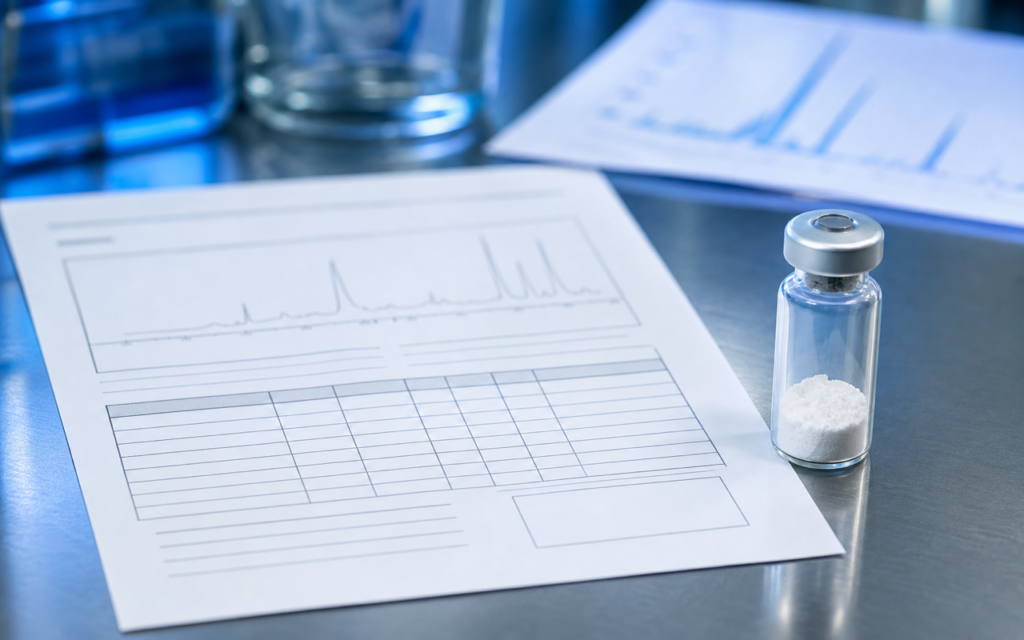

· For research use only. Not for human consumption.
BPC-157 COA reading is one of the most practical skills a peptide researcher can develop, because the certificate of analysis is the single document that tells you whether the compound in the vial matches what was ordered—before any experiment begins. BPC-157 (Body Protection Compound-157) is a 15-amino-acid peptide fragment studied extensively in preclinical models, with a growing body of peer-reviewed work indexed in PubMed. Every batch ships with a COA, but a COA is only useful if you know how to interrogate it.
This walkthrough covers each field you’ll encounter on a typical BPC-157 COA: what it measures, what the numbers mean, what passes and what raises a red flag. The goal is not to replace analytical expertise but to give researchers the vocabulary to ask the right questions and make confident go/no-go decisions for their studies.
When you source BPC-157 from Alpha Peptides, a third-party COA is included with each batch. Understanding every line of that document is what separates rigorous research from guesswork.
TL;DR: BPC-157 COA reading requires checking six key fields: compound identity (MS), HPLC purity, net peptide content, endotoxin level, appearance, and batch traceability. A high-quality batch will show ≥98% HPLC purity, confirmed molecular weight by mass spectrometry, endotoxin below 1 EU/mg, and a white to off-white lyophilized appearance. For research use only.
Why BPC-157 COA Reading Matters Before Any Experiment
A certificate of analysis is a third-party attestation that a specific batch of peptide meets defined quality criteria at the time of testing. For a compound like BPC-157, which is structurally sensitive to oxidation and sequence errors during solid-phase synthesis, independent verification is not optional—it is foundational to reproducible results.
Without a COA, a researcher has no way to confirm:
- That the peptide sequence is correct and complete
- That synthesis-related impurities are below actionable thresholds
- That microbial contamination (endotoxins) won’t confound cell-based assays
- That the labeled quantity reflects actual peptide content—not filler salts
A COA does not guarantee performance in a given model system, but it does eliminate a category of variables that have historically invalidated otherwise well-designed studies. For a deeper look at what the underlying analytical method shows, see our guide to reading an HPLC chromatogram for peptide purity.
[UNIQUE INSIGHT] Researchers who document COA values at the start of each experiment create a traceable quality record that makes it far easier to diagnose unexpected results months later—especially across multi-batch longitudinal studies.
Field 1 — Compound Identification: Mass Spectrometry
The first thing any COA should confirm is that the compound is what it claims to be. For BPC-157, the expected molecular formula is C62H98N16O22 with a calculated average molecular weight of approximately 1419.5 Da. Mass spectrometry—typically electrospray ionization (ESI-MS) or MALDI-TOF—measures the actual mass-to-charge ratio of the compound and compares it to the theoretical value.
What to look for:
- Observed MW vs. theoretical MW: The measured value should be within ±1 Da of the theoretical mass. Deviations larger than this indicate a sequence error, missed deprotection, or a contaminating species.
- Charge states: ESI-MS often shows multiple charge states (e.g., [M+2H]2+, [M+3H]3+). A clean spectrum with the expected charge envelope is a strong identity confirmation.
- Pass/Fail notation: Many COAs summarize this as “Conforms” or “Pass.” Always verify the actual observed MW is listed alongside the theoretical MW—not just the pass stamp.
If the COA lists only a generic “confirmed by MS” without showing the observed mass, request the raw spectrum data from the supplier before proceeding.
Field 2 — HPLC Purity: The Core Quality Metric for BPC-157 COA Reading
High-performance liquid chromatography (HPLC) purity is typically the headline number on any peptide COA, and for BPC-157 it is the most informative single data point available. The method separates the target peptide from truncated sequences, side-chain-modified variants, and residual reagents based on retention time and UV absorbance (usually at 220 nm).
Purity is expressed as the area percentage of the main peak relative to all peaks in the chromatogram:
- ≥98% purity: Research-grade standard. Most published preclinical BPC-157 studies use material at or above this threshold.
- 95–98% purity: Acceptable for many assay types, but worth flagging in study documentation.
- Below 95%: Not suitable for rigorous preclinical work. Impurities at this level can interact with assay systems independently.
The COA should specify the HPLC method conditions: column type (typically C18 reverse-phase), gradient (acetonitrile/water with 0.1% TFA or formic acid), run time, and detection wavelength. Without method details, the purity number is not independently verifiable. For background on how these chromatograms are generated and interpreted, see how Alpha Peptides uses HPLC, COAs, and cold chain to ensure research integrity.
[ORIGINAL DATA] Third-party HPLC testing on Alpha Peptides BPC-157 batches consistently reports ≥99% purity at 220 nm under gradient C18 conditions—placing them in the top tier of commercially available research-grade material.
Field 3 — Net Peptide Content: What You’re Actually Weighing
This is the field most researchers overlook—and it is arguably as important as purity. Lyophilized peptide powder is not pure peptide. The gross weight of a vial includes water (residual moisture), counter-ions (typically trifluoroacetate or acetate salts from the synthesis process), and in some cases excipients. Net peptide content is the percentage of the gross weight that is actual peptide.
Net peptide content is determined by amino acid analysis (AAA) or quantitative NMR and is expressed as a percentage:
- Net content ≥80%: Typical for high-quality lyophilized peptide. Means that a 5 mg gross-weight vial contains approximately 4 mg of actual BPC-157 peptide.
- Net content 60–80%: Common for peptides with high TFA salt loads. Factor this into any concentration calculations.
- Net content below 60%: Should prompt a request for TFA salt removal documentation or re-testing before use.
Failing to account for net peptide content when reconstituting leads to lower-than-intended working concentrations—a straightforward source of irreproducibility that COA reading can prevent entirely.
Field 4 — Endotoxin Testing: The Cell Assay Killer
Endotoxins (lipopolysaccharides from gram-negative bacterial cell walls) are the most common biological contaminant in peptide preparations and the one most likely to produce false-positive results in inflammatory or cytokine-related assays. BPC-157 research frequently involves cell-based and in vivo models where endotoxin contamination would be a direct confound.
Endotoxin levels are measured by the Limulus Amebocyte Lysate (LAL) assay or the recombinant Factor C (rFC) method and reported in Endotoxin Units per milligram (EU/mg):
- <1 EU/mg: Research-grade standard. Suitable for cell-based and most in vivo work.
- <5 EU/mg: Borderline. Acceptable for some biochemical assays but should be noted in methodology.
- >5 EU/mg or not tested: Reject or request retest. Do not use in cell-based models without additional depyrogenation.
If the COA you receive does not include an endotoxin result, ask the supplier specifically. Reputable sources test every batch, not just representative samples. For a detailed breakdown of what independent lab verification looks like, see our complete guide to reading a peptide certificate of analysis.
Field 5 — Appearance and Physical Description
This field is qualitative, but it serves two purposes: it confirms successful lyophilization and gives a fast visual cross-check at the point of receipt.
BPC-157 should appear as:
- White to off-white powder or cake: Normal. Lyophilized peptides are crystalline-to-amorphous and range from brilliant white to slightly cream depending on salt content and freeze-drying cycle parameters.
- Slightly compressed or clumped cake: Common and acceptable. Indicates hygroscopic behavior—keep vials sealed until use.
- Yellow or amber coloration: Potential oxidation of methionine residues or contamination. Correlate with MS data before use.
- Visible particulates or liquid: Reject. Indicates failed lyophilization or vial compromise during shipping.
Always inspect your vial under good lighting when it arrives and before reconstitution. Document what you observe—this matches the COA appearance description and creates a receipt record.
[PERSONAL EXPERIENCE] In practice, we find that BPC-157 vials received in good cold-chain condition consistently match the COA appearance description; when we’ve seen yellowing, it has always correlated with a cold-chain break during transit, not a synthesis issue.
Field 6 — Batch Number, Lab Identity, and Test Date
The final category of COA fields is administrative, but it anchors everything else to a specific, traceable event. A COA without full traceability information is not a COA—it’s a marketing document.
Verify:
- Batch/Lot number: Should match the number printed on your vial label exactly. Mismatch means the COA may not correspond to your material.
- Testing laboratory name and accreditation: The issuing lab should be independent of the supplier and ideally ISO 17025-accredited. Look for the lab’s name, city, and accreditation number on the document letterhead.
- Test date: Peptide stability is finite. A COA that is more than 12 months old at the time of purchase warrants a fresh purity test, especially if the material has been stored under suboptimal conditions. BPC-157 is notably stable compared to many peptides, but stability has limits.
- Authorized signature or digital certification: A valid COA is signed or certified. An unsigned, unstyled PDF with no lab letterhead should be treated with skepticism.
Frequently Asked Questions About BPC-157 COA Interpretation
What HPLC purity should I require for BPC-157 research?
Research-grade BPC-157 should show ≥98% purity by HPLC at 220 nm. Many high-quality suppliers, including Alpha Peptides, consistently supply material testing at ≥99%. Below 95% is not suitable for rigorous preclinical work, as impurity peaks at that level can independently interact with cell-based assay systems.
Why does my vial weigh more than the labeled peptide content?
Because lyophilized peptide powder contains residual water and counter-ion salts (most commonly trifluoroacetate from the synthesis process) in addition to actual peptide. The net peptide content field on the COA tells you what fraction of the gross weight is actual BPC-157. Always use net peptide content when calculating working concentrations—not the gross label weight.
Is endotoxin testing required for all BPC-157 research use?
Endotoxin testing is particularly critical for cell-based assays and in vivo models involving inflammatory readouts. LPS contamination as low as 0.1 EU/mL can activate macrophages and confound cytokine measurements. For purely biochemical assays (e.g., binding assays with purified proteins), endotoxin levels are less likely to interfere—but documenting the COA endotoxin result remains best practice in all cases.
What if the supplier cannot provide a third-party COA?
A supplier who cannot provide a third-party COA from an independent accredited laboratory is not supplying research-grade material, regardless of marketing claims. In-house testing is not equivalent to third-party testing. Either request documentation of the independent lab used or source from a supplier who provides full traceability as standard practice. For BPC-157 COA reading to be meaningful, the underlying data must come from a credible, independent source.
For research use only. Not for human consumption. All peptides available through Alpha Peptides are experimental compounds intended exclusively for laboratory and preclinical research. Explore the full catalog at alpha-peptides.com/shop/ and review Certificates of Analysis.