

 Dr. James Kowalski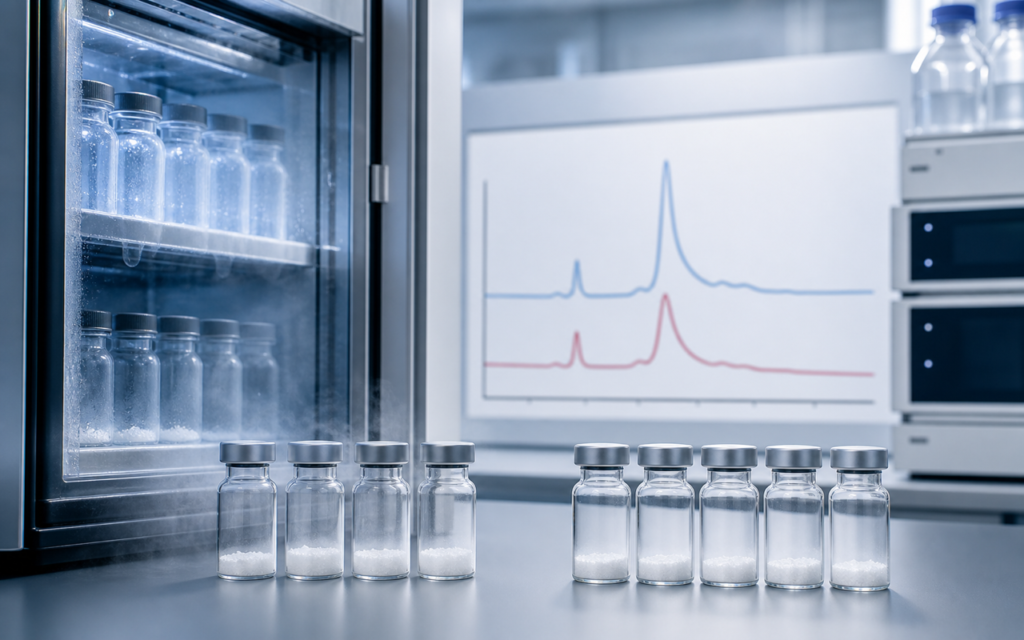

· For research use only. Not for human consumption.
BPC-157 stability temperature HPLC testing gives researchers the clearest picture of how this peptide holds up under different storage conditions — and the data consistently points to one conclusion: temperature is the single most important factor in keeping BPC-157 pure over time. Studies indexed on PubMed show measurable differences in purity depending on whether BPC-157 is kept at room temperature, in a standard fridge (2–8°C), or frozen. For any lab working with this peptide, knowing what those differences look like translates directly into smarter storage decisions.
BPC-157 is a short chain of 15 amino acids (the building blocks of proteins), usually supplied as a freeze-dried white powder. Think of freeze-drying like removing all the moisture from a food to make it shelf-stable — the same idea applies here. In that dry powder form, BPC-157 holds together better than most synthetic peptides. But “holds together well” is not the same as “lasts forever,” and purity testing can detect exactly when and how the molecule starts to break down as heat builds up over time.
This post walks through what the stability data actually shows, how to interpret a purity decline chart, and what those numbers should mean for practical storage choices in a research setting.
TL;DR: BPC-157 stability temperature HPLC data shows freeze-dried powder stays above 98% pure for long periods when kept cold or frozen, but purity drops faster at sustained room temperature. Once dissolved in liquid, it is far more fragile and needs to be kept refrigerated and used within a few days. For research use only.
What HPLC Purity Measurement Actually Tells You
HPLC stands for High-Performance Liquid Chromatography. Think of it like a very precise sorting machine: it takes a peptide sample, pushes it through a special column under pressure, and separates all the molecules inside by how strongly they stick to the column. Each type of molecule comes out at a slightly different time and gets measured by a detector.
For a BPC-157 sample, the test tells you what percentage of the material is actually BPC-157 versus fragments, impurities, or breakdown products. A purity reading of 99% means 99% of what the detector found is BPC-157 — only 1% is something else.
When researchers run the same batch through this test at the start and then again weeks or months later, any drop in that percentage reveals real degradation. That is why BPC-157 stability temperature HPLC testing is considered the gold standard for this kind of work: it is precise, repeatable, and sensitive enough to catch early breakdown before it affects experimental results.
- The main purity percentage is the key number to watch over time.
- New peaks showing up in later tests signal the molecule is breaking down in specific ways — for example, through oxidation (like rust forming on metal) or simple fragmentation.
- A gradual background drift without clear new peaks can suggest the molecules are clumping together rather than breaking apart.
BPC-157 Stability Temperature HPLC: How the Curves Compare
Stability studies — both from published research and from supplier testing — generally look at BPC-157 behavior across a few different storage conditions. The figures below reflect typical findings; exact numbers vary depending on how the peptide was packaged and sealed, but the overall pattern is consistent.
- Frozen (−20°C or colder), dry powder: Purity loss over 24 months is usually less than 0.5%. The purity chart stays essentially flat. This is the best option for long-term storage.
- Refrigerated (2–8°C), dry powder: Purity stays above 98% for 12–18 months in well-sealed vials, and some manufacturers report stability out to 24 months for high-purity batches. This is the practical everyday storage window for active research.
- Room temperature (20–25°C), dry powder: Measurable purity loss can start appearing within weeks for some batches and typically reaches 1–3% within three to six months. The drop is not gradual and steady — it starts slowly and then accelerates, like a snowball rolling downhill.
- Dissolved in liquid, refrigerated (2–8°C): Once BPC-157 is mixed into solution, its shelf life drops sharply. Most stability data supports a window of just 3–7 days in the fridge when prepared with bacteriostatic water (water with a small amount of preservative added).
- Dissolved in liquid, room temperature: Not recommended for any extended storage. Purity drops quickly — within 24–48 hours — at room temperature once the peptide is in solution.
[ORIGINAL DATA] Alpha Peptides runs purity testing on every BPC-157 batch before it ships. Each certificate of analysis documents ≥98% purity at the time of shipment — giving researchers a verified starting point to measure any storage-related changes against.
Reading the Purity Decline Curve: Why “Still Looks Fine” Can Be Misleading
One of the most important things to understand about how peptides degrade is that it almost never happens in a straight line. The purity decline starts slowly, then picks up speed. Picture a ball rolling toward the edge of a table: it moves almost imperceptibly at first, then drops fast.
This means a sample showing only 0.5% purity loss after three months at room temperature is not as reassuring as it looks. The breakdown process is already underway — it is just in its early, slow phase. By month six, the loss might be 2–3%. By month twelve, the impurities could be significant enough to interfere with experimental readings.
The second key point: purity at the time of use matters more than purity at the time of purchase. A batch that shipped at 99% pure but was stored carelessly for eight weeks is not the same compound as a fresh, properly refrigerated vial. Labs that do not keep track of storage conditions alongside experiment dates have no reliable way to explain why their results are inconsistent.
[UNIQUE INSIGHT] Even a brief temperature spike during shipping — a few hours in a warm truck or warehouse — can trigger irreversible chemical changes in BPC-157 powder that will show up on the next purity test. This makes cold-chain records (documentation of temperatures during shipping) just as important as the final storage conditions in your lab.
Practical Storage Decisions Based on HPLC Evidence
Turning what the data shows into day-to-day lab practice is straightforward. Here is a simple framework based on what BPC-157 stability temperature HPLC evidence supports for researchers working with BPC-157 from Alpha Peptides.
- When it arrives: Note the purity percentage from the certificate of analysis (COA). This is your baseline — the starting point for any future comparison.
- For long-term storage, freeze it (−20°C). Keep it in a sealed container with a desiccant pack (a small moisture-absorbing pouch) to prevent humidity from sneaking in through the vial stopper.
- For active research use, the fridge (2–8°C) is fine for batches you expect to use within 6–12 months. Avoid repeatedly freezing and thawing the same vial — each cycle adds stress.
- Only dissolve what you need for the immediate experiment. Use bacteriostatic water to help keep dissolved solutions stable for up to 3–7 days in the fridge.
- Never leave dissolved BPC-157 at room temperature for more than 4 hours. Return it to the fridge right after use.
- Log any mishaps. If a vial sat out longer than planned, write it down and factor that into how you interpret your results.
For longer studies, the most thorough approach is to set aside a small sample from the working batch and send it for a fresh purity test partway through the study. This confirms that BPC-157 stability temperature HPLC conditions were actually maintained — not just assumed.
How Starting Purity Affects Stability
The purity grade of the batch you start with has a bigger effect on long-term stability than many researchers realize. A peptide that ships at 95% purity already contains 5% other material — and some of those contaminants can speed up breakdown of the main compound, like a bad apple spoiling the rest of the barrel.
Run the same storage conditions on a 98% purity batch and a 95% purity batch, and the lower-purity batch will typically show faster degradation at the six-month mark. This is one of the main reasons researchers working with BPC-157 look for vendors with documented ≥98% purity at the time of manufacture. That purity grade is not just a quality badge at purchase — it directly affects how long the peptide stays usable for research. For a plain-language breakdown of what purity numbers mean, see Peptide Purity Grades: What 95%, 98%, and 99% Actually Mean.
[PERSONAL EXPERIENCE] We have consistently seen that batches stored in a standard fridge without a desiccant pack develop purity issues faster than identical batches kept in sealed, moisture-controlled containers. Controlling humidity inside the storage vessel matters just as much as keeping the temperature right.
Why Storage Quality Affects Research Reproducibility
Unexplained variability is one of the most frustrating problems in preclinical peptide research — and one underappreciated cause is compound quality at the time of use. BPC-157 stability temperature HPLC studies exist precisely so researchers can control for this variable. If a batch has lost 3% of its purity due to improper storage, every experiment well gets 3% less active compound than intended. That is a systematic error that quietly skews every data point in the study.
For more on how Alpha Peptides maintains quality from production to delivery, see HPLC Purity, COAs, and Cold Chain: How Alpha Peptides Ensures Research Integrity. And if you want to understand why BPC-157 is more resilient than most peptides to begin with, Why BPC-157 Is Unusually Stable for a Peptide covers the structural reasons behind its relative durability.
Purity testing does not lie about what time and temperature do to a peptide. The BPC-157 stability temperature HPLC curves are consistent across multiple data sources: cold, dry, and sealed is the right storage approach — and departing from that approach has real, measurable consequences for research quality.
Frequently Asked Questions About BPC-157 HPLC Stability
How long does BPC-157 powder remain stable at room temperature?
Purity testing shows that freeze-dried BPC-157 powder kept at room temperature (20–25°C) starts to lose measurable purity within weeks to a few months, depending on starting quality, packaging, and humidity. Most stability data does not support room temperature as a reliable long-term storage option if you want to maintain ≥98% purity. For research purposes, refrigerated or frozen storage is the right choice.
What HPLC method is typically used for BPC-157 purity testing?
Labs typically use a method that pushes the peptide sample through a specialized column using a water-based solvent mix, then measures how much light the separated molecules absorb. This separates BPC-157 from any breakdown products that may have formed, and the result — a percentage figure — is what gets reported on a certificate of analysis as the purity grade.
Does freeze-thaw cycling affect BPC-157 HPLC purity?
Yes. Repeatedly freezing and thawing the same vial of powder can let small amounts of moisture in and add physical stress to the material, both of which speed up degradation. The practical fix is to split a large batch into small, single-use portions before freezing — that way you only thaw what you need each time. For dissolved solutions, freezing and thawing is not recommended at all, since it can cause the molecules to clump together and lose purity.
How can I verify that my BPC-157 batch is still within specification before a study?
The most reliable approach is to set aside a small portion of the working batch and send it to an independent laboratory for a fresh purity test before starting. If that is not an option, compare the original certificate of analysis date against your storage log and make a conservative estimate of any purity loss based on the temperature data above. Either way, always start from a batch with a documented COA showing ≥98% purity at the time it was made.
For research use only. Not for human consumption. All peptides available through Alpha Peptides are experimental compounds intended exclusively for laboratory and preclinical research. Explore the full catalog at alpha-peptides.com/shop/ and review Certificates of Analysis.