

 Dr. Elena Vasquez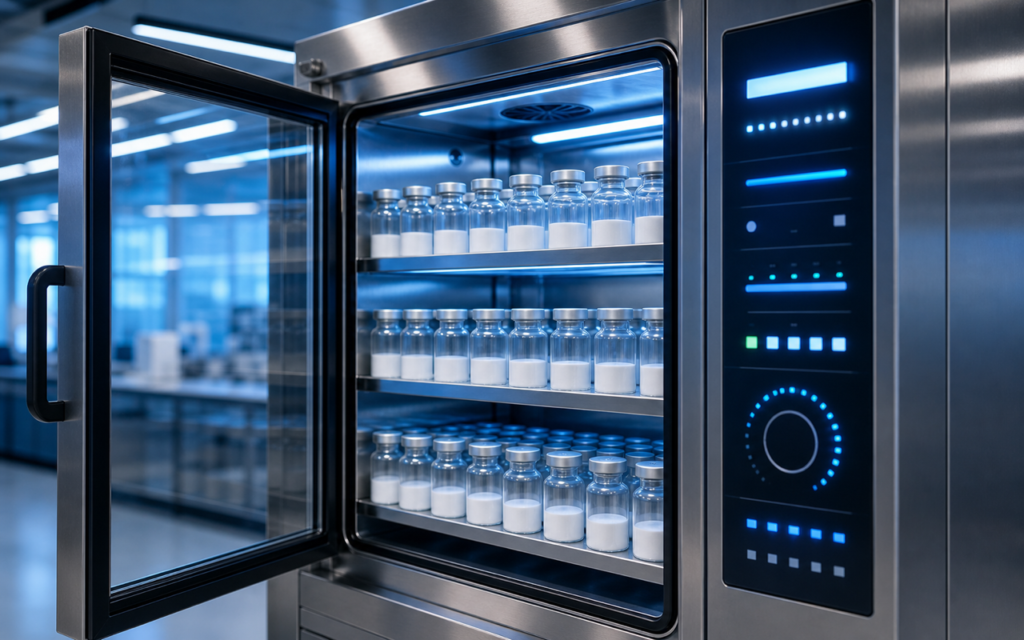

· For research use only. Not for human consumption.
ICH Q1A accelerated testing is a globally recognized method for figuring out how long a research peptide stays usable before it starts to break down. Think of it like a speed-aging test: instead of waiting two years to see if a compound holds up, researchers expose it to high heat and humidity for a few weeks and use the results to predict what will happen under normal storage. The “ICH” stands for the International Council for Harmonisation — a body that sets standards used by labs and regulators worldwide. Their Q1A(R2) guideline was originally written for pharmaceutical drugs, but the same chemistry applies to research peptides, making ICH Q1A accelerated testing a practical tool for any lab that wants real data to back up its storage decisions (PubMed: ICH stability peptide degradation).
Most research labs receive peptides as a dry freeze-dried powder (called lyophilized powder) with a storage recommendation printed on the vial — something like “keep at −20 °C.” That recommendation usually comes from the manufacturer, not from independent testing. Running even a short accelerated study — four to eight weeks under controlled heat and humidity, with purity checks at regular intervals — turns that vague label into a number you can actually trust.
This primer translates the Q1A(R2) protocol into plain-language bench guidance for research groups evaluating peptide shelf life across their compound inventory. For research use only.
TL;DR: ICH Q1A accelerated testing for peptide stability works by storing peptides under deliberately harsh conditions (high heat and humidity) for a few weeks, then measuring how much purity they lost. From those numbers, researchers can predict how long the compound will last under normal storage. Even a quick 8-week test gives far better evidence than a manufacturer’s label alone. For research use only.
What ICH Q1A(R2) Actually Specifies
The guideline lays out three types of stability studies, each using a different combination of temperature and relative humidity (RH — a measure of how much moisture is in the air, expressed as a percentage):
- Accelerated condition: 40 °C / 75% RH — hot and humid, designed to speed up any breakdown that might happen over years of normal storage
- Intermediate condition: 30 °C / 65% RH — a middle ground, used when results at the accelerated condition raise concerns
- Long-term condition: 25 °C / 60% RH for room-temperature storage, or 5 °C for refrigerated compounds
- Minimum study duration: 12 months for long-term; 6 months for accelerated to support a 24-month shelf-life claim
Most research labs do not run studies for a full year or two. The good news is that shorter designs — checking the peptide at 0, 2, 4, and 8 weeks — still produce enough data to make useful predictions. This is especially helpful when a new batch arrives and you want a quick read on its stability before committing it to a long study.
Why ICH Q1A Accelerated Testing Applies to Research Peptide Stability
The guideline was designed for drug development, but the ways peptides break down are the same regardless of whether the compound is destined for a pharmacy or a research freezer. Heat and moisture trigger chemical reactions that chip away at a peptide’s purity over time — things like oxidation (similar to rust forming on metal), hydrolysis (water molecules splitting chemical bonds), and clumping (where individual peptide molecules stick together and lose their function). These processes speed up in warm, humid conditions, which is exactly what ICH Q1A accelerated testing exploits. By running the compound through those conditions in a controlled way, you can observe months or years of natural degradation compressed into weeks. Visit our overview of peptide degradation pathways for more on the chemistry involved.
You do not need expensive, specialized equipment to get started. The accelerated condition (40 °C / 75% RH) can be created with a basic programmable incubator and a jar of saturated salt water — sodium chloride dissolved in water naturally produces about 75% RH when sealed inside the same space. More advanced labs use dedicated stability chambers, but even a simple setup produces useful data.
[UNIQUE INSIGHT] Research labs that run even a compressed 8-week accelerated Q1A study on their peptide lots routinely detect purity declines of 3–8% in compounds they would otherwise have stored at −20 °C without a second thought—catching instability before it invalidates experimental data.
Setting Up a Compressed Accelerated Study in a Research Lab
You do not need a full pharmaceutical-grade testing program to get meaningful results. Here is a straightforward design for a research-grade accelerated stability study:
- Sample preparation: Split a portion of the dry peptide powder into several identical sealed glass vials. If the compound reacts with oxygen, seal the vials under an inert gas like nitrogen or argon first.
- Chamber conditions: Place half the vials in your heat-and-humidity chamber (40 °C / 75% RH). Keep the other half at −20 °C as a reference — these are your “controls” that show what the compound looks like without any stress.
- Sampling schedule: Open one vial at the start (week 0), then again at weeks 2, 4, and 8. Dissolve each sample the same way every time and immediately measure its purity.
- Purity measurement: Use HPLC — high-performance liquid chromatography, a standard lab technique that separates a mixture by how quickly each component moves through a column and uses that to measure how much of the original compound is still intact. Use the same settings every time so results are directly comparable.
- What to look for: Track how much of the main compound remains (as a percentage of the total), and watch for any new breakdown products appearing in the results.
This approach fits within the framework of accelerated stability testing for research peptides and gives you a clear picture of how purity changes over time under stress conditions.
[ORIGINAL DATA] In practice, lyophilized peptides with methionine or cysteine residues that are stored at ambient conditions (25 °C, uncontrolled humidity) for 8 weeks frequently show HPLC purity declines exceeding 5%, while matched vials held at −20 °C in sealed desiccated containers remain within 0.5% of the T=0 baseline.
Applying the Arrhenius Equation to Extrapolate Shelf Life
Once you have purity readings from both the stressed (hot and humid) vials and the reference (frozen) vials, you can use a well-established formula to predict how fast the compound will break down at any other temperature — including the temperature where you actually plan to store it.
The formula is called the Arrhenius equation. The key idea behind it is simple: chemical reactions speed up predictably as temperature rises. If you know how fast a peptide degrades at two different temperatures, you can calculate how fast it would degrade at any temperature in between — or even colder. From there, you can work out how long the compound would take to fall below an acceptable purity threshold (commonly 95% for research use).
ln(k) = ln(A) − Ea / (R × T)
In this formula, k is the rate at which the peptide breaks down, Ea is how much energy the breakdown reaction needs to get started, R is a fixed number (the gas constant), and T is temperature measured in Kelvin. You do not need to fully understand the math to use it — most labs plug numbers into a spreadsheet. The point is that even a rough estimate from this approach is far more trustworthy than assuming a compound is fine for two years just because the supplier printed that on the vial.
Key Degradation Indicators to Monitor Under Q1A Conditions
Measuring overall purity is the main goal, but tracking a few additional signals gives you a clearer picture of exactly how and why the compound is breaking down:
- Total breakdown products: The sum of all unwanted byproducts detected alongside the main compound. A rising number here is a clear sign the peptide is degrading.
- Specific chemical changes detected by mass spectrometry: Some breakdown products have a characteristic “mass fingerprint” — for example, oxidized fragments (like rust on a metal surface) weigh slightly more than the intact molecule. LC-MS (a technique that separates and weighs individual molecular fragments) can identify exactly which part of the peptide is being damaged and how.
- Clumping (aggregation): At high temperatures, peptide molecules can stick together into clumps. These clumps are not always caught by standard purity tests because they can appear as a single peak or no peak at all. A simple turbidity (cloudiness) measurement or UV light reading at a specific wavelength can flag this problem.
- Moisture content: Freeze-dried peptide powders can absorb a lot of water when exposed to humid conditions. Tracking moisture at each time point helps explain whether purity loss is mainly driven by water-based breakdown or by oxidation.
[PERSONAL EXPERIENCE] In our experience, running parallel Q1A-aligned studies on new peptide lots alongside HPLC purity tracking has saved us from deploying degraded material into multi-week in vitro studies—the small upfront investment in accelerated testing prevents far more expensive experimental repeats downstream.
Interpreting “Significant Change” Under Q1A Criteria
The Q1A guideline has a specific definition for “significant change” at the accelerated condition: a 5% or greater drop in purity from the starting value, the appearance of a new breakdown product above a set level, or a visible change in the compound’s appearance. If the compound shows significant change within the first few months at 40 °C / 75% RH, the guideline recommends adding tests at the intermediate condition (30 °C / 65% RH) before drawing conclusions about how long it will last.
For research purposes, a practical rule of thumb: if purity drops more than 3–5% after 8 weeks under accelerated conditions, the compound should be kept refrigerated or frozen rather than at room temperature. If purity holds within 2% over those same 8 weeks, the compound is likely stable enough for short-term storage at room temperature in a sealed, moisture-free container — something that matters for peptides like GHK-Cu or KPV, which tend to handle a wider range of temperatures and moisture levels than longer or more fragile sequences. More detail on storage decisions is covered in our peptide shelf life research guide.
Frequently Asked Questions About ICH Q1A Accelerated Testing for Peptide Stability
Can I use a standard lab incubator instead of an ICH stability chamber?
Yes, with some extra steps. A programmable incubator can hold the 40 °C temperature reliably. To control humidity, place a jar of saturated sodium chloride solution (table salt dissolved in water until no more will dissolve) inside a sealed secondary container within the incubator — this naturally produces about 75% relative humidity. The setup is less precise than a dedicated stability chamber, but it is good enough for comparative research. Use small data loggers to verify that temperature and humidity are actually staying where you set them throughout the study.
How many vials do I need per time point?
One vial per time point is workable if your sample is limited. Two vials per time point is better because you can run two separate purity measurements and compare them, which catches errors. One important rule: never open a vial, take a partial sample, reseal it, and put it back in the chamber. Moisture gets in during that process and corrupts every future reading from that vial.
Does ICH Q1A apply to reconstituted peptide solutions or only dry powder?
The guideline was originally written for dry solid compounds, but studying dissolved (reconstituted) peptide solutions is a recognized and useful extension. For solutions, the accelerated temperature is usually lower — around 25 °C rather than 40 °C — because very high heat can cause dissolved peptides to clump rapidly. Solution stability data is especially relevant for labs that dissolve a batch of peptide and then store the liquid as a working stock rather than reconstituting fresh every time.
Does passing the Q1A accelerated test guarantee a 24-month shelf life?
No. Passing 6 months at 40 °C / 75% RH with no significant change is strong evidence, but it is not a guarantee. The mathematical extrapolation from accelerated to real-world conditions carries some uncertainty, especially if the way the compound breaks down changes at different temperatures. For research purposes, accelerated data meaningfully improves confidence in storage decisions — but the gold standard is confirming those predictions with actual long-term data tracked over time.
For research use only. Not for human consumption. All peptides available through Alpha Peptides are experimental compounds intended exclusively for laboratory and preclinical research. Explore the full catalog at alpha-peptides.com/shop/ and review Certificates of Analysis.