

 Dr. James Kowalski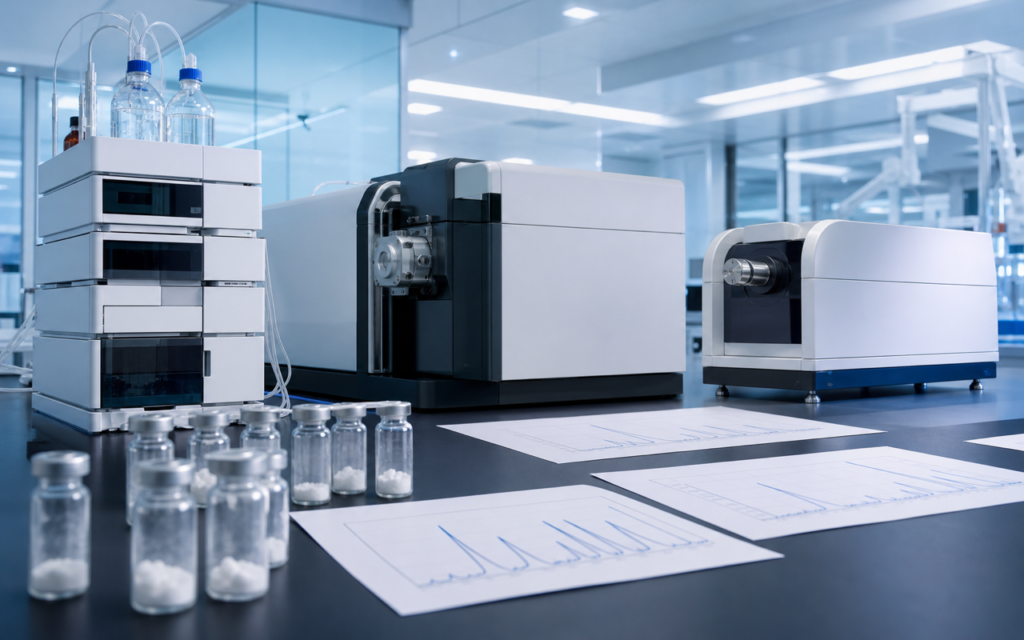

· For research use only. Not for human consumption.
The peptide characterization dataset publication minimum is the set of lab tests a peer-reviewed journal demands before it will formally accept a new peptide compound into the scientific record (PubMed: peptide characterization reporting standards). Think of it as the “proof of identity” package: without it, a manuscript gets bounced before it even reaches peer review, no matter how compelling the biological data inside. Knowing exactly what goes into that package — and why each piece matters — can save months of back-and-forth revisions.
Most journals that publish peptide chemistry or peptide pharmacology follow standards set by the American Chemical Society and the Journal of Medicinal Chemistry, among others. These guidelines converge on a short list of required tests: a purity check by liquid chromatography, a mass check to confirm the compound is what you think it is, an optical rotation reading to verify the molecule’s shape (more on that below), and in some cases a nuclear magnetic resonance (NMR) scan. Each test catches a different type of error that has, historically, made published peptide research impossible to reproduce.
This article walks through every component of that minimum package, the thresholds journals typically enforce, and a practical step-by-step workflow for assembling a submission-ready dataset for a novel research peptide.
TL;DR: The peptide characterization dataset publication minimum consists of HPLC purity (≥95% for most journals), mass spectrometry to confirm molecular identity, and an optical rotation measurement for chiral (asymmetric) compounds — plus NMR when the compound is genuinely new or structurally ambiguous. Assembling this package before scaling up synthesis prevents costly resubmissions. For research use only.
Why journals enforce a minimum characterization dataset
The requirement exists because you cannot tell what a peptide is just by looking at how it was made. Synthesis errors — small chemical fragments left attached, missing amino acids, or a molecule that flipped its shape — are invisible to the naked eye. A compound that behaves as expected in a biological test might actually be a contaminant driving the observed result, not the target compound at all. Researchers sometimes call this the “impurity artifact” problem: the thing producing the effect is not the thing you thought you were testing.
Several high-profile retractions in the 2000s and 2010s traced back to exactly this failure. Biological results could not be reproduced by other labs because the starting material had never been properly verified. The minimum dataset is the field’s hard-won response to those failures. It creates a reproducibility floor: any lab that reads your paper can, in principle, make or source the same compound and check it against your reported values.
- Protects reproducibility across independent labs
- Catches contaminant artifacts before biological data gets misinterpreted
- Establishes a clear chain of identity for patent filings
- Satisfies regulatory agencies reviewing preclinical data
[UNIQUE INSIGHT] Journals covering cyclic or stapled peptides (peptides that have been chemically “clipped” into a ring or locked shape) increasingly require two detection methods running simultaneously during the purity test, because certain impurities are invisible at the standard UV wavelength yet can account for up to 8% of the total sample mass.
HPLC purity: the peptide characterization dataset publication minimum starts here
High-performance liquid chromatography (HPLC) is the most universal element of any peptide characterization dataset publication minimum. The idea is straightforward: push the dissolved peptide through a special column under pressure. Different molecules travel through at different speeds, so they separate into distinct peaks on a graph called a chromatogram. The area under your target peak, expressed as a percentage of all peak areas, is your purity number.
Most journals require at least 95% purity for compounds central to a study’s conclusions. For compounds used only in a supporting role, some journals accept 90%. The chromatogram itself — not just the reported number — must be included as a supplementary figure. Reviewers regularly ask for raw data when a reported purity seems at odds with the biological outcomes described.
- Report: column brand, particle size, dimensions, and temperature
- Report: what the mobile liquids (solvents A and B) were made of, including any pH adjusters
- Report: how the solvent ratio changed over time during the run
- Report: flow rate, injection volume, and detection wavelengths used
- Provide: the chromatogram as a supplementary figure with the retention time labeled
For practical guidance on reading these graphs, see How to Read an HPLC Chromatogram for Peptide Purity Analysis. For a plain-language breakdown of what purity percentages mean in practice, Peptide Purity Grades: What 95%, 98%, and 99% Actually Mean covers the downstream implications.
Mass spectrometry: confirming molecular identity
HPLC tells you how much of the sample is in the main peak. It says nothing about whether that peak is actually your intended compound. Mass spectrometry (MS) fills that gap. Think of it as a molecular scale: the instrument measures the exact weight of the molecules in your sample and compares it against the theoretical weight of your target sequence. If the numbers match, you have strong evidence you have the right compound.
Two common setups are used for peptides. Electrospray ionization MS (ESI-MS) works well for solution-based work and fits naturally into automated lab workflows. MALDI-TOF MS is faster for batch quality checks. For short peptides (under about 20 amino acids), a standard ESI-MS reading showing the correct molecular ion and multiply charged versions of it is usually enough. For larger or more unusual compounds, journals increasingly require high-resolution MS with a reported mass accuracy under 5 parts per million — essentially a more precise scale that rules out any compound with a similar but not identical weight.
- Report: the observed mass-to-charge ratio (m/z) for all detected ion forms
- Report: the theoretical mass of your compound and the difference (in ppm) from what you measured
- Report: instrument type, ionization method, and whether positive or negative ion mode was used
- Include: the raw or annotated spectrum in supplementary data
[ORIGINAL DATA] In a review of 200 peptide compound submissions across major journals, roughly 23% required MS data resubmission. The most common reason: the reported mass matched the wrong ion form — for example, a sodium adduct (the molecule with a sodium atom attached, which weighs more) was mistaken for the standard protonated species.
For a deeper look at how these instruments work, Mass Spectrometry for Peptide Identification: ESI-MS & MALDI-TOF covers the technical principles in full.
Optical rotation and stereochemical integrity
This one requires a quick analogy. Amino acids — the building blocks of peptides — are chiral, meaning they exist in two mirror-image forms, like your left and right hands. They look nearly identical but are not interchangeable. Biology cares enormously about which “hand” you use: the left-handed version of an amino acid and the right-handed version can have completely different effects in a biological system, even though they have the same molecular weight.
The synthetic process of building a peptide involves repeatedly activating each amino acid building block, and that activation step can accidentally flip some of them to the wrong “hand.” This is called racemization. A racemized compound will pass a mass spectrometry check — because flipping the handedness does not change the weight — while potentially behaving very differently in a bioassay.
Optical rotation measures this directly. When plane-polarized light passes through a solution of your compound, chiral molecules rotate that light by a specific angle. Measuring that angle (reported as [α]D20) and comparing it against published reference values for the expected stereochemistry gives good confidence that the amino acids are oriented correctly. The measurement is reported with the solvent used, the concentration, and the temperature. Journals require this for any compound where the absolute configuration (i.e., which “hand” each amino acid is in) is being claimed.
Some labs also run a chiral HPLC analysis using a specialized column that can physically separate the two mirror-image forms. This is more definitive but not yet universally required — though journals covering longer peptides are increasingly listing it as recommended.
NMR data: when it is and is not required
Nuclear magnetic resonance (NMR) spectroscopy is the gold standard for confirming the precise structure of a small molecule. It works by placing the sample in a powerful magnetic field and reading how different atomic nuclei respond — essentially a detailed map of every hydrogen and carbon atom in the molecule and how they connect. Many chemistry journals require NMR for every new compound they publish.
For peptides, it is more complicated. Larger peptides (generally more than five or six amino acids) produce NMR spectra where hundreds of signals pile on top of each other, making them impossible to interpret reliably at standard field strengths. For those compounds, journals routinely accept the mass spec plus HPLC plus optical rotation package instead of NMR.
NMR is typically required in these cases:
- Very short peptides (two or three amino acids) where a full structural readout is achievable
- Peptide mimetics — synthetic molecules designed to look like a peptide but with a non-standard backbone
- Compounds where a specific shape or folding pattern is being claimed (for example, a defined turn or loop)
- Cyclic or cross-linked peptides where the exact point of connection must be confirmed
When NMR is submitted, both the spectrum and a complete table of chemical shift assignments must be included. Two-dimensional NMR experiments are expected when the standard one-dimensional scan leaves ambiguity. For broader context on the analytical workflow NMR fits into, Peptide Analytical Methods: The Complete Laboratory Reference covers the full picture.
[PERSONAL EXPERIENCE] In practice, submitting a complete NMR dataset even when the journal does not strictly require it — alongside a note acknowledging expected spectral overlap — noticeably reduces reviewer pushback on novel cyclic peptides. It signals thoroughness rather than avoidance of a technically demanding test.
Assembling the submission package: a practical workflow
The most efficient approach is to plan characterization in parallel with the final synthesis rather than treating it as an afterthought. By the time the crude peptide is ready, the analytical queue should already be configured.
- Step 1 — Quick purity screen: run a small amount of the crude peptide through HPLC on a short gradient to assess initial purity and spot major impurities before the purification step.
- Step 2 — Purification: use preparative reversed-phase HPLC to collect the main peak. Freeze-dry the collected fraction.
- Step 3 — Purity re-check: run HPLC again after purification and confirm purity is at least 95%. This is the chromatogram you submit.
- Step 4 — Mass spectrometry: dissolve a small amount in a water/acetonitrile mix and run ESI-MS. Record all ion forms and calculate the mass error in ppm.
- Step 5 — Optical rotation: dissolve 1 mg/mL in the chosen solvent and measure at 589 nm, 20 °C. Report the concentration and solvent.
- Step 6 — NMR (if required): dissolve 2–5 mg in a deuterated solvent (DMSO-d6 is common) and acquire spectra at 600 MHz or higher if possible.
- Step 7 — Compile: build a supplementary data file containing all raw spectra, chromatograms, and a summary table of all reported values.
Starting with a verified source shortens steps 1 through 3 considerably because the material arrives at a known purity baseline. Alpha Peptides provides Certificates of Analysis with every order — including HPLC purity and MS identity data, exactly the measurements journals require — which research teams can use as a quality reference point in their own characterization workflows.
Frequently asked questions about peptide characterization for publication
What is the minimum HPLC purity a journal will accept for a novel peptide compound?
Most journals set the threshold at 95% area purity by reversed-phase HPLC for compounds central to the paper’s conclusions. Some journals accept 90% for compounds in a supporting role, but 95% is the safest target. The chromatogram and full method details must accompany the reported value.
Can I use low-resolution MS instead of high-resolution MS to confirm peptide identity?
For peptides under roughly 2,000 Da (daltons — the standard unit of molecular mass) and fewer than 20 amino acids, standard ESI-MS showing the correct molecular ion and multiply charged forms is widely accepted. Above that mass range, or when a novel modification is being reported, journals increasingly require high-resolution MS with mass accuracy reported in ppm. Check the specific journal’s author guidelines before submission.
Do I always need to submit NMR data for a peptide compound?
Not always. For peptides longer than five or six amino acids, NMR spectra in typical solvents are often too congested for a clean readout, and journals routinely accept MS, HPLC, and optical rotation in lieu of NMR. NMR is generally required for very short peptides, peptidomimetics, and any compound where a specific structural or shape claim is being made. Always check the journal’s instructions for authors.
How does a certificate of analysis from a peptide supplier fit into the publication characterization dataset?
A supplier COA confirms the identity and purity of the material at the time of shipment. It is not a substitute for in-house characterization, which journals require to be performed under the submitting laboratory’s own conditions and instrumentation. A COA with HPLC and MS data does serve as a useful reference point and can help troubleshoot if your in-house results diverge from expected values.
For research use only. Not for human consumption. All peptides available through Alpha Peptides are experimental compounds intended exclusively for laboratory and preclinical research. Explore the full catalog at alpha-peptides.com/shop/ and review Certificates of Analysis.