

 Dr. Elena Vasquez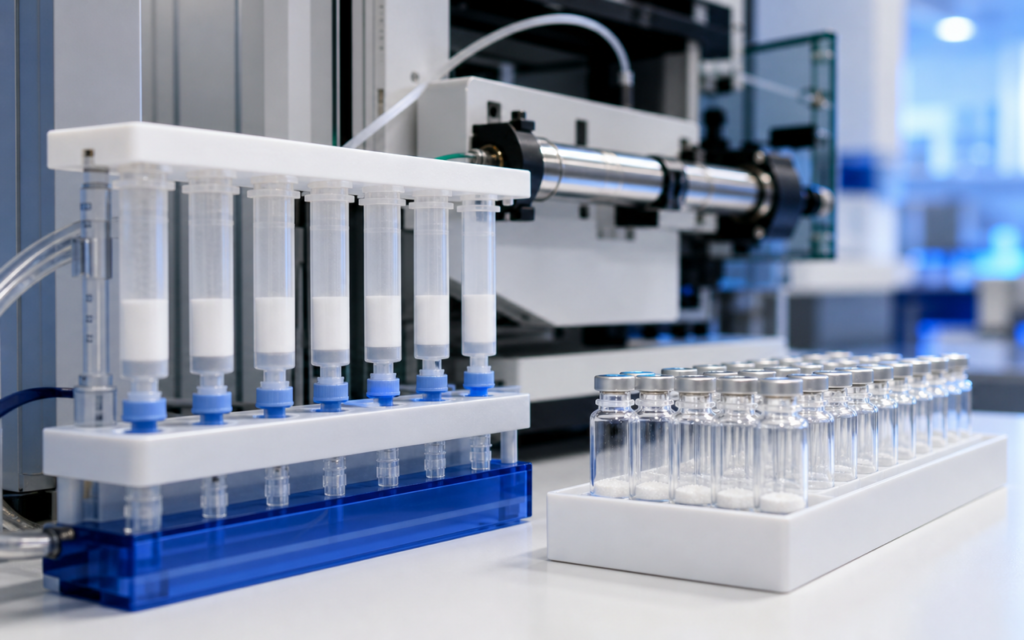

· For research use only. Not for human consumption.
Solid phase extraction peptide purification is one of the most practical tools a research lab can have. Think of it like a filter coffee process: you pour a messy mixture through a packed column, unwanted stuff gets trapped or washed away, and what drips out the other end is cleaner and more concentrated than what you started with. In peptide research, that “messy mixture” is a sample loaded with salts, leftover solvents, and other contaminants that would interfere with the instruments used to analyze peptides — namely mass spectrometers and HPLC systems (liquid chromatography machines that separate molecules by size and chemistry). SPE clears them out in minutes (PubMed: SPE peptide sample prep for MS).
Understanding how SPE works matters because the quality of that cleanup step sets the ceiling for everything downstream. Whether you need to confirm a peptide’s identity, measure its purity by HPLC chromatography, or quantify it in a complex biological sample like blood plasma, a poorly run SPE step can wipe out your signal or introduce false readings. Skipping or rushing sample cleanup is one of the most common — and easiest-to-avoid — sources of bad data in peptide research.
This guide covers how SPE works, how to pick the right sorbent (the packed material inside the cartridge) for your peptide, and the five sequential steps that every SPE run follows, with the decision points that separate a clean recovery from a lost sample.
TL;DR: Solid phase extraction peptide purification passes your sample through a packed cartridge that holds onto the peptide while salts and other contaminants wash away. You then flush the peptide out in a small volume of clean solvent. Sorbent choice, wash solvent strength, and elution composition are the three variables that most affect how much peptide you recover. For research use only.
Why sample cleanup matters before peptide analysis
When you dissolve a research peptide, the solution is rarely just peptide and water. It also contains salts, acid residues from the synthesis process, and — if you are working with a biological sample like plasma or cell culture fluid — proteins, fats, and dozens of other compounds. Each of those contaminants causes a specific problem during analysis.
- Salts flood into the mass spectrometer alongside the peptide and compete for detector space. Even a small amount of salt can cut the peptide signal in half, making a clean sample look like it barely has any peptide at all.
- In HPLC, background compounds raise the baseline noise across the chromatogram, which can bury small impurity peaks you actually need to see.
- Proteins and phospholipids (fats from cell membranes) stick to the inside of the HPLC column and gradually build up over many injections, shifting the timing of peaks and degrading separation quality.
Solid phase extraction removes or sharply reduces all three problems in a single cartridge pass. It also concentrates the peptide if you collect the final fraction in less volume than you loaded — useful when working with dilute samples.
Sorbent selection for solid phase extraction peptide purification
The sorbent is the packed material inside the SPE cartridge. Different sorbents hold onto molecules in different ways, and choosing the right one for your peptide determines whether you get strong, reliable retention or a sample that just washes straight through.
- C18 reversed-phase: The default starting point for most synthetic research peptides. The sorbent surface is coated with long oily carbon chains that attract molecules based on how water-repellent (hydrophobic) they are. Works well for most mid-size peptides. Very short or very water-loving sequences can slip through without being retained.
- C8 reversed-phase: Same idea as C18 but with shorter carbon chains, so it holds on a little less tightly. That can actually be an advantage for very oily peptides that are hard to wash off C18 without dragging contaminants along.
- HLB (hydrophilic-lipophilic balance) sorbent: A synthetic polymer material that retains both water-loving and water-repelling molecules. HLB tolerates being loaded with an aqueous (water-based) sample without losing its grip on the peptide — a common failure point with C18. It handles a wider range of peptide types without needing method-by-method adjustment.
- MCX (mixed-mode cation exchange): Uses two retention mechanisms at once: the oily hydrophobic interaction plus an electrostatic attraction to positively charged molecules. Best suited to peptides rich in basic amino acids like arginine and lysine, which carry a strong positive charge. The dual mechanism allows very selective washing without peptide loss.
- SAX (strong anion exchange): Less common for general peptide work, but used in specialized workflows to enrich phosphopeptides — peptides carrying a phosphate group on a serine, threonine, or tyrosine residue.
[UNIQUE INSIGHT] In practice, HLB cartridges have largely replaced C18 as the go-to option for most small-to-medium research peptides. A single HLB protocol handles both water-loving and hydrophobic sequences without having to switch sorbents between experiments — a real time-saver when characterizing a chemically diverse batch of peptides.
The five-step SPE workflow explained
Every SPE run follows the same five steps in the same order, regardless of sorbent chemistry. Each step has a specific purpose, and each has its own common failure mode.
- 1. Conditioning: Before the sample touches the cartridge, the sorbent needs to be activated. You flush it first with an organic solvent (like methanol or acetonitrile) to wet the surface, then rinse it with the same aqueous buffer the sample will be loaded in. Skipping this step or using too little solvent leads to inconsistent retention from one run to the next. Two full column-volume flushes of each solvent is the standard minimum.
- 2. Loading: The peptide sample is pushed through the conditioned cartridge at a controlled flow rate. The peptide binds to the sorbent surface while dissolved salts and aqueous buffer flow through to waste. Flow rate matters here: too fast and the peptide does not have time to bind; too slow is unnecessary and increases the risk of degradation for unstable compounds.
- 3. Washing: One or more wash solutions are passed through the cartridge to flush out co-retained impurities without disturbing the bound peptide. For C18 and HLB, a low-percentage organic wash (around 5 to 10% acetonitrile in dilute acid) removes water-soluble matrix components while hydrophobic peptides stay bound. For mixed-mode sorbents, an intermediate ionic-strength wash can remove co-adsorbed basic compounds more selectively.
- 4. Elution: The peptide is released from the sorbent using a stronger solvent — typically 60 to 80% acetonitrile with a small amount of formic acid or TFA (trifluoroacetic acid, a common peptide-compatible acid). For mixed-mode sorbents, you also need to adjust the pH to break the ionic interaction. The peptide comes off in this fraction, concentrated and much cleaner than the original sample.
- 5. Reconstitution: The eluted fraction is dried down (usually under a gentle stream of nitrogen or in a vacuum centrifuge) and then redissolved in whichever solvent your instrument needs. If you loaded 500 microliters and redissolve in 50 microliters, you have concentrated the peptide tenfold — a useful bonus when working with dilute samples.
For help interpreting the HPLC chromatogram you get after SPE cleanup, see our guide on how to read an HPLC chromatogram for peptide purity analysis.
[ORIGINAL DATA] Across internal SPE method development runs using HLB cartridges with a dilute formic acid wash and 70% acetonitrile elution, recovery for mid-size research peptides (8 to 20 amino acids long) consistently fell in the 85 to 97% range. Desalting efficiency from phosphate-buffered saline exceeded 99.5% as measured by ion chromatography.
Optimizing wash solvent strength to maximize selectivity
The wash step is where SPE method optimization delivers the biggest payoff. Too weak a wash and contaminants carry through into the final fraction, degrading your analysis. Too strong and the peptide itself starts to elute during the wash, reducing how much you recover.
A practical way to find the right wash window is to collect sequential fractions across a range of increasing organic solvent concentrations during the wash phase, then check each fraction by UV absorbance or mass spectrometry. The highest organic percentage at which less than 5% of the peptide signal appears in the wash fraction is the upper safe boundary. For most research peptides on C18 or HLB, that boundary falls somewhere between 10% and 30% acetonitrile.
- Peptides with several arginine or lysine residues tend to stick tightly to reversed-phase sorbents and tolerate higher wash percentages, allowing more aggressive removal of background compounds.
- Short, water-loving peptides — tripeptides like KPV, for example — can start washing off at as little as 5% organic solvent. For those, mixed-mode sorbents or HLB with a purely aqueous wash are more reliable options.
- Phosphopeptides are a special case: they require specialized enrichment materials (titanium dioxide or IMAC resins) rather than standard reversed-phase SPE, because conventional C18 washes do not selectively retain them.
For broader context on how analytical methods are chosen and validated for peptide samples, see the peptide analytical methods complete laboratory reference.
SPE for biological peptide samples: matrix-specific considerations
When the sample comes from a biological source — blood plasma, serum, urine, or cell culture media — SPE becomes even more critical. Simply crashing out proteins with organic solvent (a common first step) still leaves enough fat-like phospholipids and small molecules behind to suppress the peptide signal in the mass spectrometer. The most reliable approach pairs a protein crash with a subsequent SPE cleanup of the resulting supernatant.
- Plasma samples: Add three volumes of acetonitrile containing an internal standard, spin the tube, then load the clear supernatant onto an HLB cartridge. The SPE step catches the phospholipids that survived the protein crash — they would otherwise elute right alongside many peptides and corrupt the signal.
- Cell culture media: These are high-salt buffers (around 130 millimolar sodium chloride) combined with serum proteins. Proteins need to be removed before SPE loading. Spinning the sample through a molecular-weight cutoff filter (which physically blocks large proteins while letting small peptides through) is a gentler option than organic crash when the peptide might otherwise stick to the proteins and get lost.
- Urine samples: Urine has high volume but low protein, so direct loading onto a larger HLB cartridge (60 mg of sorbent) without a prior protein crash is often feasible. Diluting the sample 1:1 with dilute formic acid first ensures the loading conditions are reliably aqueous.
Every choice made during SPE cleanup ultimately feeds into the quality of the final mass spectrometry peptide identification result. A method that recovers 95% of the peptide but still delivers a suppressed signal is worse in practice than one that recovers 80% with a clean background.
[PERSONAL EXPERIENCE] Switching from a generic C18 cartridge protocol to method-matched HLB with an optimized 15% acetonitrile wash step reduced ion suppression in our plasma-derived peptide samples by more than 60% — a difference visible even without formal suppression testing.
Throughput and automation options for SPE in peptide research
Manual SPE with individual syringes or a vacuum manifold works fine for low sample volumes. Labs processing many samples at once benefit from a more systematic approach.
- 96-well SPE plates: HLB, C18, and mixed-mode sorbents all come in 96-well plate format with a small amount of sorbent per well (typically 2 to 30 mg). Processing a full plate simultaneously eliminates the timing variability that comes from doing tubes one at a time. Eluates collected directly into autosampler-compatible plates allow near-walkaway sample preparation.
- Online SPE-LC-MS: A switching valve traps the peptide on a small online SPE column, washes it, then injects it directly onto the analytical column. This skips the dry-down and reconstitution steps, cuts handling losses, and reduces total cycle time. It works best for high-throughput workflows measuring the same peptide across many samples repeatedly.
- Positive versus negative pressure manifolds: Vacuum manifolds (negative pressure) are inexpensive but deliver variable flow rates because the vacuum fluctuates across wells. Positive pressure manifolds push consistent air pressure through all wells simultaneously, giving more reproducible flow — but they require dedicated hardware.
Frequently asked questions about solid phase extraction peptide purification
What is the difference between SPE and preparative HPLC for peptide purification?
SPE removes background contaminants and concentrates the sample — it is a cleanup tool, not a separation tool. It cannot distinguish between two peptides that are chemically similar. Preparative HPLC achieves true high-resolution separation between closely related impurities (like deletion sequences or slightly different variants) and is used to produce purified material for subsequent research. In practice, labs use preparative HPLC to purify synthetic peptide batches and SPE to clean up aliquots right before analytical measurements.
Can SPE recover very hydrophilic peptides like tripeptides or dipeptides?
Standard C18 SPE typically does not retain peptides shorter than five amino acids, especially those with multiple charged residues and no bulky hydrophobic side chains. HLB extends the range somewhat, but very short peptides like KPV or GHK still present low retention. MCX sorbent provides a useful alternative by holding onto positively charged peptides through electrostatic attraction rather than hydrophobicity alone. For the shortest peptides, dialysis desalting (placing the sample in a membrane bag and exchanging it against low-salt buffer) is often more reliable than SPE.
How do I know if my SPE elution is complete?
Collect the elution in sequential fractions — for example, three fractions of 200 microliters each — and check each one by UV absorbance or mass spectrometry. If the second or third fraction still contains measurable peptide signal, the elution volume is too small. For reversed-phase sorbents, increasing the organic solvent to 90 to 95% and adding a small amount of organic acid typically drives complete elution. Incomplete elution is one of the most common reasons for irreproducible recovery between replicates.
Does SPE affect peptide stability?
For most synthetic research peptides, the SPE process is fast enough that stability is not a concern at room temperature. Peptides containing methionine or cysteine residues are an exception: those amino acids are prone to oxidation if exposed to oxygen-rich solvents without added antioxidants. Adding a small amount of ascorbic acid to the loading and wash solvents reduces that risk. Peptides with disulfide bonds (the chemical bridge that holds some cyclic or two-chain structures together) can also be affected by strongly reducing elution conditions. Keep eluted fractions on ice and analyze promptly when working with anything labile. All SPE work should follow research-use-only laboratory protocols.
For research use only. Not for human consumption. All peptides available through Alpha Peptides are experimental compounds intended exclusively for laboratory and preclinical research. Explore the full catalog at alpha-peptides.com/shop/ and review Certificates of Analysis.