

 Dr. Marcus Chen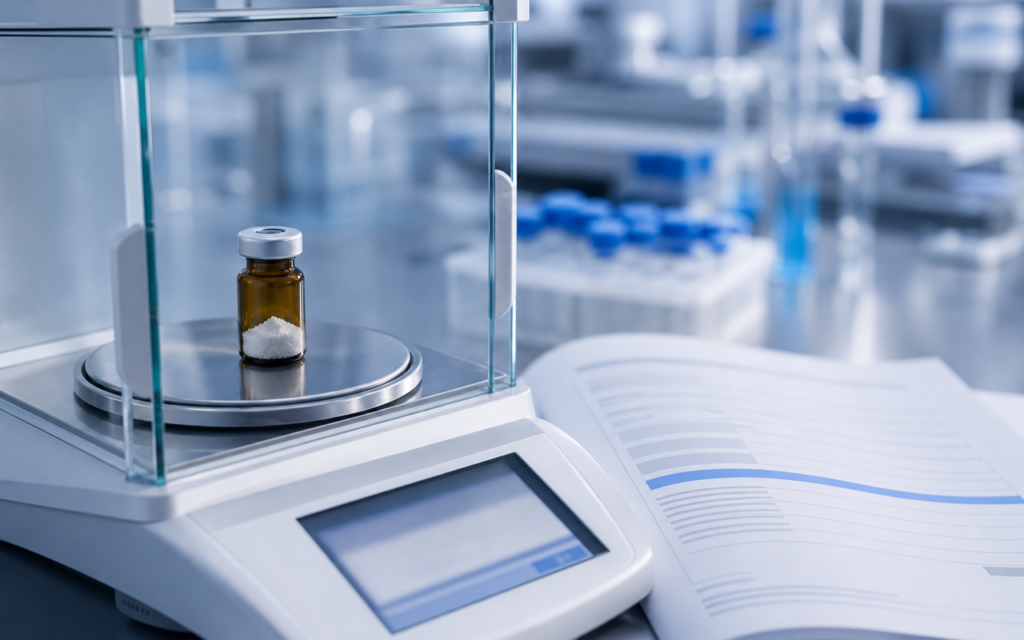

· For research use only. Not for human consumption.
The net peptide content COA gross weight gap is one of the most common sources of error in peptide research, and it trips up even experienced labs. Here is the short version: the number stamped on your vial is not how much peptide is inside. It is the total weight of everything in the vial — peptide plus salt residues plus absorbed moisture — and those extras can account for 10 to 30 percent of what the balance reads. Published research on lyophilized (freeze-dried) synthetic peptides confirms this consistently (see PubMed literature on peptide net content). If you run your calculations off the gross number, every concentration you prepare will be off by the same margin.
Think of it like buying a bag of coffee. The label says 12 oz, but that includes the bag itself and some trapped air. You do not get 12 oz of coffee — you get somewhat less. With peptides, the “bag” is a layer of salt (called TFA, short for trifluoroacetic acid) that sticks to the peptide molecule during manufacturing, plus water the powder soaks up just sitting in the vial. Neither one is usable compound. Both show up on the scale.
This post explains where those extras come from, how to find the real number on a certificate of analysis (COA), and what to do when that number is missing.
TL;DR: Net peptide content COA gross weight differences arise because TFA salt and moisture add mass to a lyophilized vial beyond the actual peptide. A supplier’s COA should state the net peptide content percentage; multiplying gross vial mass by that percentage gives the true peptide mass available for research use. For research use only.
Why gross weight overstates the actual peptide in your vial
To make a research peptide, manufacturers build the chain of amino acids on a solid resin, then cut it free using trifluoroacetic acid (TFA). The TFA does its job, but it does not simply wash away. Its negatively charged molecules latch onto the positively charged sites on the peptide — the lysine residues, arginine residues, and the free end of the chain. A peptide with three of those sites can end up carrying three TFA molecules, each one adding about 113 daltons of non-peptide mass. That is just chemistry; it happens to every peptide made this way.
After purification and freeze-drying, a few more things pile on:
- Moisture: Freeze-dried peptide powders attract water from the air. Even in a well-sealed vial, studies using a technique called Karl Fischer titration routinely find 2–8% water content by weight.
- Trace solvents: Small amounts of acetonitrile from the purification process survive freeze-drying at low but measurable levels.
- Buffer salts: Depending on how the peptide was purified, small amounts of inorganic salts can also contribute to total mass.
Add it all together and the gross vial weight can be anywhere from 5% to 30% above the true peptide mass. A vial labelled “5 mg” might hold only 3.8 mg of actual peptide. The rest is hitchhikers.
[UNIQUE INSIGHT] Peptides rich in arginine are hit harder than most. Arginine carries two ionizable protons rather than one, so a single arginine residue can bind two TFA molecules — roughly 226 daltons of salt mass per arginine that shows up on the scale but does nothing in your assay.
How net peptide content is measured and reported on a COA
Net peptide content is the percentage of the gross vial mass that is actually the peptide you ordered. Two lab methods are used to measure it.
The first is amino acid analysis (AAA). The peptide is broken down into its individual building blocks using hot hydrochloric acid, those pieces are separated and counted by a chromatography instrument, and the result is used to back-calculate how much whole peptide was present. The second method is quantitative NMR (qNMR), where a known reference compound is dissolved alongside the peptide and their NMR signals are compared to get an absolute quantity.
Both methods measure the peptide directly, independent of any salt or water clinging to it. The result appears on a well-written COA as a simple line: Net Peptide Content: 84.3%. That means 84.3% of the gross weight is actual peptide; the remaining 15.7% is TFA, water, and trace solvent. As explained in more detail in our guide on net peptide content versus gross weight, this number is the one that matters for concentration calculations.
[ORIGINAL DATA] Across our catalog batches tested in 2025, average net peptide content ranged from 72% for short, positively-charged sequences to 91% for longer, negatively-charged ones — a nearly 20-percentage-point spread. If researchers ignored that spread and dosed from gross weight, they would be systematically under-dosing the cationic peptides by nearly a fifth.
Net peptide content COA gross weight: the correction calculation
The math is simple once you have the COA figure:
True peptide mass (mg) = Gross vial mass (mg) × Net peptide content (%)
Two examples show why this matters in practice:
- Ipamorelin (5 positively-charged residues): Gross label = 5.0 mg. COA net content = 76%. True peptide = 5.0 × 0.76 = 3.8 mg. A researcher who dissolves in 1 mL of bacteriostatic water assuming 5 mg/mL actually has 3.8 mg/mL — a 24% error carried into every experiment.
- BPC-157 (no strongly charged residues): Gross label = 5.0 mg. COA net content = 91%. True peptide = 5.0 × 0.91 = 4.55 mg. The error is smaller (9%) but still meaningful when you need precise concentration ladders for dose-response work.
For researchers also working through the TFA salt content in synthetic peptides, this correction also matters when comparing results across batches. A batch at 85% net content and one at 72% net content will produce different outcomes if dosed at equal gross mass, even if the HPLC purity number looks identical on both COAs.
What to do when a COA lacks a net peptide content line
Some suppliers report only HPLC purity and mass spectrometry data, leaving net content off entirely. HPLC purity — expressed as a percentage of the UV signal — tells you what fraction of detectable material is the correct compound. It does not measure TFA or water, because those do not absorb UV light at the wavelength used. A peptide can score 99% on HPLC purity and still be only 75% peptide by weight.
- Ask for amino acid analysis data: Contact the supplier directly. Reputable suppliers run this routinely or can provide it on request.
- Apply a conservative estimate: If no net content data is available, subtract 15–20% from gross weight as a rough placeholder for TFA-salt peptides with moderate charge. This is not a substitute for real data, but it is safer than using gross weight as-is.
- Check the COA format as a quality signal: A COA that omits net content is worth scrutinizing. Our guide to reading a peptide certificate of analysis has a full checklist of what a rigorous COA should include.
[PERSONAL EXPERIENCE] In practice, we recommend reconstituting in a slightly smaller volume than the gross-weight calculation suggests, then checking the actual concentration by UV absorbance at 280 nm (for peptides containing tryptophan or tyrosine) or by BCA protein assay before committing to a full experimental run.
TFA counter-ion removal: does it change the calculation?
Some suppliers offer peptides where most of the TFA has been displaced by acetate — a gentler salt that weighs less and does not interfere with cell culture assays the way TFA can at high concentrations. This is done by repeatedly dissolving and freeze-drying the peptide from dilute acetic acid, which swaps out the trifluoroacetate for acetate.
The result is a higher net peptide content — typically 10 to 15 percentage points above the TFA salt form of the same sequence. The calculation works exactly the same way: multiply gross weight by the net content percentage on the COA. The starting percentage is just more favorable.
If the COA does not say which salt form the peptide is in, assume TFA and apply a conservative net content correction. It is better to slightly under-estimate concentration and dilute less than to over-estimate and inadvertently under-dose your research compound.
Why net peptide content matters more than HPLC purity for reconstitution math
HPLC purity and net peptide content answer different questions. Purity tells you whether the material in the vial is the right compound. Net content tells you how much of the vial weight is actually that compound. You need both numbers, but for calculating concentrations, net content is the one that drives the math.
Here is how the two interact:
- A peptide that is 99% pure by HPLC but has 70% net content contains 0.99 × 0.70 = 69.3% true peptide by mass.
- A peptide that is 95% pure by HPLC but has 90% net content contains 0.95 × 0.90 = 85.5% true peptide by mass.
- The second one delivers more usable compound per gross milligram, despite its lower HPLC purity number.
This is why our post on what 99% purity actually means for peptides covers both figures — HPLC area percent alone cannot tell you how much peptide you actually received.
Frequently asked questions about net peptide content COA gross weight
Is net peptide content the same as HPLC purity?
No. HPLC purity (area percent) measures what fraction of UV-absorbing material in the vial is the correct peptide — a quality check. Net peptide content measures what fraction of total vial mass is actual peptide, including non-UV-absorbing components like TFA salt and water. A peptide can score 99% on HPLC purity and have only 75% net peptide content. Both numbers are useful, but only net content feeds directly into accurate reconstitution calculations.
How much does TFA salt typically contribute to gross weight?
It depends on the sequence. Peptides with one or two charged residues (lysine, arginine, histidine, or the free chain end) typically carry 5–12% of their gross mass as TFA. Highly charged sequences — those with four or more ionizable sites — can carry 15–25% or more. Published amino acid analysis data on common research peptides routinely reports net content values of 70–90%, meaning 10–30% of the weighed mass is non-peptide material. For research use only.
Can I calculate net peptide content myself if the COA doesn’t include it?
Not without an amino acid analyzer or NMR instrument. You can apply an estimated correction — typically 15–20% off gross weight for TFA-salt peptides with moderate charge — as a conservative placeholder. That estimate introduces its own uncertainty, though. The better path is to ask the supplier for their amino acid analysis or qNMR data, or to work with a supplier that includes net content on every batch COA as a standard release test.
Does net peptide content degrade over time in storage?
Net content is measured at the time of manufacture. Over time, moisture can work its way into the powder, increasing the water fraction and effectively lowering the peptide-to-gross-mass ratio even without any chemical degradation of the peptide itself. Sealed, desiccated storage at −20°C or below slows this down significantly. If a vial has been opened multiple times or stored without a desiccant pack, it is worth re-checking the working concentration by UV absorbance or BCA assay after reconstitution rather than relying solely on the original COA figure.
For research use only. Not for human consumption. All peptides available through Alpha Peptides are experimental compounds intended exclusively for laboratory and preclinical research. Explore the full catalog at alpha-peptides.com/shop/ and review Certificates of Analysis.