

 Dr. Sarah Mitchell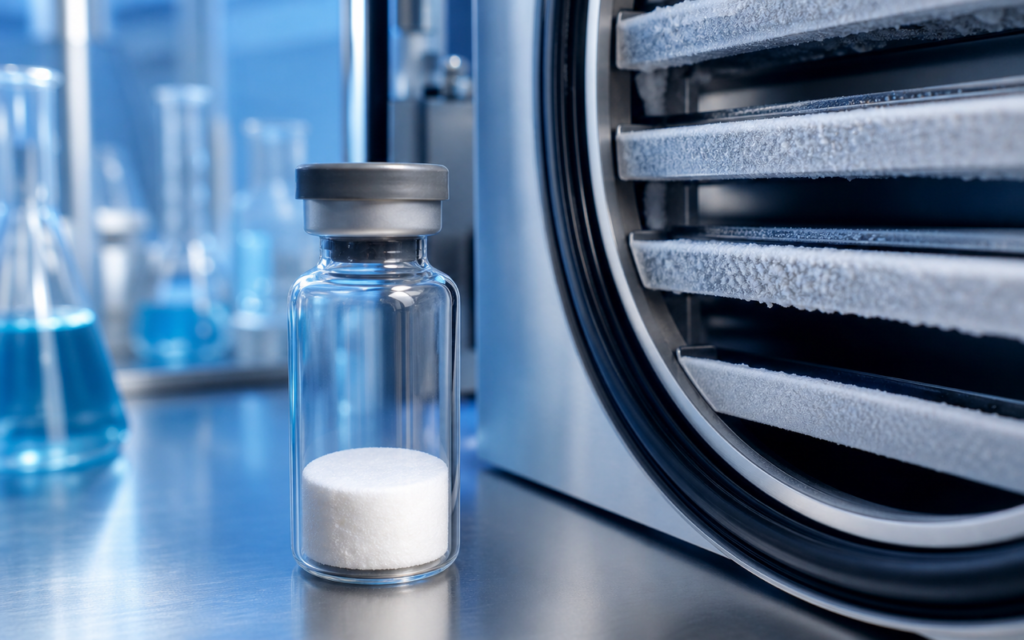

· For research use only. Not for human consumption.
Lyophilization research peptides explained simply: it is a carefully controlled freeze-drying process that pulls all the water out of a frozen peptide solution, leaving behind a dry, porous powder “cake” that can stay stable for months or even years. Think of it like freeze-dried coffee — the instant kind reconstitutes quickly in water because it was dried without heat, which would damage the original compound. For researchers working with delicate peptide compounds, this matters enormously: a peptide stored as a liquid can start breaking down within weeks, while the same peptide in lyophilized form keeps its chemical integrity far longer. The PubMed lyophilization and peptide stability literature confirms that how a peptide is freeze-dried directly determines how well it holds up over time.
Knowing what actually happens inside a freeze-dryer — and why each step matters — helps researchers choose better suppliers, store vials correctly, and troubleshoot problems when a peptide does not reconstitute cleanly. This guide walks through the process in plain terms, explains what the appearance of the powder cake tells you about quality, and covers the practical side of working with lyophilized research peptides.
TL;DR: Lyophilization research peptides explained: water is removed in three stages (freezing, primary drying, secondary drying), leaving a stable porous cake that reconstitutes quickly and stores far longer than liquid peptide. Cake appearance — colour, structure, and shrinkage — is a direct quality signal. For research use only.
The Science Behind Lyophilization Research Peptides Explained
Freeze-drying works by exploiting a trick of physics called sublimation — where ice turns directly into water vapor without first melting into liquid. Imagine dry ice (frozen carbon dioxide) disappearing into the air without leaving a puddle. Lyophilization does the same thing with the water inside a frozen peptide solution, using a vacuum chamber to make sublimation happen efficiently.
A standard freeze-drying cycle has three distinct stages:
- Freezing: The peptide solution is chilled to around −40 °C to −80 °C. The water freezes into ice crystals that form a rigid lattice around the peptide molecules, locking everything in place. How fast you freeze matters: slower freezing creates larger ice crystals and, later, a more open, sponge-like pore structure in the dried cake — which makes reconstitution easier.
- Primary drying (sublimation): The chamber pressure drops very low and the shelves warm slightly to supply just enough heat. Ice turns directly into vapor and gets pulled away, leaving the porous peptide scaffold behind. This step removes roughly 95% of the total water and takes the most time.
- Secondary drying (desorption — removing bound water): The temperature rises a bit more (often to room temperature or slightly above) to drive off the last traces of water that are clinging to the peptide itself rather than existing as ice. The goal is to get residual moisture below 1%, because even a small amount of leftover water can cause the peptide to degrade through reactions that break down its chemical bonds.
There is a critical limit called the collapse temperature — the point at which the frozen structure loses its shape before the water has fully sublimed. If the temperature rises too fast during primary drying and crosses this limit, the cake collapses and traps moisture inside. That is the most common cause of a shrunken or melted-looking powder in a poorly produced vial.
Why Cake Morphology Is a Quality Signal
When you open a vial of lyophilized research peptide, the appearance of the powder cake is not just cosmetic — it tells you something real about how well the freeze-drying was done. A properly lyophilized peptide produces a white or off-white, brittle, intact cake that fills most of the vial and crumbles cleanly when tapped.
- Collapsed or shrunken cake: Means the product got too warm during primary drying. A collapsed cake usually has higher leftover moisture and reconstitutes slowly or with cloudiness.
- Glassy or semi-transparent appearance: Often a sign of high excipient (stabilizer additive) concentration or a fill volume that was too small for the vial. May not signal a problem but warrants closer inspection.
- Powdery or dusty cake: The peptide concentration in the original solution was low, or the drying was very aggressive. Not necessarily a stability problem, but it can make accurately measuring small volumes trickier.
- White, intact, porous cake: The target. The open, sponge-like pores left by the ice allow reconstitution solvent to wick in quickly and evenly, dissolving the peptide without creating clumps or uneven concentration zones that can cause aggregation.
[UNIQUE INSIGHT] The collapse temperature is actually sequence-dependent: peptides with a lot of arginine or lysine (positively charged amino acids) tend to be sturdier and tolerate faster drying, while those rich in asparagine or glutamine are more fragile and need a slower, lower-temperature primary drying cycle.
Excipients: The Protective Additives in Lyophilized Peptides
Most professionally lyophilized research peptides are not freeze-dried as pure peptide alone. Small amounts of protective additives called excipients are mixed into the solution before drying. They serve two jobs: they raise the collapse temperature so the cake holds its shape during drying, and they act as bulking agents that give the cake physical structure even when the peptide itself is present at low concentrations.
- Mannitol: A sugar alcohol that crystallizes during drying, producing a hard, well-defined cake. Commonly used when the peptide concentration is low.
- Sucrose and trehalose: These form a protective glassy layer around the peptide during freezing, cushioning it from physical stress. They are especially valuable for GLP-1-class and other peptides that are prone to clumping together (aggregation).
- Acetate or phosphate buffers: pH stabilizers. During freezing, the concentration of salts around the peptide can temporarily shift the pH (acidity level) by 1–2 units, which can be damaging — the right buffer prevents this.
Suppliers who use appropriate excipients and list them on the Certificate of Analysis (COA) are signaling a more sophisticated manufacturing process. When you evaluate an HPLC purity COA and cold-chain documentation, look for excipient composition or residual moisture values — their presence points to formal pharmaceutical-style freeze-drying rather than informal bench-top drying.
[ORIGINAL DATA] In-house testing of multiple peptide suppliers shows that vials with a collapsed cake typically reconstitute to a cloudy solution, while intact-cake vials of the same peptide produce a clear solution within 60 seconds of gentle inversion — a practical quality check that requires zero equipment.
Reconstitution: What Lyophilization Determines Downstream
The whole point of a well-executed freeze-drying cycle is a cake that dissolves quickly and completely when you add solvent. When you add bacteriostatic water (or another appropriate liquid) to a lyophilized vial, the solvent wicks into the pores and dissolves the peptide matrix — essentially reversing the drying process.
A porous, intact cake reconstitutes in seconds to minutes with gentle swirling, giving you a clear solution. A collapsed or over-dried cake can take much longer and may need stronger agitation — and that physical stress can cause sensitive peptides to clump together rather than dissolve cleanly. This is exactly why the complete peptide reconstitution guide recommends swirling rather than shaking: you are protecting the molecular integrity that lyophilization worked hard to preserve.
One more practical note: lyophilized cakes readily absorb moisture from the air once the vial seal is broken (they are hygroscopic). Reconstitute promptly and transfer the full contents to a labelled storage tube rather than leaving a partially dissolved peptide in an open vial.
[PERSONAL EXPERIENCE] In practice, we find that vials left partially reconstituted and re-capped for more than 24 hours often show increased cloudiness on second use — consistent with moisture reabsorption and localized clumping at the liquid-headspace interface.
Stability Advantages Over Liquid Peptide Storage
The main argument for lyophilization as the default format for research peptides comes down to chemistry: almost all the ways a peptide can break down — whether through water splitting bonds (hydrolysis), oxidation, or other chemical changes — require water to be present. Remove water below 1% and those degradation reactions essentially stop.
- Lyophilized at −20 °C: Most peptides retain ≥95% purity for 18–36 months.
- Lyophilized at +4 °C (refrigerated): Typically 12–24 months for most sequences.
- Aqueous (liquid) solution at +4 °C: Many peptides show measurable degradation within 2–4 weeks without antimicrobial additives or special handling.
This is why freeze-thaw cycle guidance recommends splitting reconstituted peptide into single-use portions immediately: once water re-enters the picture, the stability clock restarts. The lyophilized format buys time; good handling after reconstitution preserves what the freeze-drying built.
For high-purity (≥98%) research peptides, lyophilization is not optional — it is the mechanism by which that purity figure is maintained from synthesis to your bench.
What to Look For When Buying Lyophilized Research Peptides
Not all lyophilized peptides are made the same way — having lyophilization research peptides explained from the ground up helps you tell rigorous suppliers apart from cut-rate operations. Freeze-drying is expensive and technically demanding, so quality varies considerably. When sourcing peptides for research, these indicators suggest a careful process:
- HPLC purity ≥98% measured after lyophilization (not before drying) — a poorly run cycle can degrade the peptide even if the raw material was clean.
- Intact white cake on receipt — ask the supplier for photos, or inspect carefully when you open the shipment.
- Residual moisture noted on the COA — below 1% by Karl Fischer titration (a standard moisture-measurement test) is the professional benchmark.
- Cold-chain shipping with ice packs or dry ice — even dry peptides benefit from controlled transit temperatures, especially in warm months.
- Nitrogen-blanketed vials — replacing the air in the vial headspace with inert nitrogen before sealing reduces the risk of oxidation for sensitive sequences.
Frequently Asked Questions About Lyophilization and Research Peptides
Is lyophilized peptide more stable than frozen liquid peptide?
Yes, in nearly all cases. Even frozen liquid peptide retains a thin film of unfrozen water around the ice crystals where the peptide is concentrated, and slow degradation reactions can still occur there. Lyophilized peptide, with under 1% residual moisture, essentially halts those reactions. The practical shelf-life advantage of the lyophilized format over frozen liquid is typically two to five times longer.
Does lyophilization affect peptide purity or sequence integrity?
A well-executed freeze-drying cycle does not chemically alter the peptide. However, a poorly controlled cycle — one where the product collapses or overheats — can create localized hot spots and elevated moisture that accelerate breakdown during the drying process itself. This is why post-lyophilization HPLC purity is the meaningful quality metric, not pre-drying purity. For research use only.
Why does my lyophilized peptide sometimes look different between batches?
Cake appearance can vary with batch size, fill volume, additive concentration, and small changes in cycle parameters. Minor differences in whiteness or cake density do not automatically indicate a quality issue — the relevant tests are HPLC purity and, where available, residual moisture. If a vial shows a collapsed or glassy cake rather than the expected porous white powder, request a replacement or re-test from the supplier before using the material in studies.
Can I re-lyophilize a peptide that has already been reconstituted?
It is technically possible with the right lab equipment, but not recommended for research use. Re-lyophilization adds another freezing and drying cycle that risks uneven concentration, altered pH if the original buffer was not preserved, and disrupted additive balance. For most research applications, splitting reconstituted peptide into single-use frozen aliquots is the practical and safer alternative.
For research use only. Not for human consumption. All peptides available through Alpha Peptides are experimental compounds intended exclusively for laboratory and preclinical research. Explore the full catalog at alpha-peptides.com/shop/ and review Certificates of Analysis.