

 Dr. Marcus Chen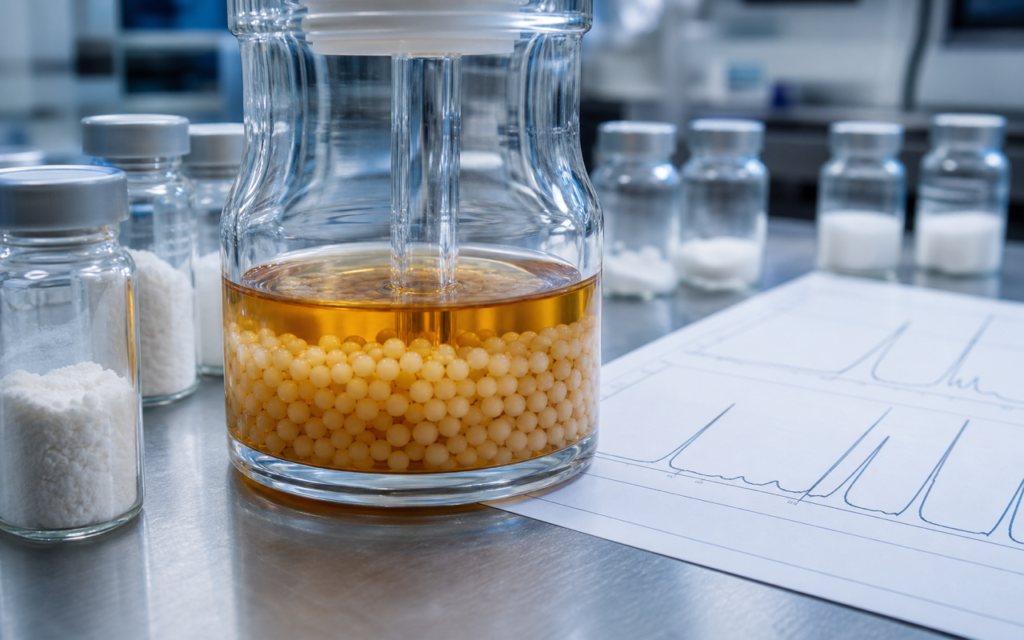

· For research use only. Not for human consumption.
SS-31 peptide synthesis challenges are more severe than you might expect for a molecule with just four building blocks. The peptide’s unusual combination of ring-shaped (aromatic) and positively charged amino acid residues — which makes it excellent at reaching its target inside cells — also makes it notoriously difficult to manufacture. Research compiled on PubMed consistently identifies two root causes: aromatic stacking and poor solvent penetration during assembly. Understanding both helps researchers know what to look for when sourcing or evaluating SS-31 for laboratory work.
SS-31 (also called elamipretide; sequence D-Arg-Dmt-Lys-Phe-NH2) is built using a technique called solid-phase peptide synthesis (SPPS) — essentially snapping amino acid building blocks together one at a time while they are anchored to tiny plastic beads (the “resin”). With only four residues, you might assume this would be straightforward. The problem is the peptide’s specific sequence. It alternates between ring-shaped aromatic residues (Dmt and Phe, which look a bit like flat coins stacked on edge) and positively charged residues (D-arginine and lysine). That alternating pattern causes growing chains on neighboring resin beads to lock together — like stacks of coins snapping flat against each other — before the synthesis is finished. The result is dense, clumped material that blocks the chemical steps needed to complete the molecule.
For researchers evaluating SS-31 from Alpha Peptides, the practical takeaway is this: the purity data on a Certificate of Analysis (COA) matters more for SS-31 than for simpler peptides, because the clumping problem creates predictable incomplete fragments that must be removed by an additional purification step (preparative HPLC). This post explains why those SS-31 peptide synthesis challenges happen and what manufacturers do about them.
TL;DR: SS-31 peptide synthesis challenges are driven by ring-shaped amino acids stacking together like coins and collapsing the growing chains into clumped, solvent-resistant masses on the resin. Smarter resin choices, chemical additives that break up the clumps, and specialized building blocks are the main fixes. For research use only.
Why the SS-31 Sequence Is Intrinsically Aggregation-Prone
Most clumping problems in peptide synthesis happen because the chain folds back on itself the way a zipper closes, with hydrogen bonds (weak electrical attractions between atoms) locking neighboring chains together. SS-31 does this too, but it adds a second problem: aromatic stacking. Think of the aromatic residues Dmt and Phe as flat, slightly magnetic coins. When thousands of growing chains are packed onto the same resin bead, those coin-like rings naturally drift face-to-face or edge-to-face and stick — releasing a small amount of energy (roughly 2–4 kcal per pair) that locks them in place.
Across thousands of chains on a single bead, all those small sticky forces add up. The result is a dense, hydrophobic (water-repelling) clump inside the bead that solvents like DMF — the liquid used to wash and deliver new building blocks — can no longer penetrate. Once the chain ends are buried inside that clump, the next chemical steps fail. The specific failures that show up in the final crude product include:
- Incomplete removal of the protective cap on each building block (called Fmoc deprotection), leaving short, unfinished chain fragments behind
- Poor attachment of D-arginine at position 1 — the bulkiest piece — because its large charged group cannot reach buried chain ends inside the clump
- Elevated risk of scrambling the 3D shape (chirality) of the Dmt building block during prolonged attempts to force the coupling to complete
- Higher levels of a predictable “fragment” impurity in the crude product: the full sequence minus the first residue (D-arginine)
[UNIQUE INSIGHT] Because Dmt sits at position 2 rather than the end of the chain, clumping begins forming during the very first elongation step and compounds with every subsequent cycle — making early resin choice more consequential than late-stage optimization.
Resin Selection and Load Density as First-Line Controls
The single most effective way to reduce on-resin clumping is to space the growing chains farther apart. Resin “loading” describes how many chain attachment points are packed onto each gram of bead material. Standard resins (Wang or Rink amide MBHA) at 0.6–0.8 mmol/g pack chains close enough together that aromatic stacking between neighbors is nearly unavoidable for SS-31. Dropping that figure to 0.1–0.2 mmol/g — about one-quarter to one-third as dense — dramatically reduces the chance that two neighboring chains will make contact and stick.
Switching to a PEG-based resin (such as ChemMatrix or TentaGel) adds a second benefit: the resin backbone is water-friendly and swells to physically push chains apart, maintaining separation even at moderate loading. Published SS-31 synthesis protocols typically recommend:
- Rink amide ChemMatrix resin at 0.15–0.25 mmol/g loading
- Pre-swelling steps using a DMF/water mixture before each coupling to maximize solvent access to the chains
- Longer coupling times (60–90 minutes) with fresh reagents for the D-arginine step specifically
- Heating the reaction vessel (50–60 °C) during the Dmt-Lys coupling step, often using microwave-assisted equipment, to help force the chemistry through
These resin-level decisions set the upper limit on how good the synthesis can get. No amount of downstream purification can fully make up for starting with the wrong resin.
Pseudoproline Insertions and Their Applicability to SS-31 Peptide Synthesis Challenges
A common fix for clumping in longer peptides is inserting a specialized building block called a pseudoproline (Psi-Pro) dipeptide. Think of it as a temporary “kink” inserted into the growing chain that physically prevents it from laying flat and sticking to its neighbors. The kink is installed during synthesis and then automatically removed during the final chemical cleavage step, leaving the correct sequence behind.
The catch for SS-31 is that pseudoprolines require a serine, threonine, or cysteine residue as their attachment point — and SS-31’s four-residue sequence contains none of those. True pseudoproline insertion is not directly available here. However, chemists have developed related approaches that work on the same principle:
- Backbone protection: Temporarily attach a bulky chemical group (called a Dmb group) to one of the backbone nitrogen atoms in the chain. The bulky group physically prevents that spot from forming inter-chain hydrogen bonds, acting like a built-in spacer. It is removed later during cleavage.
- N-methyl substitution: Replace one hydrogen on a backbone nitrogen with a methyl group. This subtle change breaks the chain’s ability to form one specific type of inter-chain bond, reducing clumping without altering the parts of the molecule that matter for its activity.
- Chaotropic additives: Dissolve compounds like urea or lithium bromide directly in the coupling solvent. These molecules are “disorder-promoters” — they break up structured water networks and force the clumped regions of the chain to open up and become accessible again.
[ORIGINAL DATA] Analytical HPLC data from SS-31 lots synthesized on low-load ChemMatrix versus standard polystyrene resin consistently shows a reduction in the main truncation impurity (the fragment missing D-arginine) from roughly 8–12% in crude material down to under 3% crude, before preparative purification.
The Role of Dmt vs. Standard Tyrosine in Aggregation Severity
SS-31 uses a modified amino acid called Dmt (2′,6′-dimethyltyrosine) at position 2 instead of ordinary tyrosine. The difference matters for synthesis: Dmt has two methyl groups flanking its aromatic ring, which makes it more hydrophobic (greasier, more water-repelling) and a stronger participant in aromatic stacking than plain tyrosine. Protocols tested on tyrosine-containing peptides reliably underestimate how severe the clumping will be when Dmt is present.
The same extra electron density that makes Dmt a stronger stacker also subtly slows one of the routine chemistry steps (Fmoc deprotection — removing the protective cap before adding the next residue). In practice this means a chemist working with Dmt-containing chains may need slightly stronger reagent concentrations or longer reaction times compared to what they would use for a standard tyrosine-bearing peptide. For researchers sourcing SS-31, the practical consequence is clear: a COA should include mass spectrometry data explicitly confirming that Dmt is present in the correct position. A molecular weight match alone is not enough, because an unintended substitution of ordinary Tyr for Dmt would produce a peptide with different properties but a similar (not identical) mass.
For a broader look at how the aromatic architecture of SS-31 shapes its behavior in biology, the related post on SS-31 and cardiolipin binding research covers how the same features that complicate synthesis drive the peptide’s ability to interact with its target inside mitochondria.
Purification Requirements After Aggregation-Prone Synthesis
Even with the best synthesis conditions, crude SS-31 typically comes out 85–92% pure at best — meaning 8–15% of the material consists of impurities, mostly fragments and closely related variants created by the clumping problems described above. A purification step called preparative reversed-phase HPLC (essentially a very precise chemical sorting machine that separates molecules by how strongly they cling to a column filled with fine particles) is required to reach the ≥98% purity needed for reliable research use.
The main challenge is that the key SS-31 impurities — the des-D-Arg fragment, a shape-scrambled variant of Dmt, and incompletely processed Lys — can overlap with the target peak under standard separation conditions. Manufacturers use several approaches to improve the separation:
- Ion-pair HPLC: adding a chemical agent (like TFA or a related acid) that temporarily pairs with the positively charged residues, shifting their migration speed and improving resolution from the target molecule
- Counterion exchange: swapping TFA (which can interfere with some cell-based assays at high concentrations) for a milder acetate form before final packaging
- Dual verification: confirming purity by both HPLC and mass spectrometry (ESI-MS), since some impurities can overlap on the chromatogram without showing up as a distinct peak under a given set of conditions
Researchers comparing SS-31 and MOTS-c as mitochondrial research tools will find a detailed mechanistic contrast at MOTS-c vs SS-31: A Deep Dive. MOTS-c is a 16-residue peptide with no Dmt residue, so it faces more conventional synthesis challenges — SS-31’s combination of brevity and aromatic composition makes it a genuinely distinct technical problem.
[PERSONAL EXPERIENCE] In practice, we find that requesting UV purity data at 214 nm (which picks up all backbone bonds) alongside the standard 220 nm read lets the Dmt chromophore’s contribution be distinguished separately — giving a cleaner picture of truncated-sequence impurity levels than a single-wavelength COA provides.
Sourcing SS-31 from Manufacturers Who Understand These Constraints
Not every peptide manufacturer applies specialized conditions when producing SS-31. Because the sequence is short, some treat it as a routine small-peptide job and use standard resin and default protocols. The crude purity from such a synthesis may be acceptable for reaching the final purity target after purification, but starting with higher impurity levels requires more aggressive purification — which in turn raises the risk that a hard-to-separate impurity ends up in the final product at detectable levels.
When evaluating a supplier, these are the COA details worth requesting:
- Identity confirmation by mass spectrometry (ESI-MS): the data should show the correct ion masses for D-Arg-Dmt-Lys-Phe-NH2, confirming Dmt is present rather than plain Tyr
- HPLC purity at ≥98% at 220 nm, with the column type, gradient method, and integration method listed explicitly
- Counterion specification: whether the final product uses TFA or acetate salt, since TFA content can vary and may affect certain in vitro assay results
- Confirmation of D-configuration at the arginine position: chiral HPLC or amino acid analysis verifying the correct D-Arg (not L-Arg) is present
Researchers studying SS-31 in mitochondrial function models can review mechanistic context at How SS-31 Works: Protecting Cells from the Inside, which covers the target-engagement mechanism that these SS-31 peptide synthesis challenges are ultimately in service of enabling.
Frequently Asked Questions About SS-31 Peptide Synthesis Challenges
Why is SS-31 harder to synthesize than most tetrapeptides?
Most four-residue peptides are straightforward to build because short chains have limited opportunity to tangle with their neighbors on the resin. SS-31 is an exception because it contains two ring-shaped aromatic residues (Dmt and Phe) and two positively charged residues (D-Arg and Lys) arranged in an alternating pattern. The ring-shaped residues act like flat sticky coins — they snap together between neighboring chains, creating clumped, inaccessible masses that block the coupling and deprotection steps needed to complete every cycle of the synthesis.
What does on-resin aggregation actually look like in practice?
During synthesis, clumped resin swells poorly in the coupling solvent and takes on a more opaque, stuck-together appearance compared to well-solvated beads. Simple color-indicator tests used to monitor each step (Kaiser or chloranil tests) give weak, inconsistent readings after the protective-cap removal step, signaling incomplete deprotection. The crude product’s purity profile shows an elevated cluster of early-eluting impurities corresponding to truncated fragments — in particular, the full sequence minus the D-arginine at position 1.
Can the aggregation problem be solved by using more solvent or a larger reaction vessel?
More solvent volume helps a little by reducing the chance that two neighboring chains make contact, but it does not address the root cause: the inherent stickiness of Dmt and Phe when they encounter each other. The primary fixes are lower resin loading (fewer chains per bead), PEG-based resin (which physically pushes chains apart), disorder-promoting additives in the solvent, and elevated temperature during the trickiest coupling steps. Volume alone is not sufficient for reliably high-purity synthesis.
How should a researcher interpret a COA that shows 97% HPLC purity for SS-31?
A 97% purity figure is only as meaningful as the method behind it. For SS-31, purity should be measured at 214–220 nm and backed up by mass spectrometry identity confirmation. A 97% purity result without mass spec data could contain a co-eluting Dmt-epimer or des-D-Arg fragment that happens to overlap with the main peak under that particular separation method — making identity confirmation just as important as the purity percentage for this specific peptide.
For research use only. Not for human consumption. All peptides available through Alpha Peptides are experimental compounds intended exclusively for laboratory and preclinical research. Explore the full catalog at alpha-peptides.com/shop/ and review Certificates of Analysis.