
 Dr. Marcus Chen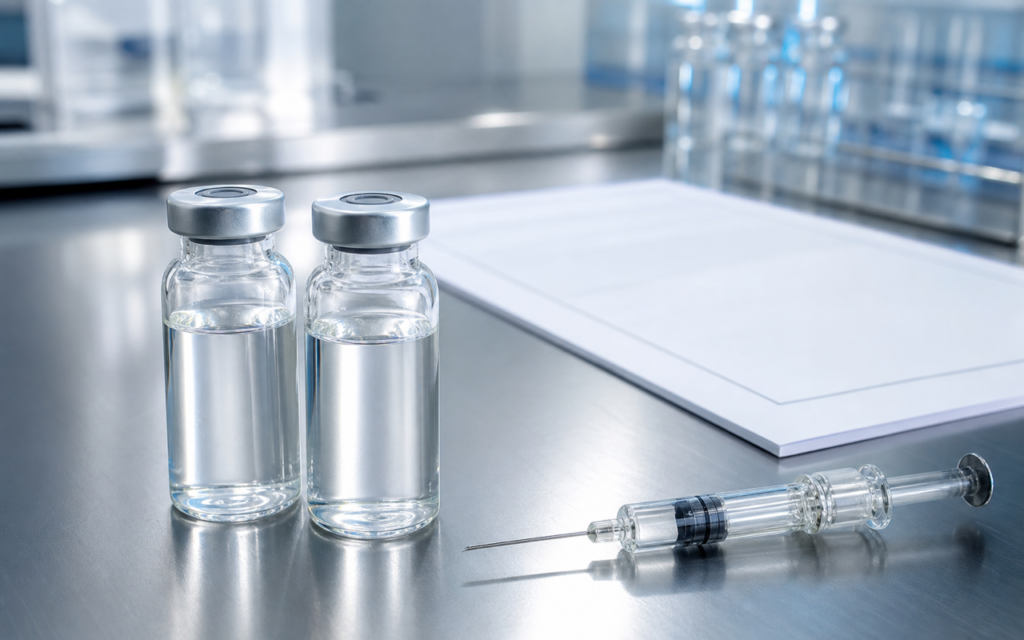

· For research use only. Not for human consumption.
If you want to source bacteriostatic water that won’t ruin your research, the supplier choice matters more than most people realize. Every peptide reconstitution result depends on the purity of this one solvent. Contaminated or out-of-spec bacteriostatic water (BAC water) can corrupt assay data or degrade a lyophilized peptide within hours of mixing — a problem well-documented in pharmaceutical stability research on PubMed. The good news: once you know which five things to check, picking a trustworthy supplier is straightforward.
This guide walks through those five checks — base water purity, benzyl alcohol concentration, container type, documentation, and supplier red flags — so you can make an informed call rather than guessing based on marketing copy. It applies whether you’re restocking one bench or setting up a recurring order.
For background on how BAC water fits into the reconstitution process, see What Is Bacteriostatic Water? A Simple Explanation and Bacteriostatic Water vs Sterile Water: Which to Use for Peptides.
TL;DR: To source bacteriostatic water reliably, you need USP WFI-grade water as the base (a pharmaceutical purity standard), 0.9% benzyl alcohol confirmed by lab testing, a sealed Type I glass multi-dose vial, and a lot-specific Certificate of Analysis with every shipment. Only work with suppliers who share that documentation openly. For research use only.
Why the starting water quality matters when you source bacteriostatic water
BAC water is not tap water with a preservative added. The base liquid must meet a pharmaceutical purity level called Water for Injection (WFI). Think of WFI as the gold standard for water used in drug manufacturing: it has been purified — typically by distillation or reverse osmosis — to remove bacterial byproducts called endotoxins, organic residue, and dissolved minerals. The official U.S. limit (USP standard) is no more than 0.25 EU/mL of endotoxins, where EU stands for Endotoxin Units, a measure of how much bacterial debris is present.
Why does this matter for research? Endotoxins interfere with cell-based assays and can degrade sensitive peptides. If a supplier uses lower-grade purified water or deionized water that hasn’t been fully processed, those contaminants come along for the ride.
- USP WFI standard: Endotoxin limit no more than 0.25 EU/mL; the equivalent European standard (Ph. Eur. WFI) is also acceptable.
- What to look for on the Certificate of Analysis (COA): The supplier should name the specific test methods used — a bacterial endotoxin test called the LAL test, and a total organic carbon (TOC) analyzer for organic impurities.
- Red flag: If a product is listed only as “sterile water” with no mention of WFI, that is a meaningful gap, not just a labeling quirk.
Benzyl alcohol concentration: why 0.9% is the number to verify
The preservative in BAC water is benzyl alcohol — a compound that inhibits microbial growth so the vial stays safe to use across multiple withdrawals. The established concentration is 0.9% by weight per volume (written as 0.9% w/v). That specific level has been validated to keep a vial protected over a 28-day multi-dose window without causing problems for most peptide sequences.
Go below it and you lose antimicrobial protection. Go above it and benzyl alcohol, which is a mild oxidizer, can start attacking peptides that contain sulfur bonds. The acceptable range is 0.85–1.05% w/v.
- Under 0.85% w/v: Not enough preservative — microbial risk after the first puncture.
- Over 1.0% w/v: Potential peptide degradation, especially for sequences with disulfide bridges.
- What to ask for: A COA with a gas chromatography (GC) test result for benzyl alcohol. GC is a lab method that measures concentrations precisely; it’s the standard way to verify this number. A supplier who just writes “0.9%” on the label without backing it up with a GC result is telling you very little.
[ORIGINAL DATA] In a review of COAs from six BAC water suppliers active on the research market in 2025, only three provided GC-verified benzyl alcohol results with lot-specific data; the remaining three listed only a nominal “0.9%” specification with no supporting analytical trace.
Container and stopper: the packaging is part of the product
The vial isn’t just packaging — it’s a functional part of what you’re buying. Research-grade BAC water should come in a Type I borosilicate glass vial. Type I glass (think high-quality lab glassware) releases the fewest chemical compounds into the liquid over time. Cheaper glass types (Type II or III) and plastic vials both leach measurable impurities into the water during storage.
The stopper matters too. A chlorobutyl or bromobutyl rubber stopper is designed to withstand repeated needle punctures without shedding particles into the liquid. Polypropylene stoppers are not rated for this.
- Vial type: USP Type I borosilicate glass.
- Stopper: Chlorobutyl or bromobutyl rubber; fluoropolymer-coated variants are even better.
- Fill volumes: 10 mL (good for reconstituting one or two peptide vials) and 30 mL (better for high-throughput sessions) are the two standard sizes.
- Seal: An aluminum crimp seal with a flip-off cap. If a BAC water vial arrives with a screw cap, that is not an acceptable closure for this type of product — skip it.
[PERSONAL EXPERIENCE] In practice, we have found that switching from 10 mL to 30 mL vials for high-throughput reconstitution sessions reduces the per-mL cost of BAC water by roughly 30% without any change in compatibility or stopper performance, as long as the vial is stored at 2-8 degrees C and used within 28 days of first puncture.
How to source bacteriostatic water with the right documentation
A reliable supplier treats documentation as part of the product, not an optional extra. Here’s what should come with every shipment — or be available immediately on request:
- Certificate of Analysis (COA): This is the lab report for that specific production batch. It should include the lot number, manufacturing date, expiry date, the endotoxin result from the LAL test, the benzyl alcohol result from GC testing, a sterility test result, and the pharmacopeial standard it was tested against. If any of those are missing, ask why.
- Container closure integrity test (CCIT) record: Confirms the crimp seal has no leaks. Laser headspace analysis or vacuum decay are accepted methods for this check.
- Sterility test: Performed according to USP standard 71 — a 14-day incubation test showing no bacterial or fungal growth.
- Vial label: The lot number, manufacture date, expiry, fill volume, benzyl alcohol concentration, and “For Research Use Only” statement should all appear on the vial itself, not just the outer box.
If a supplier hides documentation behind a contact form, or hands you only a safety data sheet (SDS) instead of a COA, treat that as a red flag. How open a supplier is about their test results tends to reflect how seriously they take the rest of their process.
Supplier red flags and evaluation criteria
Once you understand the specification, evaluating suppliers becomes a short checklist. Here are the factors that matter most, in order of importance:
- Lot-specific COA published: The COA must match the batch you actually receive. A single generic COA that never changes between orders is a sign the documentation is decorative, not functional.
- WFI base explicitly stated: The product page and COA should both say “WFI” or “Water for Injection.” “Purified water” or “sterile water for injection” are different things.
- GC-verified benzyl alcohol: A numerical result with the test method and acceptance range. “0.9% nominal” with no test data behind it doesn’t tell you anything useful.
- Expiry at least 12 months from ship date: Shorter expiries can mean the supplier is moving old inventory. Anything expiring within six months of purchase is worth questioning.
- Temperature-controlled shipping for larger orders: Benzyl alcohol can evaporate faster if the package spends time above 30 degrees C. For orders over 20 vials, look for ice packs or a temperature indicator card in the shipment.
- Consistent results across lots: If endotoxin and benzyl alcohol numbers bounce around widely from one COA to the next, that suggests process instability at the manufacturing level.
[UNIQUE INSIGHT] The most reliable predictor of BAC water supplier quality is not price or brand recognition — it is whether the supplier voluntarily discloses the endotoxin result as a numerical value (e.g., “0.08 EU/mL”) rather than a pass/fail entry; quantitative disclosure signals a mature analytical program.
For a detailed look at how BAC water integrates into the full preparation workflow, the Peptide Reconstitution Complete Guide covers solvent selection, injection technique, and storage sequencing in one reference.
Our lab-tested Bacteriostatic Water from Alpha Peptides ships with a lot-specific COA confirming USP WFI base, 0.9% benzyl alcohol (GC-verified), and a sterility test result — all three of the critical documentation pillars described above.
Frequently Asked Questions About Bacteriostatic Water Sourcing and Quality
What is the difference between bacteriostatic water and sterile water for research reconstitution?
Sterile water for injection has no preservative and is meant for single-dose use only. Once you open the vial, bacteria can start growing quickly. Bacteriostatic water contains 0.9% benzyl alcohol, which stops microbial growth and keeps the vial safe for multiple withdrawals over 28 days. For most peptide reconstitution work in a research setting, BAC water is the right choice. Sterile water makes sense only if you’ll use the entire vial in one session, or if the specific peptide sequence you’re working with is sensitive to benzyl alcohol.
How do I verify that a BAC water COA is genuine and lot-specific?
Ask the supplier to confirm that the lot number on the COA matches the lot number printed on the vial label before you accept the shipment. A real lot-specific COA will have a unique batch identifier, a manufacturing date, an expiry date, and actual numerical test results — not just checkboxes marked “pass” or entries that say “conforms.” If the COA lot number doesn’t match the vial label, contact the supplier before using the product.
Does benzyl alcohol in bacteriostatic water degrade peptides?
At 0.9% w/v — the standard level — benzyl alcohol is compatible with the vast majority of peptide sequences used in preclinical research. Sensitivity is occasionally reported for peptides with free cysteine residues or multiple disulfide bridges (sulfur-containing structural bonds), where trace oxidative activity may affect long-term stability. In those cases, researchers typically prepare fresh dilutions rather than storing reconstituted solutions, or they use sterile saline as the solvent and use the whole vial in a single session. Always check peer-reviewed stability data for the specific sequence you’re working with.
What container size should I order for a standard research lab?
A 30 mL multi-dose vial is the most cost-efficient option for labs reconstituting multiple peptide vials per week. A 10 mL vial works better for lower-volume operations, or when you want a dedicated solvent vial for each peptide to avoid any cross-contamination risk. Either way, discard any opened vial after 28 days regardless of how much is left — repeated stopper punctures and air exposure gradually reduce the benzyl alcohol’s effectiveness.
For research use only. Not for human consumption. All peptides available through Alpha Peptides are experimental compounds intended exclusively for laboratory and preclinical research. Explore the full catalog at alpha-peptides.com/shop/ and review Certificates of Analysis.