
 Dr. James Kowalski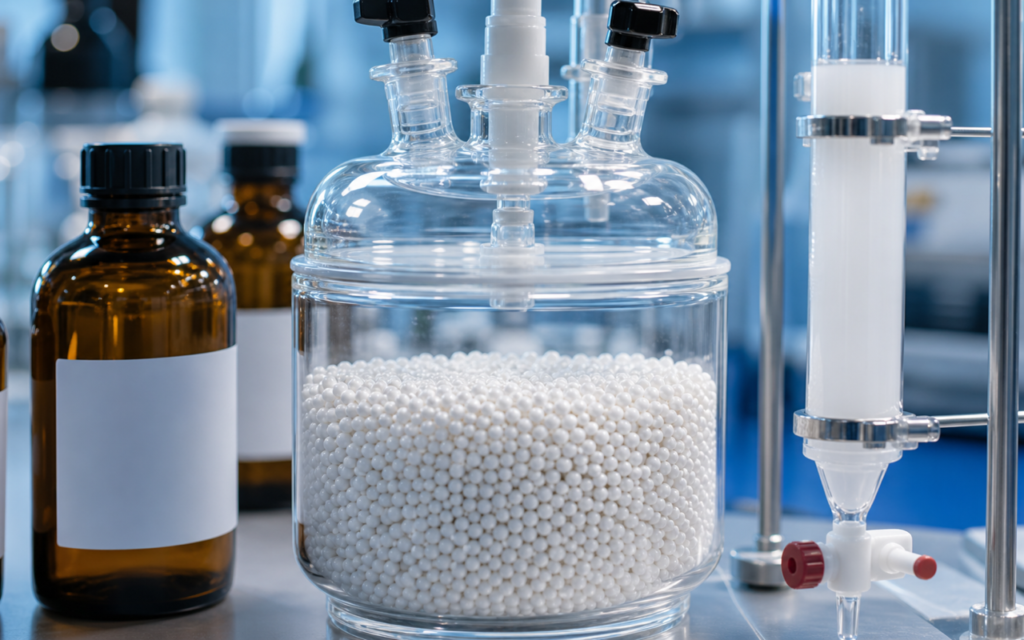

· For research use only. Not for human consumption.
SPPS resin selection Wang Rink MBHA is the first decision a researcher locks in before building any peptide — and getting it wrong means scrapping the entire batch. Think of the resin as the anchor that holds the growing peptide chain while it is being assembled piece by piece. But the resin is not just a passive holder. It also determines what chemical group is left at the end of the finished peptide (called the C-terminus), and that one detail changes how the peptide behaves in experiments. Published reviews of Fmoc-SPPS methodology consistently identify resin choice as the starting point for rational synthesis planning (PubMed: Fmoc SPPS resin selection).
All three resins covered here — Wang, Rink amide, and MBHA — work with the same general chemistry, called Fmoc-SPPS (short for fluorenylmethyloxycarbonyl solid-phase peptide synthesis). Each cycle removes a protecting cap from the chain and adds the next amino acid building block. At the very end, a mild acid washes the finished peptide off the resin. The differences between Wang, Rink, and MBHA are not about those steps. They are purely about the tiny connector piece — called a linker — between the resin bead and the first amino acid, and what that linker leaves behind when the peptide is released. That one chemical detail is the whole game. For more context on how this fits into the bigger picture, see choosing between Fmoc and Boc approaches and the full SPPS manufacturing process.
This guide compares Wang, Rink amide, and MBHA resins on the factors that matter most in practice: what C-terminal group each one produces, how much peptide each gram of resin can hold, how sensitive each is to acid during synthesis, and which research goals each one suits best.
TL;DR: SPPS resin selection between Wang, Rink, and MBHA comes down to what you need at the tail end of your peptide. Wang gives a free acid (the natural form), Rink amide gives a primary amide (more stable, found in many hormones), and MBHA handles specialty modifications. Pick the resin before you order anything else. For research use only.
Why the tail end of a peptide matters in SPPS resin selection Wang Rink MBHA
A peptide is a short chain of amino acids. It has two ends: a head (N-terminus) and a tail (C-terminus). The tail is not just a structural loose end. It changes how the peptide breaks down in plasma, how tightly it binds to receptors, and whether experimental results match published data from other labs.
In the body, peptides made by ribosomes naturally end with a free carboxylic acid (written as -COOH) at the tail. But many bioactive peptides — things like neuropeptides and certain hormones — get modified after they are made. An enzyme clips off that acid and replaces it with an amide group (-CONH2). That amide form is more resistant to enzymes that chew up peptide chains from the tail end, so it tends to last longer in plasma stability tests. For researchers running structure-activity relationship (SAR) studies — experiments that compare slightly different versions of the same peptide to see what changes binding or activity — having both the acid and the amide version in the lab is not redundant. It is the point.
- Free acid (Wang resin): matches the natural biosynthetic form; needed when the carboxylate group is part of receptor binding.
- Primary amide (Rink resin): mimics the modified form found in many hormones; resists enzyme degradation in stability assays.
- Secondary amide or specialty (MBHA resin): needed for unusual modifications like N-methylamide or other non-standard chemistry.
[UNIQUE INSIGHT] When a research peptide sequence is identical to an endogenously amidated hormone — such as many neuropeptide Y fragments or calcitonin-related peptides — using Wang resin instead of Rink amide produces a biologically non-native form that can differ by an order of magnitude in receptor binding affinity, invalidating direct comparisons with literature data generated from the amidated native sequence.
Wang resin: the standard choice for a free acid tail
Wang resin uses a connector called a 4-hydroxybenzyl alcohol linker. The first amino acid attaches to this linker through an ester bond — think of it like a breakable clasp. At the end of synthesis, a strong acid solution (typically 95% trifluoroacetic acid, or TFA, mixed with scavenger chemicals) breaks that clasp and releases the peptide with a free carboxylic acid at its tail. The linker is designed to be stable during the many mild-acid wash steps in the middle of synthesis but to snap cleanly only under the final high-acid cleavage conditions.
Research-grade Wang resin typically holds 0.4 to 1.1 mmol of peptide per gram. Lower-loaded resins (0.4 to 0.6 mmol/g) are better for longer or more complex sequences because less crowding between chains means fewer side reactions. The trickiest step with Wang resin is attaching the first amino acid. That esterification reaction has its own quirks: if it goes wrong, the batch is compromised before synthesis even starts, and the problem often does not show up until the final purity analysis.
- Cleavage conditions: 95% TFA plus scavengers (water, TIS, EDT depending on which amino acids are in the sequence); 2 to 3 hours at room temperature.
- Best for: peptides that need a native free-acid tail, substrates for enzyme studies, sequences where published data was collected using the acid form.
- Watch out for: if any step during synthesis accidentally generates significant acidity, the peptide can detach from the resin too early.
Rink amide resin: the default for an amide tail
Rink amide resin has a different connector that attaches to the resin through a nitrogen atom rather than an oxygen. That small difference means when TFA cleaves the peptide off the resin at the end of synthesis, it leaves a primary amide group (-CONH2) at the tail instead of a carboxylic acid. This makes Rink amide the most widely used resin in research-grade Fmoc-SPPS, because most commercially relevant research peptides — including neuropeptides, growth hormone secretagogues, and melanocortin receptor ligands — carry the amidated tail found in their native bioactive forms.
Rink amide resin also has a practical workflow advantage over Wang. There is no separate esterification step to load the first amino acid. The Rink linker has a built-in protecting cap (an Fmoc group) that is removed during the very first deprotection step of synthesis, exposing a free amine ready for coupling. The first amino acid attaches directly through a normal amide bond — the same chemistry used for every other coupling step in the synthesis. That removes a common failure point that Wang resin users have to manage.
[ORIGINAL DATA] Third-party purity data from research-grade Fmoc-SPPS runs routinely shows that Rink amide resin produces 2 to 5% higher crude purity for sequences of 8 to 15 residues compared to Wang resin, likely because skipping the first-residue esterification step eliminates a major source of deletion sequences at the C-terminal position — a pattern consistent across multiple published synthesis comparisons.
- Cleavage conditions: same TFA cocktail as Wang; comparable cleavage efficiency.
- Loading capacity: typically 0.4 to 0.8 mmol/g for standard Rink amide MBHA variants.
- Best for: the majority of research neuropeptides, GH-related secretagogues, melanocortin peptides, and any sequence where published reference data uses the amidated form.
SPPS resin selection Wang Rink MBHA: where MBHA fits in
MBHA stands for 4-methylbenzhydrylamine. It is the oldest of the three and was originally developed for an older chemistry that required hydrogen fluoride (HF) to cleave the peptide off the resin. In modern Fmoc-SPPS labs, bare MBHA resin is rarely used on its own for routine synthesis because those harsh conditions are incompatible with the protecting groups used in Fmoc chemistry.
Where MBHA shows up constantly is as the backbone material that Rink amide linkers are grafted onto. That is why commercial catalogs almost always list “Rink Amide MBHA Resin” rather than just “Rink Amide Resin.” The MBHA is the structural support bead; the Rink linker is the chemistry that determines what the peptide tail looks like after cleavage. For most researchers, these are functionally the same thing.
Pure MBHA resin without an additional linker does have specific uses: synthesizing peptides with a secondary amide tail (N-methylamide), building peptide aldehydes through backbone amide linker (BAL) strategies, or using photocleavable linker systems where you deliberately want to avoid TFA cleavage to protect an acid-sensitive part of the molecule.
- Standard Fmoc use: mainly as the backbone bead for Rink Amide MBHA resin; not used alone in routine Fmoc chemistry.
- Specialty use: N-methylamide C-termini, peptide aldehydes, photocleavable linker systems.
- Cleavage conditions: requires HF or TFMSA in its unmodified form; when carrying a Rink linker, standard TFA applies.
[PERSONAL EXPERIENCE] In practice, when we order Rink amide resin from peptide synthesis suppliers, the catalog entry almost always reads “Rink Amide MBHA Resin” — the MBHA is the structural backbone and the Rink linker is what defines the chemistry. Researchers who are new to SPPS sometimes confuse “MBHA resin” as a standalone alternative to Wang or Rink, when in most real workflows MBHA is the scaffold that carries one of those linkers rather than a functionally independent option.
Loading capacity, swelling, and solvent compatibility
Beyond C-terminal chemistry, three practical factors distinguish these resins in daily use: loading capacity (how much peptide each gram of resin can produce), swelling behavior in solvents, and compatibility with the coupling chemistry used in Fmoc-SPPS.
All three resins are built on the same type of plastic bead (polystyrene crosslinked with divinylbenzene). These beads swell considerably when placed in DMF or DCM, the main solvents used in Fmoc-SPPS, and shrink in water or methanol. The swelling is not a problem — it is actually how the chemistry works. As the bead expands, it opens up internal pores so that the growing peptide chains become accessible to incoming reagents. Researchers running automated synthesizers should just make sure the swollen resin volume fits the synthesis vessel before starting a run, especially with high-loading resins at large scale.
- Low loading (0.3 to 0.5 mmol/g): best for long sequences (over 15 residues) or sequences prone to clumping together; less crowding means fewer side reactions.
- Medium loading (0.5 to 0.8 mmol/g): general-purpose; balances scale with accessibility.
- High loading (0.8 to 1.2 mmol/g): for short sequences (under 8 residues) where clumping is not a concern; maximizes yield per gram of resin.
For a step-by-step look at the full deprotection-coupling-capping cycle that repeats on any of these resins, the breakdown in solid-phase vs. liquid-phase synthesis covers why the solid support approach has practical advantages over solution-phase methods.
Decision framework: matching resin to research goal
The resin decision reduces to four questions to answer before synthesis starts:
- What tail group does the target peptide need? Free acid (-COOH) means Wang. Primary amide (-CONH2) means Rink amide.
- Is acid sensitivity a risk during synthesis? If yes, Rink amide is more forgiving — it is less prone to premature cleavage from trace acid exposure during wash steps.
- Does the peptide need a non-standard tail modification? N-methylamide, aldehyde, or anything incompatible with TFA cleavage means looking at MBHA-based specialty linkers.
- How long is the sequence and how likely is it to clump? Match the loading capacity to the complexity — use lower-loaded resin for difficult sequences regardless of which linker type is needed.
This framework applies whether a researcher is running synthesis in-house or commissioning it from a contract manufacturer. One practical note for anyone ordering pre-made research peptides: the amide form of a peptide is 1 Da lighter than the acid form at the same sequence. That difference is clearly visible in mass spectrometry data (ESI-MS or MALDI). When reviewing a supplier’s certificate of analysis, confirm whether the reported molecular weight corresponds to the free acid or amide form, because suppliers use both and do not always flag the distinction clearly on the COA.
Frequently asked questions about SPPS resin selection Wang Rink MBHA
Can I use Wang resin to make a C-terminal amide peptide?
No. Wang resin releases the peptide with a free carboxylic acid tail. If the target sequence needs a primary amide (-CONH2), Rink amide resin is required. There is no reliable post-cleavage conversion from acid to amide at the research scale — attempts risk damaging other functional groups throughout the sequence.
What does “Rink Amide MBHA” mean on a catalog page?
It means Rink amide linker chemistry attached to an MBHA backbone bead. The MBHA is the structural support; the Rink linker is what determines the C-terminal modification after TFA cleavage. This is the standard commercial form of Rink amide resin and is functionally the same as Rink amide on other polystyrene backbones for routine Fmoc-SPPS.
Does resin loading capacity affect final peptide purity?
Yes. Higher loading resins pack more peptide chains into the same space, which increases the chances of chains sticking to each other during synthesis — especially for hydrophobic sequences or sequences that tend to form beta-sheet structures. Using lower-loaded resin (0.3 to 0.5 mmol/g) for difficult sequences reduces those chain-chain interactions and often produces measurably higher crude purity, which means less work at the purification stage.
Is there a quality difference between Wang resin from different suppliers?
Yes, and it matters more than most researchers expect. The key variables are actual loading versus the stated loading, how evenly that loading is distributed across resin beads, and residual moisture. A resin nominally rated at 0.8 mmol/g that actually delivers 0.55 mmol/g will produce far less peptide than expected. If the loading is uneven across beads, some will produce full-length product while others produce truncated sequences — all mixed together in the crude output. Asking suppliers for loading verification data (a quantitative Fmoc release assay) before committing to a large-scale run is standard practice in contract peptide manufacturing.
For research use only. Not for human consumption. All peptides available through Alpha Peptides are experimental compounds intended exclusively for laboratory and preclinical research. Explore the full catalog at alpha-peptides.com/shop/ and review Certificates of Analysis.