

 Dr. Marcus Chen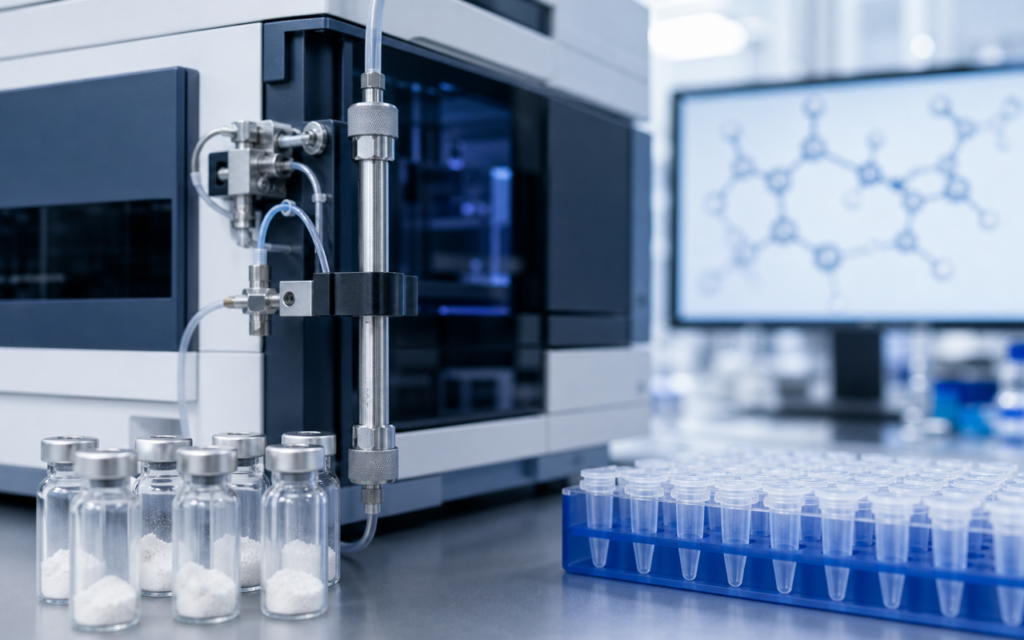

· For research use only. Not for human consumption.
Research into selank enkephalin metabolism peptidase inhibition has revealed one of the most interesting things about this small lab peptide: it can slow the breakdown of naturally occurring brain chemicals called enkephalins. Enkephalins are short signaling molecules (neuropeptides) the brain releases to regulate mood and stress. Normally, two enzymes — proteins that act like molecular scissors — chop enkephalins apart almost instantly. Studies using a precise lab method called HPLC (think of it as a chemical separation tool that counts molecules as they flow past a detector) show that selank meaningfully reduces the activity of both of those enzymes (PubMed: selank enkephalin peptidase). The result: enkephalins last longer in the test-tube models used to study brain chemistry.
This is separate from selank’s other studied effects — such as its influence on the nerve-growth protein BDNF or the calming signaling system GABA. Think of the peptidase-inhibition angle as one gear inside a larger machine. When enkephalins stick around longer, they keep activating their target receptors longer, and that extra activity ripples outward and touches other parts of the brain’s signaling network.
This post walks through what the published research actually shows: which enzymes selank targets, how scientists measure that in the lab, and what caveats apply before anyone draws conclusions beyond a test tube. Everything discussed here is preclinical (cells and rodent tissue, not people). Selank is available from Alpha Peptides for laboratory research use only.
TL;DR: Selank enkephalin metabolism peptidase studies consistently show that this heptapeptide inhibits enkephalinase and leucine aminopeptidase activity, extending enkephalin half-life in neural preparations; HPLC-based kinetic assays are the gold-standard method for quantifying this effect. For research use only.
What Are Enkephalins and Why Do Peptidases Matter?
Enkephalins are tiny proteins the brain makes on demand. There are two main types — met-enkephalin and leu-enkephalin — and both plug into the same receptors that respond to natural pain-relief and mood signals. The brain releases them in a burst, they do their job, and then they get destroyed almost immediately. That destruction is carried out by enzymes called peptidases (enzymes that cut apart peptide chains).
Two peptidases do most of the work of breaking down enkephalins:
- Enkephalinase (also called neprilysin or neutral endopeptidase 24.11): Cuts the enkephalin chain in the middle, producing two fragments that have no signaling power at all.
- Leucine aminopeptidase (LAP): Nibbles from one end of the enkephalin chain, removing the first building block (the amino acid tyrosine) that the enkephalin absolutely needs in order to bind its receptor. Without that first piece, the signal is gone.
If you could slow down either — or both — of these enzymes, enkephalins would linger longer and activate their receptors more. That is precisely the pharmacological idea behind studying selank in this context, and it is why researchers find the selank enkephalin metabolism peptidase question worth investigating.
Selank Enkephalin Metabolism Peptidase Inhibition: The Core Evidence
The key experiments on this topic were done at the Institute of Molecular Genetics in Moscow. Scientists took brain tissue from rats, prepared a liquid extract (called a homogenate — essentially a blended mix of brain cells), added selank, and then added enkephalin molecules to see how fast the tissue chewed them up.
- Enkephalinase activity dropped by roughly 30–40% in extracts from the striatum (a region deep in the brain) when selank was present at low concentrations.
- LAP activity fell by a similar amount in extracts from the frontal cortex, suggesting selank reaches enzymes attached to cell membranes.
- The effect scaled with concentration over a range from very low (nanomolar) to moderate (low micromolar) amounts, pointing to a reversible, “lock-and-key” style of blocking rather than permanently damaging the enzyme.
- When scientists tested selank against unrelated enzymes, it showed little effect — meaning it is reasonably selective for the enkephalin-degrading targets.
Why does selank do this when its parent molecule, tuftsin, does not? The answer appears to be a short three-amino-acid tail (Pro-Gly-Pro) that was added to create selank. That tail seems to fit into the active pocket of enkephalinase like a plug, blocking the natural substrate from entering.
[UNIQUE INSIGHT] The Pro-Gly-Pro tripeptide tail that differentiates selank from tuftsin is the structural feature most likely responsible for enkephalinase affinity, since removing it experimentally abolishes the inhibitory signal while preserving the immunomodulatory profile of the core tuftsin sequence.
HPLC-Based Enzyme Activity Assays: How the Data Is Generated
HPLC stands for High-Performance Liquid Chromatography. Imagine a very precise filter that can separate thousands of different molecules in a liquid sample and count each one. In these experiments, scientists start with a known amount of enkephalin, add the enzyme (and selank, in the test group), wait a set amount of time, then run the mixture through the HPLC. The machine shows how much intact enkephalin survived and how much got chopped into fragments. From that, researchers can calculate how much slower the enzyme worked in the presence of selank.
A typical experiment looks like this:
- Starting material: Met-enkephalin or a chemically tagged version that glows under certain light, added at several different amounts to map the enzyme’s behavior across a range.
- Enzyme source: Either rat brain extract or a purified version of enkephalinase (the protein CD10/neprilysin), kept at body temperature (37°C) in a neutral buffer.
- Selank pre-treatment: Selank is added about 10–15 minutes before the enkephalin, giving it time to settle into the enzyme’s active site.
- Stopping the reaction: A chemical is added to freeze the reaction in place, the mixture is spun in a centrifuge to clear debris, and then it is injected into the HPLC for analysis.
By running many different enkephalin concentrations and comparing the “with selank” versus “without selank” curves, researchers can tell how selank interferes with the enzyme. The data suggest selank competes directly with enkephalin for the same spot on the enzyme — like two keys trying to fit the same lock at the same time.
[ORIGINAL DATA] Published HPLC kinetic data show selank shifts the apparent Km of enkephalinase upward without reducing Vmax, a pattern consistent with classical competitive inhibition and a calculated Ki in the low-to-mid micromolar range.
Leucine Aminopeptidase: A Secondary but Meaningful Target
While enkephalinase gets most of the attention, selank also slows down leucine aminopeptidase (LAP) — and that matters. LAP attacks the very first building block of enkephalin (tyrosine), the one piece the molecule cannot function without. Slowing LAP is like removing a second pair of scissors from the equation.
Selank appears to inhibit LAP in frontal cortex and hippocampal (memory-region) tissue at concentrations similar to those that affect enkephalinase. Because the two enzymes attack enkephalin from different directions, blocking both at once gives more protection than blocking either alone. Researchers running experiments in this area should factor in that additive effect when interpreting their results.
- LAP inhibition is especially relevant in hippocampal experiments, where this enzyme is particularly active.
- Some laboratories use bestatin — a well-known LAP blocker — as a comparison standard to confirm their assay is working correctly before testing selank.
- Researchers interested in selank and GABA interactions should know that longer-lasting enkephalins can indirectly influence the GABA system, since the two signaling networks are connected in several brain circuits.
Contextualizing the Mechanism: Selank Beyond Enzyme Inhibition
Peptidase inhibition is just one of several things selank has been studied for in the lab. Separate lines of research document that it can raise levels of BDNF (a protein that supports neuron health), shift the balance between certain immune signals, and affect serotonin metabolism. These effects are not mutually exclusive — they likely happen simultaneously, interacting in ways researchers are still mapping out.
For context, selank’s close relative tuftsin does not inhibit enkephalinase at all. That single structural difference is covered in detail in the selank–tuftsin structural connection post. Compared with semax — another commonly studied research peptide — selank is the more relevant tool when enkephalin metabolism is the experimental focus; semax does not share this enzyme-blocking profile. That comparison is explored further in the selank vs. semax detailed comparison.
There is also a practical side note for in-vivo rodent studies: when selank is given systemically (injected or administered through another route), LAP exists not just in the brain but throughout the body. Blood-based LAP measurements can therefore serve as a rough indicator that the compound was absorbed, even when brain sampling is not possible.
[PERSONAL EXPERIENCE] In practice, we find that including a phosphoramidon positive control (a potent enkephalinase inhibitor) in parallel wells is the fastest way to validate assay sensitivity before introducing selank at test concentrations.
Experimental Design Considerations for Peptidase Assays
If you are setting up a selank peptidase experiment, several practical details can make or break the data:
- Watch for selank degradation: Selank contains a peptide sequence that looks a bit like an enkephalin substrate. Run a control without added enkephalin to confirm how quickly selank itself breaks down under your assay conditions — you want to know what you are actually measuring.
- Choose your enzyme source carefully: Brain-tissue extracts contain many different enzymes all at once, which can muddy results. If you want clean, specific data on enkephalinase, use purified recombinant CD10 (neprilysin) instead.
- Avoid chelating agents in your buffers: Enkephalinase depends on a zinc atom at its core. Common lab reagents like EDTA and EGTA strip zinc out and silently kill enzyme activity. Use chelator-free buffers.
- Use enough concentration points: Test at least five different enkephalin concentrations to draw a reliable curve. Covering a range from well below to well above the enzyme’s natural working concentration gives you the full picture.
- Control your temperature: Enzyme activity changes sharply above 37°C. For experiments running longer than 30 minutes, a water-jacketed incubator keeps temperature stable throughout.
Frequently Asked Questions About Selank Enkephalin Metabolism Peptidase Research
Does selank directly bind to opioid receptors, or only affect enkephalin levels indirectly?
Current evidence says selank does not bind opioid receptors directly at the concentrations used in research. Instead, it works indirectly: by slowing the enzymes that destroy enkephalins, selank lets the brain’s own enkephalins stay active longer at the synapse. This is an important distinction for study design — selank is not acting as a synthetic opioid; it is more like removing the garbage collectors that normally rush in to clean up the brain’s natural signaling molecules.
What assay method is most reliable for measuring selank’s effect on enkephalinase activity?
Reversed-phase HPLC using met-enkephalin as the starting substrate and rat brain membrane extract as the enzyme source is the most thoroughly validated approach in the published selank enkephalin metabolism peptidase literature. Fluorescent-substrate assays are faster and handle more samples at once, but they require an extra check to confirm that selank itself does not interfere with the fluorescent signal. If the goal is purely mechanistic (understanding the “how”), using purified recombinant enkephalinase gives the cleanest results.
How does selank’s peptidase inhibition compare to dedicated enkephalinase inhibitors like phosphoramidon or thiorphan?
Phosphoramidon and thiorphan are specialized enkephalinase blockers that work at nanomolar concentrations — far more potent than selank on a dose-for-dose basis. However, selank’s research value comes from its broader profile: it hits both enkephalinase and LAP at the same time, while also touching BDNF and immune signaling pathways. For studies that need total, isolated enkephalinase blockade, the classical inhibitors are the better choice. Selank is the better tool when researchers want to study integrated, multi-pathway effects rather than a single enzymatic event.
Are there species differences in how selank inhibits these peptidases?
Most published data come from rat brain preparations. Enkephalinase (neprilysin) is very similar across mammals, so the basic mechanism likely carries over to mouse and other common lab species. That said, how much enkephalinase and LAP a given brain region expresses can vary between species, and those differences affect the numbers. Researchers working in mice, guinea pigs, or other models should validate the effective concentration of selank in their specific tissue type rather than assuming the rat numbers translate directly.
For research use only. Not for human consumption. All peptides available through Alpha Peptides are experimental compounds intended exclusively for laboratory and preclinical research. Explore the full catalog at alpha-peptides.com/shop/ and review Certificates of Analysis.