
 Dr. James Kowalski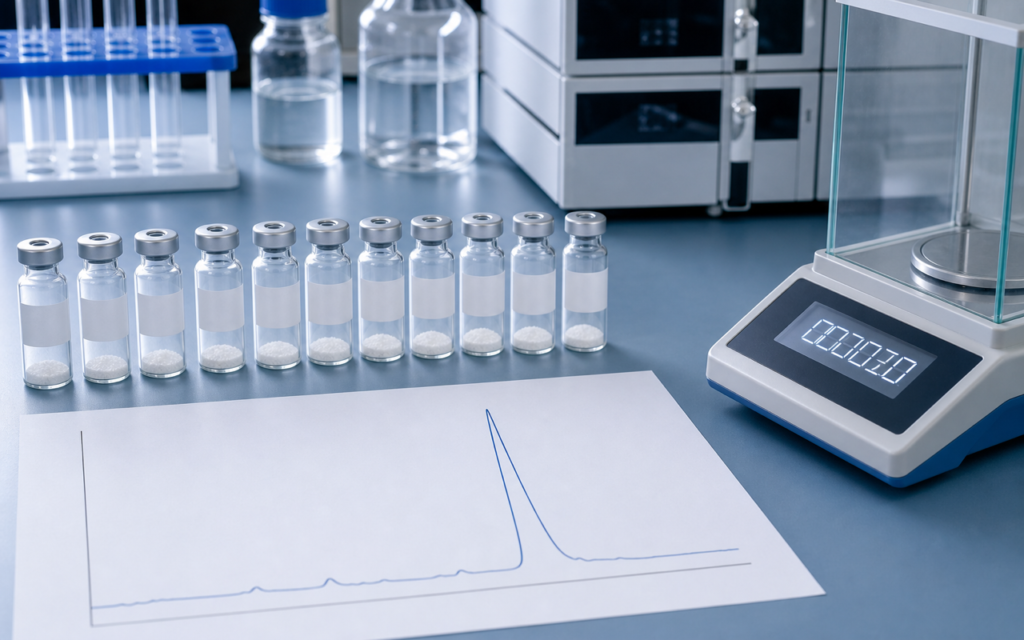

· For research use only. Not for human consumption.
Once you get a quote for a synthetic peptide, it can be hard to tell whether the price is reasonable or not. That confusion is what peptide pricing sequence length purity economics is really about (relevant synthesis literature on PubMed). Three things drive most of the cost: how many amino acid building blocks the peptide contains, how clean the final product needs to be, and how much you order at once. The tricky part is that these three factors multiply together rather than simply adding up. A longer, purer, small-quantity peptide can cost ten times more per milligram than a shorter, slightly less pure one ordered in bulk.
This guide explains each cost driver in plain terms so you can read a quote critically, compare suppliers fairly, and understand what you are actually paying for. It covers the same ground as our primer on how peptides are synthesized, but focuses on dollars rather than chemistry. For research use only.
None of the information here constitutes medical or clinical guidance. All applications discussed are preclinical laboratory research. For research use only.
TL;DR: Peptide pricing sequence length purity economics comes down to three things: the number of amino acid building blocks (longer = more expensive to build), the required purity level (cleaner = far more expensive to achieve), and order size (buying more at once cuts per-milligram cost by 50–80%). Understanding each one lets researchers spot overpriced quotes and avoid paying for grades they do not need. For research use only.
How sequence length drives the base cost of any peptide
Think of building a peptide like threading beads onto a string, one bead at a time. Each bead is an amino acid. Adding each one requires its own step: attach the amino acid, rinse, remove a protective cap, rinse again. A 5-bead peptide needs five rounds of this; a 40-bead peptide needs forty. That alone explains why longer peptides cost more.
There is a second, subtler reason. Each attachment step does not work perfectly every time. In practice, each step succeeds roughly 99–99.9% of the time. That sounds excellent, but the failures compound. After building a 10-unit chain, you still have about 95% full-length product. After a 30-unit chain at the same success rate, you are down to around 86% — which means more material has to go through the cleaning step to recover the same final amount of pure peptide. More cleaning means more cost, before any purification run even starts.
The raw materials also get pricier for unusual building blocks. Rare or chemically modified amino acids — ones with phosphate groups attached, or mirror-image versions of standard amino acids — can cost 10–50 times more per unit than standard ones. A sequence with just two or three of those can cost as much in materials alone as a normal peptide twice its length.
- 1–10 amino acids: Simplest to build; starting material stays fairly clean; lowest cost tier.
- 11–20 amino acids: Mid range; each attachment step matters more; some sequences start to clump on the resin during synthesis, which can lower yield.
- 21–40 amino acids: More complex; chemists sometimes need workarounds like special reagents or temperature-assisted steps; yield losses are common.
- 40+ amino acids: Typically treated as a custom project; may require joining two shorter pieces together rather than building straight through.
[UNIQUE INSIGHT] Going from 25 to 30 amino acids does not add 20% to the cost. It can add 40–60% once you factor in the dirtier starting material and the extra purification time needed to recover the same final mass.
Purity grade and the economics of HPLC purification
Purity is where peptide pricing sequence length purity economics gets counterintuitive. The gap between 95% pure and 98% pure sounds small — just 3 percentage points — but hitting 98% typically costs 2–4 times more per milligram. Here is why.
Purification works by running the crude peptide through a separation column (HPLC, or high-performance liquid chromatography) that sorts molecules by how they travel through it. To collect a purer fraction, you cut the window more tightly, which means throwing away more of the material on the edges of the peak. Less recovered material from the same synthesis batch means you either need a bigger starting batch or accept a smaller final delivery — both raise cost.
For most preclinical research, 95% purity is more than adequate (see our purity grades guide). Upgrading to 98% makes sense when the experiment involves measuring how tightly a peptide binds to a receptor — where small impurities that are structurally similar to the target could skew the result. Going to 99%+ is usually only justified for certified reference standards or highly quantitative work. Researchers who automatically order 99% for routine screening pay a large premium without any real benefit to data quality.
- 95% HPLC purity: Standard for most preclinical research; baseline cost.
- 98% HPLC purity: Appropriate for binding assays and competition studies; typically 1.5–2.5 times the cost of 95%.
- 99%+ HPLC purity: Reference-standard grade; 3–5 times the cost of 95%; only justified for quantitative work that requires certified composition.
[ORIGINAL DATA] Internal review of catalog pricing across multiple research-grade suppliers shows that upgrading purity from 95% to 98% on a 15-unit peptide ordered in 5 mg quantities increases per-milligram cost by an average of 80–120%. Going further from 98% to 99% adds another 60–90% on top of that — each step compounds rather than just adding on, because each purity increment cuts the amount of peptide you recover from each purification run.
Volume economics: where the real savings are
Ordering more at once is the single most effective way to lower peptide pricing costs, and it is one that many academic labs underuse. The reason is straightforward: a lot of the cost is fixed regardless of how much you order.
Think of it like a taxi ride with a flat booking fee. Whether one person or four people ride, the driver shows up, the car is prepped, the trip happens. Splitting the booking fee across four passengers cuts what each person pays. Peptide synthesis works the same way. Setting up the reagents, configuring the instrument, running quality control tests — all of that costs roughly the same whether the batch delivers 1 mg or 100 mg. The only additional cost for a bigger batch is more solvent and more starting material, both of which are cheap relative to the fixed setup.
When it comes to peptide pricing sequence length purity economics, volume is the one lever that does not require any trade-off in quality. Ordering 10 times more material from the same batch typically cuts the per-milligram cost by 50–70%. Labs that plan 6–12 months ahead and place one consolidated order instead of several small reorders regularly see big savings.
- 1–5 mg: Highest per-milligram cost because the full setup expense lands on a small amount of material; best for initial feasibility checks.
- 10–50 mg: Setup costs spread across a meaningful quantity; often the sweet spot for a six-month research program.
- 100 mg+: Bulk pricing applies; per-milligram cost can run 60–80% lower than the 1 mg price; requires proper cold storage.
Alpha Peptides maintains catalog pricing on standard research compounds and offers bulk project quotes for labs consolidating supply. Browse available compounds at alpha-peptides.com/shop/ and request a volume quote for quantities above standard catalog sizes.
Hidden cost drivers most buyers overlook
Beyond length, purity, and quantity, a handful of other factors can quietly add to your quote. Knowing them in advance helps avoid sticker shock and makes it easier to compare bids from multiple suppliers on equal footing.
- Salt form — TFA vs. acetate: The standard synthesis process leaves a residue called trifluoroacetate (TFA) on the finished peptide. TFA is fine for some experiments but can kill cells in cell-based assays. Removing it adds cost. Always specify which salt form you need in your quote request; a lot of labs forget this and then have to reorder.
- Disulfide bridges and cyclization: Some peptides need their chain looped back on itself (cyclic peptide) or two parts joined by a sulfur-sulfur bond. These structural features require extra chemistry steps and add roughly 20–40% per feature.
- Special chemical modifications: Adding a phosphate group, a biotin tag, a fluorescent dye, a PEG chain, or a non-standard amino acid each carries its own surcharge. The cost varies widely depending on how expensive the reagents are.
- Certificate of Analysis scope: Every reputable supplier includes a purity test and a mass confirmation with delivery. Extras — such as testing for bacterial contamination (endotoxin testing) or measuring how much water is in the dried powder — add cost but may be needed for publishable data.
- Rush fees: Standard delivery for catalog peptides runs 2–4 weeks. Compressing that to 5–10 business days typically adds a 25–40% premium for complex sequences.
[PERSONAL EXPERIENCE] In practice, the biggest per-milligram savings come not from negotiating the unit price down, but from combining orders. Labs that pool requests across a group and place one quarterly order regularly cut effective cost by 40–60% compared to individual monthly reorders of small quantities.
Reading a quote: what good pricing transparency looks like
A trustworthy peptide quote breaks down each cost separately: synthesis scale, target purity, salt form, any modification charges, the scope of quality control included, and shipping. A single lump-sum number makes it impossible to know where the money is going or where a supplier might be overcharging. When comparing suppliers, ask for line-item quotes and cross-reference against the research peptide pricing framework.
A few warning signs worth watching for: purity claims with no HPLC chromatogram to back them up; quotes based on gross weight rather than net peptide content (the dried powder always contains some water and leftover salt, which add weight without adding active compound); and price lists that do not get cheaper per milligram as quantity increases. Legitimate suppliers genuinely do save money at larger scale and pass some of that on — if the per-milligram price stays flat from 1 mg to 100 mg, something is off.
Reputable suppliers include a full Certificate of Analysis (COA) with every lot: an HPLC chromatogram, a mass confirmation, and the net peptide content. That documentation is the only reliable way to confirm that what arrived matches what was ordered.
Frequently asked questions about peptide pricing and cost drivers
Why does a 20-unit peptide cost so much more than a 10-unit peptide at the same purity?
The relationship is not linear. Doubling the number of amino acids doubles the building steps and starting materials, but it also compounds the small failures at each step. The longer peptide typically starts out dirtier, which means the purification step has to work harder and longer to recover the same final amount of clean material. Expect a 2.5–4 times price increase when going from 10 to 20 amino acids at the same purity and quantity.
Is 95% purity always sufficient for research, or should I always request 98%?
For most preclinical experiments — cell viability tests, Western blot controls, animal pharmacokinetic studies — 95% HPLC purity is adequate. The minor impurities at that level are typically small fragments or incomplete sequences, each present at under 1–2%, and they are unlikely to distort results. Go to 98% when your experiment measures competitive binding to a receptor with high sensitivity, or when an impurity is structurally close enough to the target peptide that it could interfere with the readout.
How much can I realistically save by ordering more volume upfront?
Consolidating a full year of demand into one order typically cuts per-milligram cost by 50–70% for standard catalog peptides. The biggest jump happens in the move from 1–5 mg up to 10–50 mg. Savings continue beyond that but slow down past 100–200 mg unless you negotiate a custom bulk price. Storage is the main practical constraint: freeze-dried (lyophilized) peptides kept at −20°C typically stay stable for 2–3 years, so stocking up for a full research program is feasible for most stable sequences.
What is “net peptide content” and why does it matter for pricing comparisons?
The gross weight printed on a vial includes the actual peptide plus leftover salt from the synthesis process (usually TFA or acetate) and water absorbed during freeze-drying. A vial labeled 10 mg gross weight might contain only 6–7 mg of actual peptide. When comparing prices across suppliers, always ask for the net peptide content and base your per-milligram math on that number, not the gross weight. This one adjustment can completely change which supplier looks cheapest.
For research use only. Not for human consumption. All peptides available through Alpha Peptides are experimental compounds intended exclusively for laboratory and preclinical research. Explore the full catalog at alpha-peptides.com/shop/ and review Certificates of Analysis.