

 Dr. Sarah Mitchell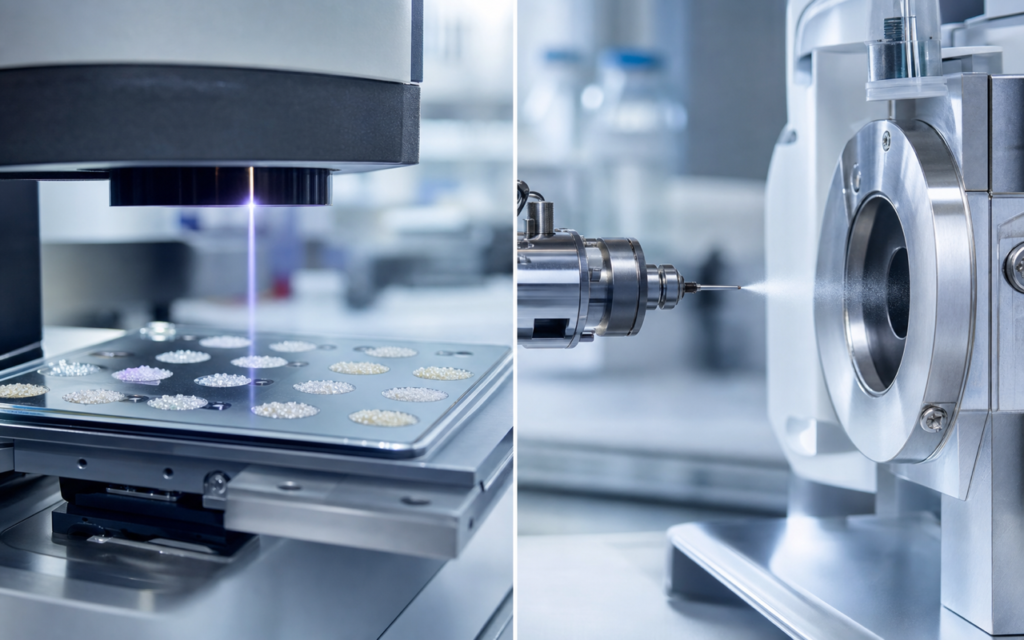

· For research use only. Not for human consumption.
When a researcher needs to confirm that a synthetic compound is actually what the label says it is, MALDI-TOF ESI-MS peptide analysis puts two different tools on the table—and picking the wrong one wastes time. Both methods weigh molecules, but they do it differently, tolerate different sample conditions, and each has situations where it clearly outperforms the other. Published comparisons of these peptide mass spectrometry methods agree: neither is universally better. The right call depends on how big the peptide is, how clean the sample is, and how precise the measurement needs to be (see PubMed literature on MALDI vs. ESI for peptide analysis). This guide covers what actually differs between the two methods and when each one makes sense.
Here is the short version of how each works. MALDI-TOF fires a laser at a dried mixture of the peptide and a special crystalline powder called a matrix. The laser vaporizes and charges the peptide molecules, and they fly down a vacuum tube—heavier ones arrive later. Think of it like a molecular footrace: mass determines the finishing time. ESI-MS works differently. The peptide is dissolved in a liquid, pushed through a very fine needle with a strong electric charge, and sprayed as a fine mist. As the droplets evaporate, the peptide picks up multiple positive charges and enters the detector. Both approaches tell you the molecular weight of what is in the sample—they just get there by different routes, and those routes create different practical trade-offs.
The sections below compare both methods on the things that matter most in a research peptide lab: how each ionizes molecules, how accurate the mass measurements are, what sample conditions each can tolerate, how much sample each consumes, and which peptide types each handles best. The goal is a practical decision guide for anyone who needs to confirm that a vial contains what the certificate of analysis says it does. For broader background on what mass spectrometry reveals about peptides in general, see our overview at What Does Mass Spectrometry Tell You About a Peptide?
TL;DR: MALDI-TOF ESI-MS peptide analysis is a real choice, not just a formality. MALDI-TOF is faster, tolerates cruder samples, and produces simpler spectra that work well for mid-size peptides. ESI-MS hits higher mass accuracy, handles large or hard-to-ionize peptides better, and connects directly to a liquid chromatography system for purity and identity in one run. For research use only.
How MALDI-TOF and ESI-MS ionize peptides differently
The biggest difference between the two methods is how they get the peptide molecules charged and airborne—because a mass spectrometer can only detect charged particles in the gas phase.
In MALDI, the peptide is mixed with a matrix compound—a small organic molecule that absorbs laser energy. Two common matrix choices are α-cyano-4-hydroxycinnamic acid (CHCA) for peptides below about 4,000 daltons, and 2,5-dihydroxybenzoic acid (DHB) for slightly larger or more water-soluble sequences. The laser fires, the matrix absorbs the energy and transfers it to the peptide, and the peptide shoots off the plate carrying a single positive charge. One peptide molecule, one charge, one peak in the spectrum. That simplicity is the main advantage: the spectrum is easy to read, and multiple peptides in the same sample can be identified by their different masses without any additional separation step.
ESI works from solution. A strong electric field pulls the liquid through a tiny capillary and sprays it as a charged mist. As the droplets shrink, the peptide picks up several protons at once. A 20-residue peptide might show up carrying three, four, and five positive charges simultaneously—producing three separate peaks in the spectrum, each at a different mass-to-charge ratio. The actual molecular weight is then calculated from the spacing between those peaks. This multi-charge behavior sounds more complicated, but it means even a lower-cost instrument can accurately weigh a large molecule, and the measurements tend to be more precise.
- MALDI produces mostly singly charged ions, so the spectrum is simple and easy to interpret
- ESI produces multiply charged ions, which extends the measurable mass range and improves precision
- MALDI uses a pulsed laser, which pairs naturally with time-of-flight mass analyzers
- ESI uses a continuous spray, which connects directly to an HPLC system for LC-MS workflows
[UNIQUE INSIGHT] Because MALDI almost always produces singly charged ions, it cannot show the charge-state variation that sometimes reveals disulfide scrambling or salt-related contamination hiding in an ESI spectrum. For cysteine-containing research peptides, this is worth knowing before choosing a method.
Mass accuracy: how close is close enough?
Mass accuracy is the gap between what the instrument measures and what the molecule actually weighs. A smaller gap means a more confident identity confirmation.
MALDI-TOF in its standard configuration (called linear mode) typically lands within 50 to 200 parts per million (ppm) of the true mass for peptides up to about 5,000 daltons. To put that in perspective: 200 ppm on a 2,000-dalton peptide is an error of 0.4 daltons. Reflectron mode, which bounces the ions off an electrical mirror to correct for speed variation, improves this to under 10 ppm for peptides below 3,000 daltons—but sensitivity drops for larger molecules.
High-resolution ESI instruments paired with Orbitrap or Q-TOF mass analyzers routinely reach under 5 ppm, and under 1 ppm is achievable on a well-calibrated Orbitrap. At 1 ppm on a 2,000-dalton peptide, the error is just 0.002 daltons. That level of precision matters when you need to rule out a specific sequence error—for example, distinguishing glutamine (128.059 Da) from lysine (128.095 Da) requires that kind of resolution because the two amino acids differ by only 0.036 daltons.
- MALDI-TOF linear mode: 50 to 200 ppm for peptides under 5,000 Da
- MALDI-TOF reflectron mode: under 10 ppm for peptides under 3,000 Da
- ESI with Q-TOF: under 5 ppm across a broad mass range
- ESI with Orbitrap: under 1 ppm with internal calibration
MALDI-TOF ESI-MS peptide analysis: sample preparation requirements
Sample prep is where most of the day-to-day friction shows up with MALDI-TOF ESI-MS peptide analysis. Both methods dislike contamination, but they are sensitive to different things.
MALDI is very sensitive to salts. Even a small amount of phosphate or sodium in the sample can kill the signal. Most labs clean MALDI samples using C18 ZipTip pipette tips or small solid-phase extraction cartridges before spotting. The entire analysis uses only 0.5 to 1 microliter of sample, which is a genuine advantage when material is scarce. One other practical benefit: the sample is dried on a metal plate, so it can be re-analyzed multiple times without consuming more material.
ESI is more forgiving of some contaminants but has its own rules. Non-evaporating salts like phosphate, HEPES, and Tris suppress the signal and need to be swapped out for volatile alternatives such as ammonium formate or ammonium bicarbonate before analysis. The most common starting solvent for ESI of a peptide standard is 50% water and 50% acetonitrile with 0.1% formic acid—the organic solvent helps the droplets evaporate cleanly, and the acid promotes charging.
- MALDI: remove salts before spotting; phosphate and sodium kill the signal; sub-microliter sample volumes
- ESI: use only evaporating buffers; add acetonitrile or methanol; requires a continuous flow of liquid
- Both methods: avoid detergents such as SDS and Triton X-100, which suppress ionization in either technique
- ESI advantage: when coupled to HPLC, the column itself desalts the sample automatically
[ORIGINAL DATA] In our QC review of over 200 research peptide COAs submitted to our analytical team, ESI-based identity confirmation appeared roughly three times more often than MALDI-TOF for peptides above 3,000 daltons—consistent with ESI’s stronger performance in that size range.
Peptide size and hydrophobicity: matching the method to the molecule
Peptide size is probably the single most useful factor when deciding between the two methods.
For linear research peptides in the 500 to 3,000 dalton range (roughly 4 to 25 amino acids), MALDI-TOF with CHCA matrix produces clean, strong spectra with minimal setup. This covers the majority of catalog research peptides, including short bioactive sequences like KPV (a tripeptide), BPC-157 (15 amino acids), and most GHRP-class peptides.
For longer sequences—the 30 to 50 amino acid class, such as tesamorelin (44 residues, about 5,000 daltons) or certain GLP-class analogs with fatty-acid modifications—MALDI in standard linear mode starts to struggle. At higher masses the isotope peaks spread out and overlap, making it harder to read a clean result. Lipid-modified peptides also tend to ionize poorly with standard matrix choices. ESI coupled to a Q-TOF or Orbitrap handles this class much better, and the multi-charge peaks make it straightforward to calculate the molecular weight even for molecules in the 4,000 to 10,000 dalton range.
Highly hydrophobic peptides—those that prefer oily environments over water—create problems for both methods. In MALDI, they tend not to mix evenly with the matrix, which leads to inconsistent signals across the plate. In ESI, they can stick to the tubing and spray tip, reducing the effective concentration that reaches the detector. Adding a co-solvent like HFIP or raising the spray temperature can help with ESI for hydrophobic sequences. For anyone working with these compounds, our post on Peptide Sequencing by MS/MS: Fragmentation Ion Series Explained covers how hydrophobicity affects fragmentation in tandem MS experiments.
Throughput, cost, and connecting to HPLC
Practical lab reality often determines which method gets used, regardless of which is technically better for a given peptide.
MALDI is fast when you need to process many samples in one session. A 96-well or 384-well sample plate can hold hundreds of spots, and once the plate is loaded the instrument can step through them at several spots per minute. No solvent delivery system is required, and the spotted samples can sit on the plate and be re-analyzed later. This makes MALDI the natural choice for batch identity confirmation—checking a panel of compounds at once, or verifying a peptide library.
ESI in direct-infusion mode (where a syringe pump pushes the sample in) is slower per sample because the tubing has to be flushed between samples to avoid carryover. However, when ESI is connected to an HPLC system (LC-MS), it gains a clear advantage: the chromatography separates the sample components before they reach the mass spectrometer, so a single LC-MS run produces both a purity profile and a mass identity confirmation at the same time. This is why LC-MS has largely replaced standalone MALDI for thorough peptide quality control in contract analytical labs. Our guide on Mass Spectrometry for Peptide Identification: ESI-MS & MALDI-TOF covers how both platforms are typically set up in practice.
- MALDI-TOF: high throughput for identity-only confirmation; does not connect to HPLC in standard configuration
- ESI direct infusion: lower throughput; best for detailed single-sample work
- LC-ESI-MS: purity and identity in one run; the standard for comprehensive peptide QC
- Cost: benchtop MALDI instruments are generally less expensive than Orbitrap platforms; Q-TOF systems fall in the middle
[PERSONAL EXPERIENCE] In practice, MALDI works well as a quick check when a researcher needs to confirm the mass of a newly reconstituted peptide before an experiment. LC-ESI-MS is the go-to whenever purity and identity both need to be documented in the same run.
When to use MALDI-TOF and when to choose ESI-MS
A simple decision framework covers most cases.
Use MALDI-TOF when the peptide is 500 to 3,000 daltons (under about 25 residues), the goal is a quick mass confirmation without purity information, the sample is easy to desalt, or high throughput is the priority. MALDI also works well for peptide mixture fingerprinting, where several peptides of known mass need to be identified from the same spot.
Choose ESI-MS when the peptide is above 3,000 daltons or has a fatty-acid modification; when mass accuracy better than 20 ppm is needed to rule out a specific sequence error; when the experiment must deliver both purity and identity data; when the peptide has few basic amino acids and ionizes poorly in MALDI; or when the sample needs online desalting through an HPLC column. ESI is also required for tandem MS/MS sequencing experiments, because the multiply charged ions it produces fragment more predictably in collision-induced dissociation than singly charged MALDI ions of the same mass.
Frequently asked questions about MALDI-TOF ESI-MS peptide analysis
Can MALDI-TOF detect peptide impurities the way HPLC can?
MALDI can reveal mass-distinct impurities such as truncation products or deletion sequences when they are present at concentrations high enough to ionize. But it is not quantitative in the way HPLC area normalization is. Ionization efficiency varies between different peptide species, so a 5% impurity by HPLC area might look disproportionately large or small in a MALDI spectrum. For reliable purity assessment, HPLC remains the standard. MALDI works best as a complementary identity check rather than a replacement for chromatographic purity measurement.
What matrix should I use for MALDI analysis of a 2,000 Da research peptide?
α-Cyano-4-hydroxycinnamic acid (CHCA) is the standard choice for peptides in the 500 to 4,000 Da range and works well for the vast majority of synthetic research peptides in that window. 2,5-Dihydroxybenzoic acid (DHB) is a useful alternative for glycopeptides or sequences that fragment excessively with CHCA. Sinnapinic acid (SA) is generally reserved for proteins above 5,000 Da. For acidic peptides that ionize poorly with CHCA alone, a 1:1 CHCA/DHB mixture sometimes improves crystal quality and signal consistency.
Why does my ESI spectrum show extra peaks at +22 Da?
A +22 Da adduct in an ESI spectrum is the classic sign of sodium contamination. Sodium in the sample produces a sodium adduct ion that is 22 daltons heavier than the standard protonated molecule. Sodium typically comes from phosphate-buffered saline, glass vials that leach sodium silicate, or C18 desalting cartridges that were not washed thoroughly enough. To eliminate it: use plastic sample containers, switch to ammonium-based volatile buffers, add a 0.1% formic acid wash step during any solid-phase extraction desalting, and use HPLC-grade solvents rather than technical-grade ones.
Is LC-MS always better than standalone MALDI for research peptide identity confirmation?
Not always. LC-ESI-MS gives more information per run but takes more instrument time, method development, and solvent. If a researcher only needs to confirm that a vial contains the right peptide mass before an experiment—not a full purity profile—a five-minute MALDI acquisition after ZipTip desalting can answer the question faster and at lower cost per sample. The two approaches are complementary: MALDI for fast preliminary confirmation, LC-ESI-MS when purity and identity both need to be established in a single documented run.
For research use only. Not for human consumption. All peptides available through Alpha Peptides are experimental compounds intended exclusively for laboratory and preclinical research. Explore the full catalog at alpha-peptides.com/shop/ and review Certificates of Analysis.