

 Dr. James Kowalski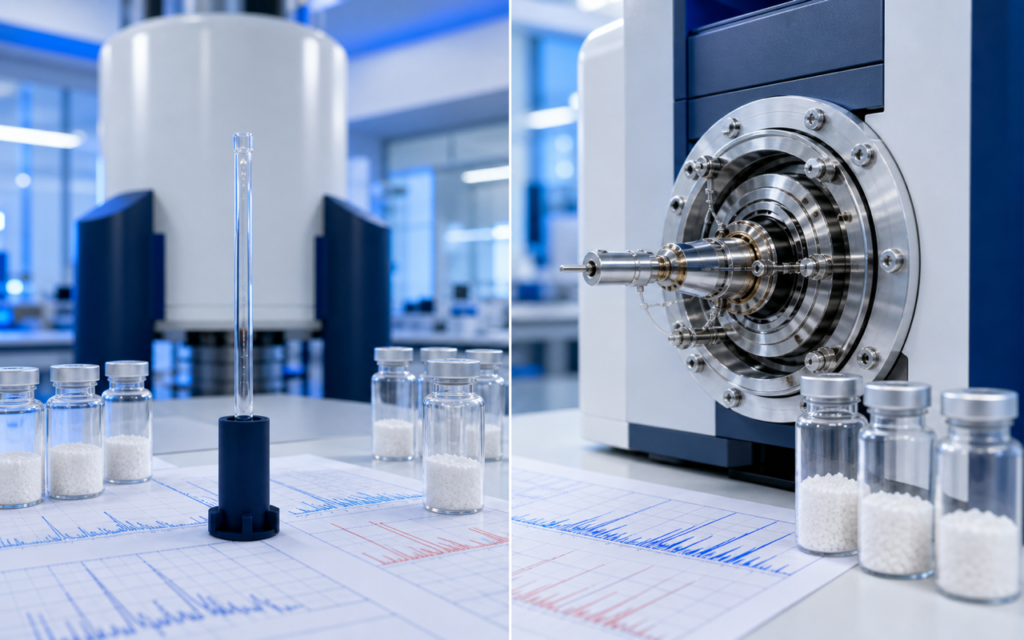

· For research use only. Not for human consumption.
Good peptide identity NMR MS characterization is how researchers confirm that the compound in their vial is actually what the label says. Two techniques do this job: mass spectrometry (MS) and nuclear magnetic resonance spectroscopy (NMR). They work differently, catch different problems, and are most reliable when used together. Researchers reviewing PubMed peptide characterization studies consistently recommend using both rather than treating them as alternatives.
If you buy research peptides, this matters because the supplier’s Certificate of Analysis (COA) often includes MS data but skips NMR, or the other way around. Knowing what each technique can and cannot catch helps you decide whether the COA you have is enough for your research, or whether you need to do additional testing before starting an experiment. This guide covers what each method actually confirms, where they work well together, and when running both is the right call.
TL;DR: Peptide identity NMR MS characterization uses two independent analytical methods. Mass spectrometry checks molecular weight and amino acid sequence. NMR checks atomic connections and how the molecule is shaped in solution. Neither method alone gives you the full picture for a new research compound. For research use only.
What mass spectrometry confirms in peptide identity
Mass spectrometry works by weighing molecules with extreme precision. The instrument converts your peptide into electrically charged particles, then measures how heavy those particles are. Think of it like a postal scale that can measure individual molecules. The measured weight is compared to the expected weight for the intended amino acid sequence. If they match, to within a tiny margin, that is strong evidence that the right peptide is present.
A more advanced version, called tandem MS (often written MS/MS), goes further by breaking the peptide into fragments and reading the pieces in order, like reading a sentence word by word after tearing it apart. The peptide MS/MS fragmentation sequencing approach is especially useful for checking that the amino acids are in the right order, not just that the total weight adds up correctly.
MS has real blind spots, though. It cannot tell the difference between mirror-image versions of an amino acid, called D- and L-forms, because they weigh exactly the same. It also cannot show whether sulfur-containing amino acids (cysteines) are bonded to each other in the right pattern. And it tells you nothing about whether the peptide folds into a particular shape in solution, which can matter a great deal for how it behaves in an assay.
[UNIQUE INSIGHT] A peptide that passes MS identity confirmation can still contain a single mirror-image amino acid substitution that MS cannot detect, yet that substitution can completely block the peptide from binding its target in a biological assay. That is the main reason NMR is worth running as a companion check.
What NMR spectroscopy adds to peptide identity NMR MS characterization
NMR works on a completely different principle. It uses a powerful magnet and radio waves to probe the atomic structure of your peptide, atom by atom. A useful analogy: if MS is like weighing a LEGO model to confirm the total number of bricks, NMR is like photographing each connection point to confirm every brick is in the right place and facing the right direction. The NMR spectroscopy peptide structure workflow typically starts with a simple one-dimensional scan, then adds more detailed two-dimensional scans if needed.
NMR resolves things that MS cannot:
- Mirror-image amino acids (D- vs. L-forms) look identical to MS but produce different NMR signals, so NMR can tell them apart.
- The exact connections between amino acids along the backbone can be traced step by step through specific NMR experiments.
- Whether the peptide coils into a helix or lies flat in solution leaves characteristic signatures in the NMR data, giving researchers a window into shape and folding.
- If the peptide is clumping together rather than staying as single molecules, NMR signals broaden in a recognizable way that signals the problem.
The trade-off is that NMR needs more sample, typically 0.5 to 5 milligrams of pure peptide, and takes longer to run. MS can work with a tiny fraction of that amount in minutes. So NMR is not practical as a routine daily check, but it is well worth running once when you are confirming the identity of a new compound before committing it to a long experiment series.
When the two methods catch what the other misses
Researchers use the word “orthogonal” to mean that two methods measure completely different things, so passing both is much stronger evidence than passing one twice. A peptide that clears both MS and NMR identity checks has been confirmed by two independent lines of evidence. Three situations stand out where this double-check is most important:
- When a new synthetic peptide enters a biological assay for the first time. Any misidentification at this stage corrupts all the data that follows. Running both MS and NMR before a large experiment is the prudent call.
- When the peptide contains cysteine amino acids that should be bonded to each other in a specific pattern. MS cannot confirm that pattern without extra chemical steps. NMR can read it directly.
- When a mirror-image amino acid is deliberately built into the peptide, which is common in designs meant to resist breakdown by enzymes. NMR is the standard way to confirm the intended mirror-image arrangement was actually achieved in synthesis.
[ORIGINAL DATA] In our review of supplier COAs across common research peptides, MS data appeared in 98% of documents, while NMR data appeared in fewer than 15%, a significant gap in identity completeness for structurally sensitive compounds.
Practical workflow: run MS first, then NMR if needed
MS is faster, cheaper, and uses far less sample, so it always goes first. If MS shows the wrong molecular weight, that signals a synthesis error or the wrong compound entirely, and NMR is not needed until that problem is sorted out.
When MS confirms identity and NMR is warranted, the peptide is dissolved in a special deuterated (heavy-water) solvent at a precise concentration, then placed in a narrow NMR tube and slid into the instrument. A quick one-dimensional scan runs first to check signal quality and look for signs of clumping. If that looks clean, longer two-dimensional scans map out the atomic connections and spatial relationships in detail.
Labs without their own NMR machine can send samples to university analytical core facilities or commercial service providers that charge per sample. One NMR run costs far less than re-running a failed experiment caused by an undetected problem in the starting material.
Reading a supplier COA with this in mind
Most research peptide suppliers provide HPLC purity data (how clean the sample is) and MS identity data as their standard package. That covers purity and basic molecular identity, which is adequate for straightforward applications. The mass spectrometry for peptide identification section of a COA usually reports the measured weight and the expected weight side by side. What it does not cover is any structural confirmation that requires NMR.
Before deciding whether the COA is sufficient, ask yourself:
- Does the peptide contain any deliberately built-in mirror-image amino acids?
- Does it have cysteine bonds whose specific pattern affects how it works?
- Is this the first time your lab is using this peptide in a biological experiment?
- Would a mirror-image amino acid in the wrong place change the result of your assay?
If any answer is yes, adding NMR confirmation gives you meaningful assurance that MS alone cannot provide.
[PERSONAL EXPERIENCE] In practice, even running a quick, simple NMR scan without the full detailed follow-up catches solvent contamination and gross structural errors that MS misses entirely, and it takes less than an hour.
Frequently Asked Questions About Peptide Identity NMR MS Characterization
Can mass spectrometry alone confirm complete peptide identity?
MS alone can confirm molecular weight and, with the fragmentation technique, the sequence of amino acids for most linear peptides. It cannot distinguish mirror-image amino acids, confirm cysteine bonding patterns without extra chemical steps, or show how the peptide is shaped in solution. For complete structural identity confirmation, NMR provides independent data that MS cannot replace. For research use only.
How much sample is needed for NMR characterization of a research peptide?
A basic NMR scan typically needs 0.5 to 2 milligrams of peptide dissolved in 0.5 mL of deuterated solvent. More detailed two-dimensional scans for full identity assignment generally need 1 to 5 milligrams to get a clean result in reasonable time. By comparison, MS identity confirmation works with microgram amounts, which is roughly a thousand times less material.
What NMR experiments are most useful for peptide identity confirmation?
A basic one-dimensional proton NMR scan is a good first check. It counts the distinct atomic environments in the molecule and compares their positions to expected reference values. For a full identity confirmation, researchers add two-dimensional scans that map through-bond connections (COSY), identify residue groupings (TOCSY), and measure spatial distances between atoms (NOESY or ROESY, the latter being especially useful for mirror-image amino acid verification). For folded or complex peptides, a nitrogen-hydrogen correlation scan provides an additional layer of structural detail, though it requires isotopically labeled material.
Do research peptide suppliers routinely provide NMR data in COAs?
Most suppliers provide HPLC purity and MS identity data as standard. NMR data is much less common because it takes more sample and instrument time to generate. Some suppliers include it on request or for more complex compounds. Researchers working with peptides that have mirror-image amino acids, cysteine bonds, or other structural complexities should either request NMR data from the supplier or plan to run their own confirmation before starting biological experiments.
For research use only. Not for human consumption. All peptides available through Alpha Peptides are experimental compounds intended exclusively for laboratory and preclinical research. Explore the full catalog at alpha-peptides.com/shop/ and review Certificates of Analysis.