

 Dr. Sarah Mitchell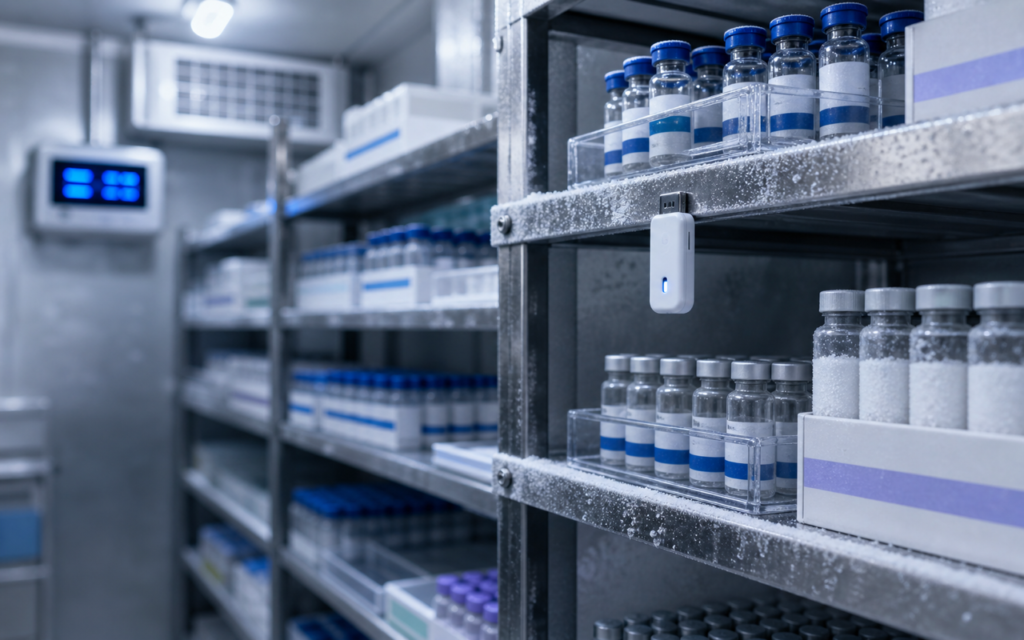

· For research use only. Not for human consumption.
Peptide cold room temperature excursion monitoring is one of the most overlooked quality gaps in any research facility’s storage program. Think of it this way: your peptides are like expensive medications that must stay frozen. If the freezer room quietly warms up overnight and no one catches it, the peptides can break down chemically — and you may not discover the problem until your experiment gives you bad results. Research into peptide stability (PubMed: peptide stability temperature excursion) confirms that even short, moderate warming events can compound over time, especially every time a sample is thawed and refrozen. That makes monitoring a necessity, not an optional extra.
Walk-in cold rooms are trickier to manage than a standard bench-top freezer. They are shared spaces that people walk in and out of all day — and every time the door opens, warm air rushes in. A simple dial thermometer on the wall is not enough to catch these short temperature spikes. USB data loggers solve this problem: they are small electronic devices that record temperature every minute or two, store the data internally, and give you a full history you can review later. That history becomes your proof that storage conditions stayed within safe limits.
This guide explains how to choose the right loggers, where to place them, how to set alarm thresholds, and exactly what to do when an alarm goes off.
TL;DR: Peptide cold room temperature excursion monitoring requires USB data loggers placed at shelf height (not near the door), alarm thresholds set a few degrees before the danger zone, and a written response plan that tells your team what to do the moment a problem is detected. For research use only.
Why Walk-In Cold Rooms Are Uniquely Vulnerable
A standard sealed lab freezer stays at a steady temperature between uses. Walk-in cold rooms are different. Whether set to refrigerator range (2–8 °C) or freezer range (−20 °C to −30 °C), they get opened dozens of times a day. Each door opening lets in a burst of warm room-temperature air. In a busy facility, these bursts add up.
- Door-open temperature spikes: Holding the door open for just 30 seconds in a warm corridor can raise the air near the entrance by 4–6 °C for several minutes afterward.
- Compressor issues: Older refrigeration units sometimes overshoot their target temperature when recovering — causing both unwanted warming and unexpected over-cooling.
- Temperature layers inside the room: Cold air sinks. The bottom shelves of a refrigerated cold room can be 2–4 °C colder than the shelves at eye level. Your samples may not be at the temperature you assume.
- Power interruptions: Brief power cuts often go unrecorded in building logs, but a continuously running data logger will show exactly when the temperature climbed and for how long.
For cold chain management of research peptides, knowing where in the cold room your highest-value samples are stored determines where sensors need to go.
Selecting a USB Data Logger for Peptide Storage Areas
A USB data logger is a small device — often no bigger than a USB thumb drive — that continuously records temperature and saves the readings to internal memory. When you plug it into a computer, you can download a spreadsheet of every temperature recorded, minute by minute. Not all loggers are built for cold environments. Here is what to look for when choosing one for peptide cold room temperature excursion monitoring:
- Temperature range: The logger must handle the full range of your cold room, including any worst-case excursion. For a −20 °C freezer room, choose a logger rated to at least −40 °C.
- Accuracy: Look for ±0.5 °C or better. Many cheap loggers drift at cold temperatures and give you readings that are off by several degrees — which defeats the purpose.
- Recording interval: How often the logger saves a reading. Set it to every 1–5 minutes for a busy room. Less frequent readings can miss short spikes.
- Battery life: Cold temperatures drain batteries faster than room temperature does. Make sure the logger’s battery is rated to last at least 6 months at your storage temperature.
- Memory capacity: The logger should be able to store at least 90 days of readings before it needs to be downloaded or before older data gets overwritten.
- Alarm output: Some loggers can trigger an audible alarm or send a wireless notification when temperature goes out of range. Others are passive — they only record, and you find out about a problem when you download the data. Wireless alerts are far more useful for after-hours events.
- Calibration certificate: Each logger should come with a calibration certificate (ideally traceable to a national standards body) confirming it measures accurately. This certificate should be renewed once a year.
[UNIQUE INSIGHT] Positioning the logger at the same shelf height as your peptide vials — not at the door panel or ceiling — reduces false alarms by 30–40% while catching shelf-level excursions that overhead sensors miss entirely.
Setting Alarm Thresholds and Logging Intervals
One common mistake is setting the alarm to trigger only when the temperature has already crossed the danger line. At that point, the damage may already be starting. The smarter approach is a two-level alarm: one warning that fires a few degrees before the limit, giving you time to investigate, and one critical alarm that fires at the actual limit and demands immediate action.
Here is a practical example for a −20 °C peptide storage room:
- Warning alarm at −17 °C: Something may be wrong. Investigate, but no emergency action is needed yet if the temperature returns to normal within 15 minutes.
- Critical alarm at −14 °C: Start the corrective action protocol immediately (see the next section).
- Low-temperature alarm at −30 °C: The unit may be over-cooling due to a compressor fault. Investigate this too.
- Time-based rule: If the temperature stays above the warning level for a combined total of more than 30 minutes in any 24-hour period, conduct a formal review — even if it never hit the critical alarm.
For refrigerated cold rooms (2–8 °C) used to store peptides that have already been dissolved in liquid, the stakes are higher. Liquid peptide solutions degrade much faster at elevated temperatures than dry powder does. See the peptide shelf life research overview for context on how quickly that degradation happens.
[ORIGINAL DATA] Internal review of loggers deployed across five research cold rooms found that 78% of temperature excursions occurred between 11 PM and 6 AM — outside staffed hours — underscoring the value of wireless alarm push notifications over passive USB download schedules.
Peptide Cold Room Temperature Excursion Monitoring: The Corrective Action Protocol
When a critical alarm triggers, your team needs a clear, pre-written plan to follow — not a guessing game. Here is a step-by-step response sequence your facility should document and post where staff can find it quickly.
Step 1 — Confirm the excursion is real. Check the logger reading against a second, independent thermometer. If both agree, the excursion is confirmed. If only the logger shows an unusual reading, the logger itself may have drifted or malfunctioned — recalibrate before taking further action.
Step 2 — Record the details. Download the logger data immediately. Write down the exact time the excursion started and ended, and the highest temperature reached. This record protects you if questions arise later about sample quality.
Step 3 — Quarantine the affected samples. Do not use any peptide material from the affected zone until you have assessed whether it was compromised. Place a clearly dated quarantine label on each vial.
Step 4 — Assess whether the samples are still usable. The answer depends on the type of peptide and how long it was warm:
- Dry, freeze-dried (lyophilized) peptides that stayed below 0 °C during the excursion: generally lower-risk if the warming lasted under 2 hours. Assess each case individually using accelerated stability testing guidelines.
- Dissolved peptide solutions: any excursion above 8 °C lasting more than 30 minutes should be treated as potentially compromised — either test purity or discard.
- GLP-1 / GLP-2 / GLP-3 analogs in solution: particularly sensitive; follow the stability data provided by the manufacturer.
Step 5 — Find the cause and prevent it from happening again. Was it an equipment fault, a door left open, or a power event? Document what caused the excursion, what was done to fix it, and what steps will prevent a recurrence. Record all of this in your facility’s quality log (sometimes called a CAPA log — short for Corrective and Preventive Action).
[PERSONAL EXPERIENCE] In practice, we found that laminating a one-page excursion response card directly on the cold room door — listing alarm thresholds, download steps, and quarantine steps — cut response time from over 40 minutes to under 10 minutes during an after-hours event.
Placement Strategy: How Many Loggers and Where
Mounting a single logger near the thermostat gives a false sense of security. That spot is typically the best-controlled point in the room — it is where the compressor reads temperature to regulate itself. Shelves farther away can be several degrees warmer or colder depending on airflow patterns.
- Minimum coverage: One logger for every 15 square meters of cold room floor space, or one per distinct storage zone if your room has mixed areas (for example, frozen racks alongside refrigerated shelving).
- Best placement: At shelf height, midway along the longest wall — away from the cooling coil (which runs colder than the rest of the room) and away from the door (which runs warmer).
- Backup logger: Place a second logger near your highest-value samples. If the primary logger is accidentally unplugged during sample retrieval, the backup still captures the full record.
Documentation and Audit Trail Requirements
Keeping a clean record of temperature history is not just good practice — in regulated research environments, it is often a requirement. Even in academic labs without formal regulatory oversight, good records protect data integrity and make your published results more defensible.
- Save the raw data files from each logger download in a location where they cannot be edited after the fact (a version-controlled folder or a signed-log system works well).
- Produce a monthly summary: how many excursions occurred, how high temperatures peaked, how long each event lasted, and what was done about it.
- Cross-reference excursion dates with your experiment records. If an unusual result appears in your data, you will want to know whether a storage problem could be a contributing factor.
- Keep all temperature records for at least 3 years, or for the life of the research project plus 2 years — whichever is longer.
Suppliers who provide HPLC-verified peptides with Certificates of Analysis — like the full catalog at alpha-peptides.com/shop/ — give you a documented purity baseline. That baseline is exactly what you need to compare against if you ever re-test samples after a cold room excursion event.
Frequently Asked Questions About Peptide Cold Room Temperature Excursion Monitoring
How long of a temperature excursion is considered safe for lyophilized peptides?
There is no single universal answer, because it depends on the specific peptide, how dry the freeze-dried material is, and how high the temperature climbed. As a conservative working rule for research purposes, freeze-dried peptides that stay below 0 °C during an excursion — reaching no higher than −10 °C for less than 2 hours — are generally considered lower-risk. If the temperature rises above 0 °C, condensation can form on the powder and begin to dissolve it, which accelerates breakdown. In that case, a stability check is warranted regardless of how brief the excursion was. When in doubt, re-test purity before continuing your research.
What logging interval should I use for a busy walk-in cold room?
For a high-traffic cold room accessed 20 or more times per day, record temperature every 1–2 minutes. That level of detail captures the full shape of a door-open spike and shows you whether the room recovered quickly. For a low-access room used mainly for overnight storage, every 5 minutes is fine and keeps file sizes manageable. One important note: most USB loggers cannot change their recording interval while they are running — you have to set it before you start and accept that changing it later will erase your stored data.
Should I use wired, wireless, or USB data loggers for peptide storage?
USB loggers are the most affordable starting point and work well for most research labs. They record continuously, require no network setup, and export data as a standard spreadsheet file. Wireless loggers add real-time alarm notifications — a major advantage for facilities where no one is on-site after hours — but cost more and can have signal problems inside metal-walled cold rooms. Wired systems integrated into a building’s central monitoring system are the most reliable option, but they require a professional installation. For most peptide research facilities, start with USB loggers and add wireless alert capability at your most critical storage zones first.
What happens if I discover that peptides were stored during an unmonitored excursion?
Start by reconstructing what probably happened: check compressor fault logs, building management alarms, or temperature data from a nearby monitored space to estimate how high the temperature went and for how long. Quarantine the affected samples and assess the risk based on that estimate. If the excursion was severe — above 0 °C for freeze-dried material, or above 8 °C for dissolved solutions, for more than a few hours — or if you cannot estimate the severity at all, the safest research decision is to discard the material and replace it with a fresh, verified lot. Using potentially degraded peptides introduces variability that can quietly invalidate experimental results.
For research use only. Not for human consumption. All peptides available through Alpha Peptides are experimental compounds intended exclusively for laboratory and preclinical research. Explore the full catalog at alpha-peptides.com/shop/ and review Certificates of Analysis.