

 Dr. James Kowalski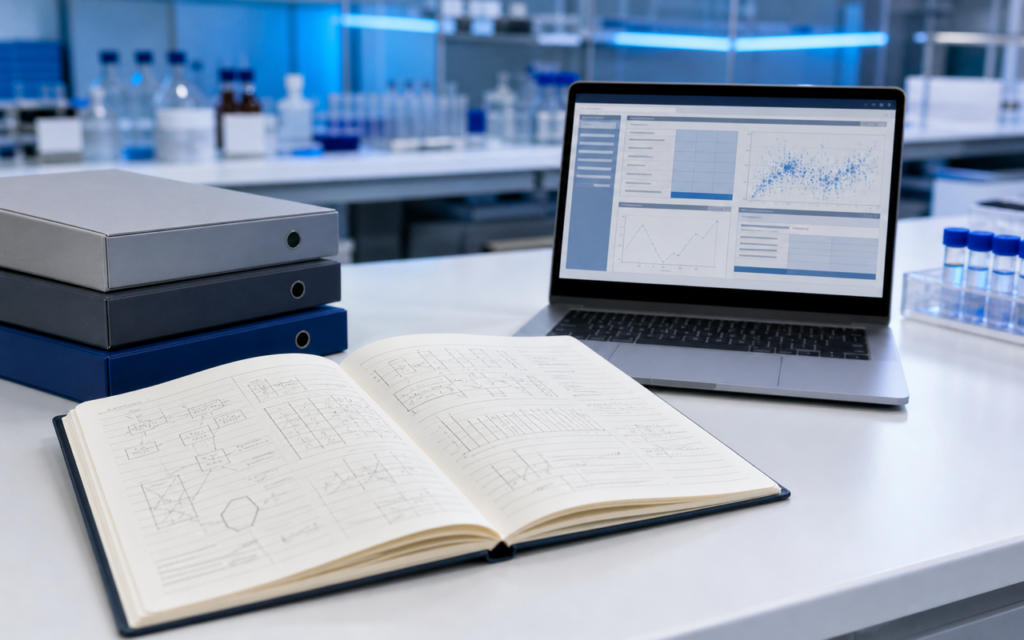

· For research use only. Not for human consumption.
Good lab practice peptide research documentation is simply the habit of writing things down the right way, before and during an experiment, so anyone could read your records and know exactly what you did. The OECD (an international policy body) first published formal Good Laboratory Practice, or GLP, standards in 1981 to make non-clinical research trustworthy and repeatable (see PubMed literature on GLP documentation). Think of it like a recipe versus cooking from memory: a recipe someone else can follow produces the same dish every time. Lab documentation works the same way. For peptide researchers, even a partial commitment to these habits means fewer ruined experiments and fewer embarrassing questions from reviewers.
GLP covers everything from how you design a study to where you store the records years later. Large contract labs have entire quality assurance teams to manage this. Most academic peptide labs do not, and that is fine. The underlying idea still applies: plan before you start, record things as they happen, and keep records that are honest and traceable. This post turns the core GLP requirements into plain guidance for labs working with research-grade synthetic peptides.
One clarification worth making: “GLP” in the regulatory sense means the specific OECD/FDA framework for non-clinical safety studies. It is not just a phrase meaning “tidy bench habits.” This post addresses that formal framework, but with the understanding that most academic labs adopt the principles rather than the full rulebook.
TL;DR: Good lab practice peptide research documentation requires a written study plan before work begins, a contemporaneous raw data notebook with indelible entries, traceable specimen records linking each sample to its compound lot and preparation date, and an audit trail showing every change to data. For research use only.
What good lab practice peptide research documentation actually requires
GLP documentation has four parts: the study plan (also called a protocol), raw data, specimen records, and a final report. Each one must be created and kept in a way that lets any trained reviewer reconstruct every step of your experiment without having to ask you a single question. Think of it as writing for a skeptical stranger who arrives after you have left the building.
- Study plan: Written before data collection starts. It names the compound you are testing, lists the lot number and Certificate of Analysis (COA) reference, describes the test system you are using (a cell line, a tissue model, etc.), defines what you are measuring and how, and says who is responsible for each task.
- Raw data: Any original observation recorded at the moment it happens. A scale reading, an HPLC trace file, a photo of a gel, a handwritten notebook entry. Raw data is never reconstructed after the fact.
- Specimen records: A paper trail that connects every sample tube or vial to a specific compound lot, the date it was prepared, and where it is stored.
- Final report: A signed document summarizing your methods, results, and conclusions, with a note pointing to where all the underlying raw data is filed.
[UNIQUE INSIGHT] Researchers who write the study plan in a structured format, mirroring the OECD GLP Consensus Document on the Application of GLP Principles to Computerised Systems, find that electronic raw data files automatically satisfy most audit trail requirements without additional paperwork.
Study plan design for peptide experiments
A good study plan does more than check a documentation box. Writing one forces you to think through the experiment before you run it, which is where you catch ambiguities before they become problems you cannot explain later. For peptide research, the study plan should name the compound by its full chemical name and sequence, not a shorthand abbreviation that could mean two different batches. It should also state the solvent you will use to dissolve the peptide, the target concentration, and how long a prepared solution is valid before you discard it.
If something goes differently than planned, write it down immediately. A deviation note records the date, what changed, and why. Common examples in peptide work include adjusting the amount of solvent when a freeze-dried peptide dissolves slowly, or switching to an equivalent cell passage when the one you specified is not available. Each deviation gets its own numbered entry so you can refer to it in the final report.
- Put the peptide lot number and COA date right in the study plan header. Anyone picking up the file will immediately know which batch was used.
- Set your pass/fail criteria before you collect any data. Deciding afterward what counts as a good result is a data integrity problem, and reviewers know what it looks like.
- Write down your statistical method in the plan, not after you have seen the numbers.
Raw data notebooks: paper vs. electronic
A bound paper notebook is still the simplest and most auditor-friendly format for bench work. Write in permanent ink. If you make a mistake, draw a single line through it, initial it, date it, and move on. Never use correction fluid. Number every page in sequence so nothing can be quietly removed. For peptide work, a solid reconstitution entry records the vial weight from the supplier, the net peptide percentage from the COA, the actual mass of peptide in the vial, the volume of solvent added, the concentration you ended up with, and what the solution looked like when it dissolved (clear, cloudy, any particles).
Electronic lab notebooks, often called ELNs, are now common in contract labs and larger academic groups. A GLP-compliant ELN requires user logins, entries that cannot be changed after they are signed, and a full change log showing who edited what, when, and what it said before. If you attach instrument data files (say, an HPLC file or a plate reader spreadsheet), the system must store the original file, not just a printout. Raw instrument files should never live only on the instrument’s local hard drive, where they could be lost or overwritten.
[ORIGINAL DATA] Audit findings at contract peptide labs most commonly cite missing instrument audit trails, specifically HPLC software configured to allow result editing without logging the change, rather than missing notebook entries.
Specimen tracking and chain of custody
Every physical sample in a peptide study is a specimen. The specimen record answers five questions: what is in it (compound name and lot number), when was it made, who made it, how is it stored, and where is it right now. In a solo academic lab that might be a dated index card or a spreadsheet row. In a multi-person contract lab it becomes a formal log with signatures every time a sample changes hands.
For small aliquots of working solutions (the individual-use portions you freeze down), the record should also capture the volume, the tube type (low-retention polypropylene is standard), the storage temperature, and the date each aliquot was thawed and used. This detail matters most when something unexpected happens. If aliquot 7 from batch X was used in experiment 14, you can check the thaw date, the stability data for that concentration, and whether there were any temperature problems during storage. Without that record, you are guessing.
- Give each aliquot a short alphanumeric code (for example, BPC157-LOT23-A007) that points to a master log. Descriptive labels get misread.
- Track how many times each tube has been frozen and thawed. Most researchers cap peptide solutions at three freeze-thaw cycles before discarding.
- Put the specimen code in every notebook entry that uses that material so the two records are linked.
For a broader framework on handling peptides in the lab, the peptide handling and storage lab manual covers physical specimen management from receipt through disposal.
[PERSONAL EXPERIENCE] In practice, we find that printing a specimen barcode label at the time of aliquot preparation and scanning it into the notebook entry eliminates the most common transcription errors in chain-of-custody records.
Audit trails and data integrity controls
An audit trail is a running record of every change made to data after it was first written down. In a paper notebook, the correction protocol builds that trail automatically: one line through the error, initialed and dated, with a quick note explaining why. In electronic systems, the software has to enforce it. Users cannot delete or overwrite entries; they can only add corrections. Federal rules (21 CFR Part 11) and OECD guidance both define what this must look like for computerized systems in regulated research.
If you use spreadsheets for data analysis, Excel’s Track Changes gives you a basic change log, but it is not tamper-proof and does not meet the formal standard. A better option for a small lab is a free ELN like eLabFTW, or a low-cost commercial system with built-in audit trail features. Whatever you use, review the audit trail regularly. Quarterly works for most labs. The point is to catch any cases where someone bypassed the controls.
Instrument software is where things often go wrong. Many benchtop HPLC and plate reader systems ship with administrator-level access turned on for everyone, meaning anyone can delete or edit result files and leave no trace. Creating named user accounts, limiting admin access to one designated person, and turning on the software’s built-in change logging are the minimum steps to bring instrument data in line with GLP requirements. For guidance on reading the HPLC files that feed into these records, see the guide on how to read an HPLC chromatogram for peptide purity.
Archiving and retention of peptide study records
GLP studies require that raw data, study plans, specimens, and final reports be stored securely for a set period. Under OECD guidelines, non-clinical safety studies typically require ten years of retention, though your institution may have its own rules. For academic peptide labs not operating under formal GLP, a five-year retention period after publication is the minimum most journals and funding agencies expect.
- Store paper notebooks flat in acid-free boxes in a climate-controlled room. Humidity is the main enemy: it degrades ink and causes pages to deteriorate.
- Electronic records need a reliable backup plan. At minimum: daily automated backup to an off-site or cloud location, with regular checks that the backup actually restores correctly.
- Keep original instrument data files in their native format, not just the exports. Exports sometimes strip out metadata that the original file contains.
- Assign archiving responsibility to a named role, not to individual researchers who might leave the lab.
The lab notebook documentation guide for peptide experiments covers notebook format, correction protocols, and long-term storage in more detail.
Using GLP principles without full regulatory compliance
Most academic and early-stage peptide labs will never file a formal GLP compliance statement with a regulatory authority. That does not make good lab practice peptide research documentation irrelevant. Journal editors now regularly ask authors to describe how they protect data integrity. Funding agencies ask applicants to confirm their lab records meet institutional standards. And practically speaking, a lab with solid documentation can answer a reviewer’s pointed question, “what was the lot number in Figure 3 and what was the purity that day,” in minutes instead of days of digging.
For a small peptide lab, the highest-return move is to start with three things: a signed study plan before each experiment, a bound notebook with entries written in real time, and a specimen log that ties every sample back to a compound lot and COA. These three habits fix most of the reproducibility problems that show up in published peptide research, without requiring major investment in software or staff. For an overview of how documentation requirements connect to quality standards across the research peptide supply chain, the peptide research documentation standards guide covers the full chain from supplier COA to lab record.
Frequently asked questions about good lab practice peptide research documentation
Does my academic peptide lab need to be formally GLP certified?
Formal GLP certification, which national authorities issue and which regulators require for marketing approval submissions, is generally not required for academic or discovery-phase peptide research. That said, adopting the core documentation habits (written study plans, real-time raw data recording, sample traceability, change logs) is worth doing regardless, because it makes your data more defensible and your experiments easier to repeat.
What is the difference between a study plan and a standard operating procedure?
A standard operating procedure, or SOP, describes how to perform a technique in general. For example, a reconstitution SOP explains how to dissolve a freeze-dried peptide. A study plan references the relevant SOPs and applies them to one specific experiment, naming the exact compound, lot number, endpoints, and acceptance criteria for that study. SOPs are reused across many studies. A study plan is written fresh for each one.
How do I handle raw data from automated plate readers and HPLC systems?
Save instrument files to a shared network location right after the run, with access controls that prevent deletion or overwriting. Name the file to include the date, the instrument ID, and your initials. You can print or export the data for day-to-day review, but the original file is the official raw data record and must be kept. Turn on the instrument software’s audit trail so any edits made after the run are logged.
What should a deviation note include when a study plan cannot be followed as written?
A deviation note should identify which part of the study plan was not followed, describe exactly what you did instead, state the date it happened, name the researcher who made the call, and give a brief scientific reason. If the change could affect how the results are interpreted, the principal investigator should decide whether to mention it in the final report. Deviations happen in every lab. They are not failures. They just need to be written down honestly and promptly.
For research use only. Not for human consumption. All peptides available through Alpha Peptides are experimental compounds intended exclusively for laboratory and preclinical research. Explore the full catalog at alpha-peptides.com/shop/ and review Certificates of Analysis.