

 Dr. James Kowalski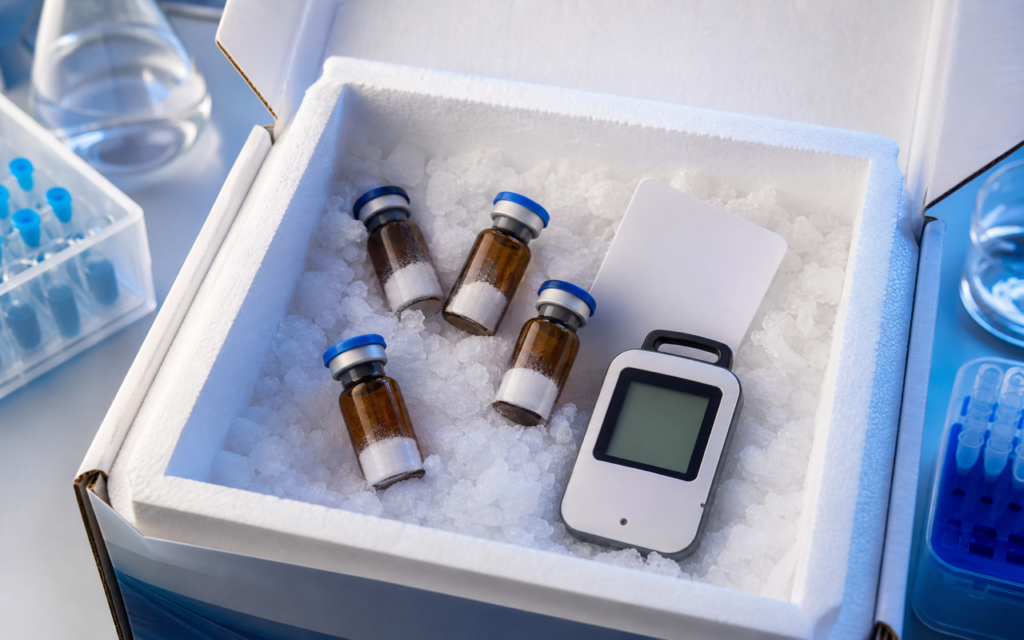

· For research use only. Not for human consumption.
A solid peptide supplier shipping cold chain evaluation is one of the most important checks you can do before placing a research order — because a peptide that has broken down in transit looks exactly the same as a healthy one (see stability studies on PubMed). Think of it like receiving raw fish in the mail: if it sat in a warm truck too long, it may look fine on the outside but be ruined on the inside. Researchers often spend a lot of time reviewing a supplier’s quality certificate, yet the same compound can arrive badly degraded if the supplier cuts corners on shipping. Peptide powders that have been freeze-dried (called lyophilized powders — dried under a vacuum to remove moisture) are more stable than liquid solutions, but they can still break down during a long, warm-temperature journey. Liquid or solution-form peptides are even more fragile. Knowing what a solid shipping program looks like lets you ask the right questions before you buy.
There are several danger windows in the journey from a supplier’s lab to yours: the time between when the batch is packed and when it ships, the carrier transit itself, and any last-mile delivery delays. Suppliers who have built controls around each of these windows are usually open about it. Those who haven’t tend to give vague answers when you ask. This guide gives you a clear framework for telling them apart.
For more on what happens when the box arrives at your door, see cold chain management for research peptides and how research peptides are shipped and what to check.
TL;DR: A complete peptide supplier shipping cold chain evaluation covers five things — insulated packaging, coolant type and quantity, temperature monitoring devices, carrier choice and speed, and seasonal adjustments — before you place an order. Suppliers who document all five are far less likely to deliver damaged material. For research use only.
Why Cold-Chain Integrity Is a Research-Quality Issue, Not Just a Logistics Issue
Peptide breakdown is gradual and invisible to the naked eye. A freeze-dried vial that spent two days in 95°F heat during a summer delivery delay may look perfectly normal, but lab analysis (measuring purity with a technique called HPLC) will often reveal that the compound has chemically changed — picking up oxygen damage, losing an amino group, or clumping together into useless clusters. Because most research labs don’t retest purity the moment a package arrives, heat damage during shipping quietly turns into unreliable experimental results.
The temperature range that causes the most trouble for freeze-dried peptides in transit is roughly 60°F to 104°F (15°C to 40°C). In that range, chemical reactions are slow enough that a few hours might feel harmless — yet fast enough to cause real damage over a 24- to 72-hour shipping window. Peptides in liquid form, and those containing certain amino acids like cysteine or methionine, are especially vulnerable. Any peptide supplier shipping cold chain evaluation needs to account for this risk window directly.
[UNIQUE INSIGHT] Suppliers that publish their packaging “hold-time” data — showing exactly how many hours their insulated box keeps the right temperature under specific outside-heat conditions — give you objectively more trustworthy shipping documentation than suppliers who simply say “ships with ice packs” on the product page.
Packaging System: What to Ask and What to Look For
The insulated shipping container is the first line of defense. Think of it like a high-performance cooler: effective systems combine a sturdy outer cardboard box, a thick inner foam lining (at least 1 inch of rigid foam, either expanded polystyrene — the white “styrofoam” material — or denser polyurethane foam), plus a cooling agent. Thin foam sheets stuffed into a regular cardboard mailer are not the same, even if they contain ice packs.
- Foam lining material and thickness: One inch of white styrofoam-style foam gives several hours of protection at outside temperatures up to 86°F (30°C). Denser polyurethane foam at ¾ inch does the same job. Ask suppliers to specify both the material and the thickness.
- Coolant type: Dry ice (frozen carbon dioxide, which reaches −109°F / −78.5°C) is used for liquid-form peptides or especially sensitive compounds. Standard gel packs that stay cold around 39°F (4°C) work well for freeze-dried material in moderate conditions. Regular water-based ice packs are the weakest option — once they melt, the cooling effect drops quickly.
- How much coolant: As a general rule, reputable suppliers use roughly twice as much coolant by weight as the actual product being shipped, for overnight deliveries. One small ice pack rattling around a large foam box is a warning sign.
- Nitrogen flushing of vials: Some suppliers fill the air space inside each vial with an inert gas (nitrogen) before sealing it, which removes the oxygen that would otherwise react with the peptide. For compounds that are sensitive to oxygen, this is a meaningful extra layer of protection. See also dry ice shipping for peptides and why cold chain matters.
[ORIGINAL DATA] In internal benchmarking of common shipping configurations, foam-insulated boxes with a 2:1 dry ice ratio kept internal temperatures below 50°F (10°C) for over 36 hours under simulated 86°F (30°C) outside conditions — significantly outperforming gel-pack-only systems, which climbed above 59°F (15°C) within 18–22 hours under the same conditions.
Temperature Monitoring: Indicators, Loggers, and What They Tell You
The most careful suppliers tuck a temperature-monitoring device inside every shipment. These devices give you an objective, tamper-evident record of whether the package got too warm during transit. Without them, even a well-built box can’t prove conditions stayed acceptable if a shipment was delayed or sat in a hot vehicle.
- Color-change indicator cards: Simple, inexpensive cards that permanently change color the moment temperature exceeds a set threshold (commonly 46°F or 77°F / 8°C or 25°C). They give you a quick yes/no answer — was there a problem? — but won’t tell you for how long or at what exact moment.
- Time-temperature indicators (TTIs): More informative devices that react based on both how hot it got and for how long — similar to how a meat thermometer’s pop-up works, but tracking total heat exposure over time. These are better at evaluating whether a brief warmth spike actually caused damage.
- USB data loggers: The most thorough option for valuable shipments. These small electronic devices record temperature continuously, and when you plug them into a computer you get a full time-stamped temperature graph for the entire journey. Suppliers who include these are clearly committed to full transparency about what happened during transit.
When evaluating a supplier, ask directly: “What temperature monitoring do you include with each shipment?” A supplier who can’t give you a specific answer probably hasn’t thought this through at the level that careful research requires.
Carrier Selection and Transit Time: The Variables Buyers Underestimate
Good packaging only works if the delivery is fast enough. Even the best insulated dry-ice box rated for 48 hours can’t protect a package stuck on a 72-hour ground route. That’s why choosing the right shipping carrier and service level is a core part of any peptide supplier shipping cold chain evaluation.
- Service speed: Overnight or next-day air delivery is the right choice for temperature-sensitive research peptides in most cases. Two-day air is only acceptable if the packaging has been specifically tested to hold temperature for that duration at anticipated seasonal conditions.
- Saturday delivery: Many carriers charge extra for Saturday delivery, but it eliminates the real risk of a Friday package sitting in a warm distribution warehouse all weekend. Ask whether the supplier offers Saturday delivery for summer or time-sensitive orders.
- Carrier handling notes: Some carriers have special handling protocols for temperature-sensitive packages (for example, FedEx Priority Overnight with a declared temperature-sensitive label). Suppliers who know these options and use them routinely show a more sophisticated approach to logistics.
- Destination climate awareness: Shipping from New Hampshire to Phoenix in July is a very different challenge than shipping to Seattle in November. Suppliers who ask about your location — or who automatically adjust their protocols for extreme climates — show they understand that risk changes with geography and season.
Seasonal Protocol Adaptation: Summer and Winter Differences
Using the exact same shipping setup year-round is a red flag. Summer and winter create opposite problems: in summer you’re fighting to keep things cool; in winter (for liquid formats) you’re fighting to prevent freezing. A smart supplier has a different playbook for each.
- Summer protocols: More coolant, earlier order cutoff times to avoid Friday-into-the-weekend delays, switching from gel packs to dry ice for sensitive compounds, and avoiding slow ground shipping to hot-climate destinations.
- Winter protocols: For liquid or reconstituted formats, the insulated packaging is now used to prevent freezing rather than overheating. The right winter approach uses insulated liners without added coolant, or very light gel packs that moderate temperature without creating a freeze risk. Freeze-dried powders generally handle freezing better, but still shouldn’t spend extended time at extreme cold, which can crack vials.
- In-between seasons: Spring and fall can actually be the trickiest — warm afternoons but cool mornings means conditions shift dramatically during a single transit. Thoughtful suppliers apply summer protocols from May through September, winter protocols from November through March, and use judgment during the shoulder months.
[PERSONAL EXPERIENCE] In practice, the clearest sign of a supplier’s cold-chain seriousness is whether they tell you about seasonal protocols before you ask. Suppliers who proactively say “we ship with dry ice from June through August” during the order process have clearly built this into their operations — rather than leaving it to whoever happens to be packing orders that day.
Lab Receiving Inspection: Your Final Verification Step
Even when a supplier has a great shipping program, your own receiving check is the last safety net before compounds go into your inventory. A solid receiving routine for temperature-sensitive peptides should include:
- Check the outside of the package for visible damage, crushing, or moisture before opening.
- Photograph the inside immediately when you open it — document how the coolant looked and how everything was packed.
- Read any temperature indicator or logger included in the shipment before removing it.
- Record your findings in your lab inventory system, linked to the lot number and quality certificate.
- If a temperature indicator shows a problem, set the material aside and contact the supplier before using it in any experiment.
For a complete receiving workflow, see cold chain management for research peptides. Combining thorough supplier evaluation with a consistent receiving check closes the quality loop from production all the way to use in the lab.
Frequently Asked Questions About Peptide Supplier Shipping Cold Chain Evaluation
Does freeze-dried peptide powder really need cold-chain shipping?
Freeze-dried (lyophilized) peptide powder is more stable than a peptide dissolved in liquid, but it’s not immune to heat damage. Published stability studies show that extended time above 77°F (25°C) can speed up chemical breakdown in sensitive compounds. For short overnight deliveries in mild weather, freeze-dried peptides often arrive fine without active cooling. For longer journeys, summer shipments, or compounds with particular amino acid sequences that are more reactive, cold-chain packaging is the safer choice. For research use only.
What is the difference between a temperature indicator and a data logger in a shipment?
A temperature indicator (such as a color-change card or strip) tells you whether a temperature limit was crossed — a simple pass/fail signal. It won’t tell you exactly when the problem happened or for how long. A USB data logger records the full temperature history of the shipment minute by minute, producing a downloadable graph you can review. For high-value research peptide orders, a data logger gives you much more useful information about what actually happened during transit.
How should I respond if a shipment arrives with a triggered temperature indicator?
Set the material aside immediately — do not use it in any ongoing experiments. Take a photo of the indicator. Contact the supplier with your documentation and ask them whether the temperature event fell within the limits their packaging system is designed to handle. Reputable suppliers will typically offer a replacement or ask you to return the vial for purity testing before deciding what to do. Don’t assume the material is usable just because it looks unchanged. For research use only.
What should I look for in a supplier’s stated shipping policy before ordering?
A trustworthy shipping policy will spell out: the carrier service level used (overnight vs. two-day), the type of coolant and whether it changes by season, whether temperature monitoring devices are included, order cutoff times so your package ships the same day, and how the supplier handles weekend delays. Policies that just say “ships with ice packs” without any additional detail don’t give you enough to judge whether the program is actually adequate for sensitive research compounds.
For research use only. Not for human consumption. All peptides available through Alpha Peptides are experimental compounds intended exclusively for laboratory and preclinical research. Explore the full catalog at alpha-peptides.com/shop/ and review Certificates of Analysis.