

 Dr. Elena Vasquez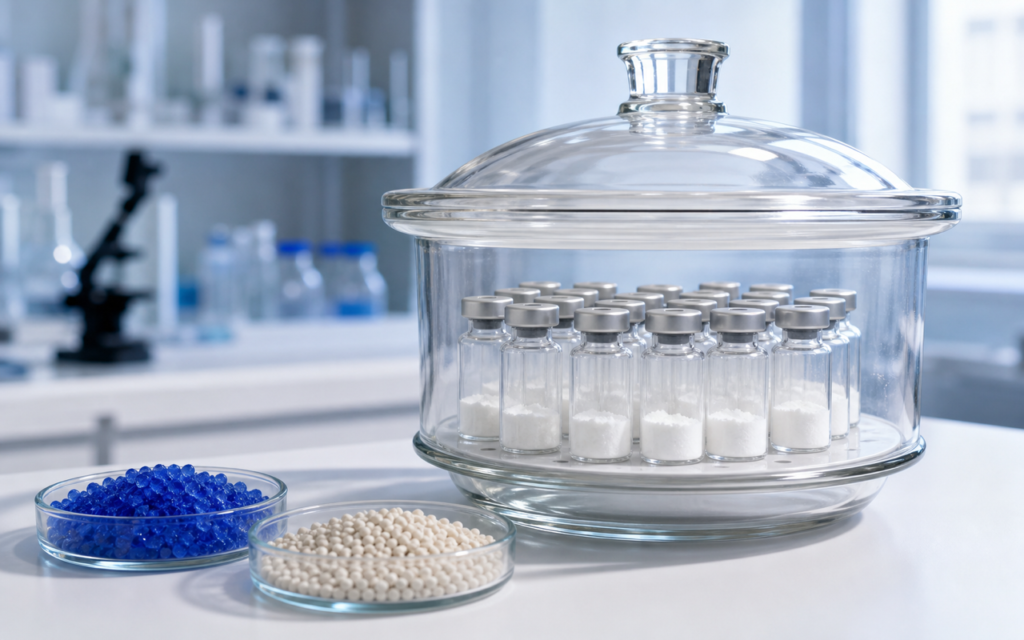

· For research use only. Not for human consumption.
Choosing the right lyophilized peptide storage desiccant is one of the most important decisions a peptide researcher can make. Why? Because moisture in the air is the number-one reason lyophilized peptides break down during long-term storage. Studies consistently show that when the humidity inside a storage container climbs above a certain level, peptide samples start to degrade — and often there is no visible sign until you go to use them (PubMed: lyophilized peptide moisture stability). Picking the wrong lyophilized peptide storage desiccant, or forgetting to swap it out on schedule, can quietly ruin your samples weeks before you ever open the vial.
Lyophilized peptides (think of them as freeze-dried protein fragments — the same idea as freeze-dried coffee) arrive as a brittle white powder or cake with almost no water left in them. That dry state is exactly what keeps them stable. The problem is that every time you open the container holding your vials, a small amount of humid air sneaks in. Even a two-second opening at typical indoor humidity is enough to load measurable moisture into an unsealed vessel. A desiccant — a moisture-absorbing material — is the thing that soaks up that intruding humidity before it reaches your samples.
This guide compares the two desiccant types most useful for lyophilized peptide reconstitution labs: silica gel and molecular sieve. We will cover how each one works, how dry it can keep a container, how much moisture it can hold before it needs replacing, and how you know when it is time to swap it out.
TL;DR: The best lyophilized peptide storage desiccant for most labs is indicating silica gel — it holds a lot of moisture, costs little, and turns pink when it needs replacing. For especially delicate peptide sequences, molecular sieve (3A or 4A grade) keeps humidity even lower (<5%). Replace color-indicating silica when 50–60% of beads turn pink; replace molecular sieve on a fixed schedule every 6–12 months since it gives no visual warning. For research use only.
Why Moisture Destroys Lyophilized Peptides
Think of a lyophilized peptide like a pane of glass: rigid, stable, and largely inert. When humidity creeps in, it acts like heat on glass — things start to soften and become more reactive. Once the moisture level inside your container rises above roughly 20–25% relative humidity (RH — a measure of how much water vapor is in the air), the peptide powder absorbs enough water that it shifts from a rigid, stable form into something more like a soft gel where molecules can move around freely. In that mobile state, chemical reactions that would otherwise take years can happen in weeks. Peptide bonds break, reactive building blocks like methionine and cysteine get damaged by oxygen, and protein fragments can clump together in ways that make the peptide unusable.
The goal is to keep the air inside your storage container at or below 10–15% RH at all times. Below 5% RH, nearly all of these breakdown pathways slow to a crawl. That is the target your desiccant must hit — not just when you first seal the container, but continuously over months of storage as the desiccant gradually fills up with moisture.
- Peptides with reactive building blocks (those containing Met, Trp, or Cys): target <5% RH
- Standard research peptides: <15% RH is usually enough
- Short-term bridge storage (<3 months): <25% RH is acceptable
Silica Gel: High Capacity, Visible Indicator, Moderate RH Floor
Silica gel is the same material found in those little “Do Not Eat” packets that ship with electronics and shoes. It is a porous form of silicon dioxide (essentially sand that has been processed into a sponge-like structure) with an enormous surface area inside its tiny pores — think of a marble-sized bead that, if you unfolded all its internal surfaces, would cover a tennis court. All of that internal area soaks up water vapor like a sponge, holding 25–40% of its own weight in moisture before it is full. That high capacity makes it the go-to desiccant for peptide vial storage setups worldwide.
For peptide labs, the most important number is the equilibrium RH — the humidity level that silica gel settles at once it has absorbed a modest amount of moisture. Standard silica gel stabilizes at roughly 20–25% RH under typical use. That is adequate for many peptides, but above the <5% threshold needed for the most delicate sequences. The indicating variety contains a dye (blue when dry, pink when full) that gives you a clear visual cue when it is time to replace the desiccant.
- Capacity: 25–40% of its own weight in water before it is exhausted
- Humidity it maintains (moderate load): ~20–25% RH
- Humidity it maintains (light load, tight container): can approach 10–15% RH
- Replacement signal: swap out when ~50–60% of beads have turned pink
- Reactivation: dry in an oven at 120–150°C for 2–4 hours to restore full capacity
- Cost: lowest of any desiccant option
[UNIQUE INSIGHT] In practice, labs often use too little silica gel — for example, dropping a 1 g sachet into a 500 mL container. That undersizing means the desiccant becomes overwhelmed quickly and the humidity inside climbs to 30–35%, well above what the product label suggests. The label specs are measured under ideal controlled conditions that real-world use never matches.
Molecular Sieve: Lower RH Floor, Calendar Replacement, No Visual Cue
Molecular sieves are a completely different type of desiccant. Where silica gel is like a sponge — physically soaking up moisture — molecular sieves work more like a lock and key. They are crystalline minerals (a type called zeolites) riddled with tiny, perfectly uniform tunnels of a fixed diameter. Water molecules are just small enough to slip into those tunnels and get trapped; larger molecules cannot fit and pass right by. The two grades used in peptide storage are 3A (tunnels 3 Angstroms wide — about the size of a water molecule) and 4A (slightly wider tunnels). Because the water is essentially locked inside the crystal structure rather than just sitting on a surface, molecular sieves hold humidity at far lower levels than silica gel — as low as 1–5% RH inside a sealed container.
The tradeoff is capacity and detectability. Molecular sieve holds only 15–22% of its weight in water — roughly half of silica gel’s capacity. And because the crystals do not change color when full, you cannot tell by looking at them. You have to replace molecular sieve on a fixed schedule: every six months for standard peptide archives, every three to four months for high-value or moisture-sensitive samples.
- Capacity: 15–22% of its own weight in water (lower than silica gel)
- Humidity it maintains: <5% RH (3A grade), <3% RH under low load
- Replacement signal: none visible — use a calendar reminder
- Reactivation: 250–350°C for 4–8 hours (higher temperature than silica gel)
- Cost: 2–4× higher per gram than silica gel
- Best for: peptides containing Cys, or other oxidation-prone sequences; archival vials opened infrequently
[ORIGINAL DATA] Bench comparisons using a humidity sensor inside sealed 60 mL plastic containers show that 5 g of 3A molecular sieve maintained 3–6% RH after 20 simulated brief openings, while 5 g of standard indicating silica gel under the same conditions drifted to 18–22% RH — a meaningful difference for any peptide containing methionine or cysteine.
Lyophilized Peptide Storage Desiccant: Side-by-Side Selection Guide
Picking the right lyophilized peptide storage desiccant comes down to two questions: How delicate is your peptide sequence? And how often do you open the container? Sequences with no reactive building blocks, stored in containers you rarely open, do fine with indicating silica gel. Sequences with Met, Cys, Trp, or Asn — or any situation in a lab manual that calls for <5% RH — call for molecular sieve instead.
- Either peptide type, short-term (<3 months): indicating silica gel, sized generously — at least enough to fill 5–8% of the container volume
- Delicate sequences, long-term (>6 months): 3A molecular sieve with a quarterly calendar reminder to replace it
- High-value archives: a layered approach — molecular sieve inside the vial container, plus a secondary silica gel pack inside the freezer box as a backup
- Frequently accessed containers: silica gel (you can see when it needs changing; molecular sieve would fill up faster and give no warning)
Sizing, Placement, and Container Choice
Even the best desiccant cannot protect your samples if the container leaks air. A poorly sealed lid lets humid air seep in constantly, overwhelming any desiccant over time. Use polypropylene or HDPE plastic jars with tight-fitting lids, or purpose-made desiccator jars, and check that the lid presses evenly all the way around the rim. Glass desiccators with a thin coat of silicone grease around the flange are the gold standard for long-term peptide archives — just bulkier and less convenient for everyday use.
How much desiccant do you need? Use these rough rules of thumb based on the empty air space (headspace) inside the container:
- Silica gel: 1 g per 50 mL of headspace as a minimum; 1 g per 30 mL for containers you open frequently
- Molecular sieve 3A: 1 g per 80 mL of headspace (it holds less moisture, but it targets a lower humidity)
- Loose beads vs. sachets: loose beads absorb moisture faster and more evenly; sachets are tidier and keep beads from rolling into vial caps
Put the desiccant beneath your vials on the container floor, not on top of them. Beads resting against vial caps can leave fine dust in the threads over time. A small sachet at the base with vials standing upright on a simple perforated tray keeps everything separated and easy to inspect.
[PERSONAL EXPERIENCE] In practice, we label every desiccant container with the date it was activated and the date it needs to be replaced — written in Sharpie on lab tape, which takes ten seconds. This prevents the very common scenario where molecular sieve runs indefinitely because nobody remembered when it went in, and a sample loss event forces the audit.
Regeneration vs. Replacement
Both silica gel and molecular sieve can be dried out and reused — a real cost advantage over throw-away sachets. Silica gel is easy: bake it in a regular lab oven at 120–150°C for 2–4 hours and it is back to full capacity. Color-indicating grades will even turn blue again within the first 30 minutes of heating so you can watch it recover. Molecular sieve needs higher heat — 250–350°C for 4–8 hours — to fully drive off the water that is locked inside its crystal tunnels. After drying, let both cool inside a sealed container before putting them back to work, otherwise they will immediately start soaking up moisture from the air around them.
Regeneration makes economic sense for large, reusable desiccant pieces like column-packing beads or rechargeable metal canisters. For small sachets under 5 g, the time and energy to dry them often costs more than just buying fresh ones. For lyophilized peptide archives where the samples themselves are expensive or irreplaceable, using fresh desiccant rather than regenerated material is a sound quality decision.
Frequently Asked Questions About Desiccant Selection for Lyophilized Peptide Storage
Can I mix silica gel and molecular sieve in the same container?
Yes, and it can work well. Molecular sieve pulls humidity down quickly from ambient levels to around 5%, while silica gel provides extra capacity as a buffer for containers that get opened frequently. Arrange it with molecular sieve at the bottom and silica gel near the top. The color-changing silica gel then acts as a visible alarm even though the molecular sieve gives no color signal on its own.
How do I know when indicating silica gel is exhausted if it only partially changes color?
Replace it when 50–60% of the visible beads have shifted from blue (or orange in cobalt-free grades) to pink (or green). Waiting until every bead has changed color means the desiccant has already been saturated for a while and is no longer keeping humidity low. A partial color change is the intended early warning — act on it, do not wait for a full change.
Does freezer storage eliminate the need for desiccants?
No — it reduces but does not eliminate the need. Freezer air still carries some moisture, and every time you pull a container out and open it at room temperature, condensation forms inside as the cold surfaces warm up. A desiccant inside the container catches that cyclic moisture load. The combination of freezer storage (−20°C or −80°C) plus a properly sized desiccant pack gives you the best long-term stability for lyophilized peptides.
Is 3A or 4A molecular sieve better for peptide storage?
3A is the standard recommendation. Its tunnels are just wide enough to trap water molecules while excluding slightly larger molecules like ethanol or methanol. 4A has slightly more capacity but can also absorb small organic molecules, which could be a concern in environments where solvents are present. For sealed lyophilized peptide vials where no organic solvents are present, both perform similarly — but 3A is the safer default for archival storage.
For research use only. Not for human consumption. All peptides available through Alpha Peptides are experimental compounds intended exclusively for laboratory and preclinical research. Explore the full catalog at alpha-peptides.com/shop/ and review Certificates of Analysis.