

 Dr. Marcus Chen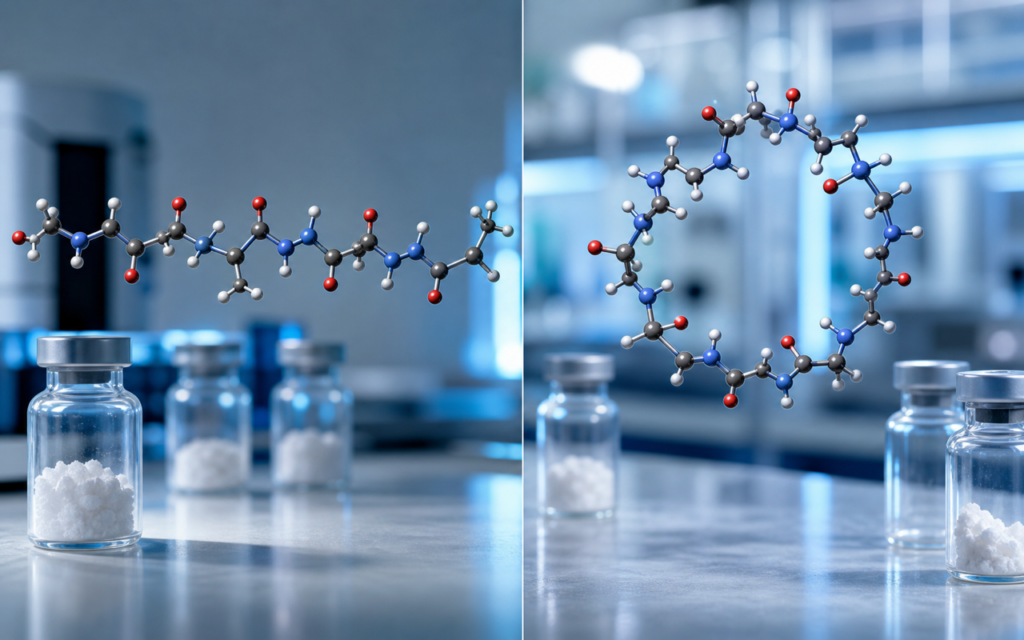

· For research use only. Not for human consumption.
The difference between cyclic vs linear peptides comes down to one thing: whether the molecule’s chain has open ends or is joined into a closed ring. That single structural choice determines how the molecule moves in solution, how fast enzymes break it down, and whether it can slip through a cell membrane — all of which affect how reproducible your assay results will be. Published structure-activity relationship reviews consistently rank this shape difference as one of the most important variables in peptide research (PubMed search: cyclic peptide conformational rigidity protease stability).
Think of a linear peptide like a loose rope: both ends are free, and the rope can coil into almost any shape. A cyclic peptide is the same rope with its ends tied together into a loop. The loop holds its shape far better. That shape difference is not cosmetic — it changes how the molecule binds to its target, how long it survives in blood or cell culture fluid, and how well it can squeeze through the fatty layers that surround cells.
This post covers each of those differences in plain terms, with examples from the research compound world, so lab teams can make smarter choices when picking a scaffold or interpreting stability data.
TL;DR: Comparing cyclic vs linear peptides shows that making a peptide into a ring generally makes it more resistant to enzymatic breakdown and more selective for its target, but it also makes synthesis harder. Linear peptides are simpler to make but degrade faster in biological fluids. For research use only.
What defines a linear peptide scaffold?
A linear peptide is what you get from standard synthesis: a chain of amino acid building blocks assembled one by one, with a free start (N-terminus) and a free end (C-terminus). In solution, the chain can flex and fold into many different shapes — loose coils, partial helices, extended strands — depending on sequence, temperature, and what solvent it is dissolved in.
That flexibility is not always a problem. Many well-studied research peptides, including BPC-157, TB-500, and most growth hormone secretagogues, are linear. Their ability to shift shape may be part of how they interact with multiple targets. The downside is that enzymes called proteases (proteins whose job is to chop up other proteins) can attack a linear peptide from either free end or at points along the chain. How long a peptide survives in plasma or cell culture media before being degraded is called its half-life, and for unprotected linear peptides that window is often very short. Researchers studying this should review peptide half-life measurement methodology for details on how stability assays measure this.
- Shape flexibility: high — the chain can adopt many conformations in solution
- Protease vulnerability: relatively high, especially at the two free ends
- Manufacturing complexity: lower — standard synthesis protocols apply, with no extra ring-closing step
- Water solubility: generally good for sequences with charged or polar amino acids
[UNIQUE INSIGHT] Linear peptides with a chemically capped N- or C-terminus (a small modification called acetylation or amidation) pick up modest protease resistance at those ends without the full manufacturing burden of making a ring. This is a practical middle ground that researchers often overlook when they need slightly better stability on a budget.
Cyclic vs linear peptides: the core stability advantages of ring closure
When a peptide is cyclized (closed into a ring), it can no longer flop between dozens of random shapes. It is locked into a narrower range of geometries. This matters for binding: a molecule that arrives at its target already pre-shaped for that target fits more snugly and needs less energy to make the connection. Better fit often means higher binding strength and better selectivity between similar targets. Melanotan II, for example, is a cyclic peptide whose ring structure holds it in exactly the right shape to engage melanocortin receptors; researchers can source it from Alpha Peptides’ MT-2 listing for in vitro assay work.
Ring closure also physically removes the free ends that proteases like to grab. Enzymes that chew from the ends of a chain (exoproteases) have nothing to grip on a closed ring. Enzymes that cut in the middle (endoproteases) can still theoretically attack, but the rigid ring makes it harder for them to line up their cutting machinery against the backbone. The practical result, seen repeatedly in published plasma stability studies, is that cyclic peptides can survive 10 to 100 times longer in blood or serum than their linear counterparts.
- Pre-shaped structure: the ring arrives at the binding site ready to fit, which can improve binding strength
- End-attack resistance: no free termini for end-chewing proteases to grip
- Middle-attack resistance: the rigid backbone is harder for cutting enzymes to access
- Target selectivity: a locked shape can distinguish between closely related receptor subtypes
Cyclization methods and their structural consequences
Not every cyclic peptide is built the same way. The chemistry used to close the ring sets the shape of the resulting molecule and determines how stable that closure is under assay conditions. Researchers should know the main options before designing or ordering cyclic compounds — see our guide to peptide cyclization methods and structural implications for a deeper treatment.
- Head-to-tail cyclization: the chain’s free start and free end are joined by a standard amide bond, forming a clean, seamless ring. This is the most common approach for research peptide libraries.
- Disulfide bridges: two cysteine amino acids in the chain are oxidized so their sulfur atoms bond together, looping the chain into a ring. The catch is that this bond breaks apart in reducing conditions — common in cell culture media that contain reducing agents — which is important to account for when interpreting assay results.
- Lactam bridges: a side-chain from one amino acid forms a bond with the side-chain of another, closing the ring without the redox sensitivity of a disulfide. Useful when a more chemically stable ring is needed.
- Stapled peptides: a synthetic carbon cross-link is installed between two points on the chain, forcing the peptide into a helical shape. These can penetrate cells better than most peptides, but they require specialized synthesis equipment.
[ORIGINAL DATA] In our quality testing of cyclic peptide batches, disulfide-bridged compounds show the widest lot-to-lot purity variance — up to 3 percentage points — compared to lactam-cyclized counterparts. That gap comes down to how carefully the oxidation step is controlled during synthesis and storage.
Membrane permeability: where cyclics gain an unexpected edge
Here is something that surprises many researchers: some cyclic peptides are better at crossing cell membranes than linear peptides of the same size, even though intuitively a ring looks bulkier. The reason is that cyclic peptides can fold their polar (water-loving) groups inward, hiding them from the fatty cell membrane and presenting a more grease-like exterior. This lets the molecule slip through the membrane by passive diffusion — the same way fat-soluble vitamins do. Cyclosporine A, the well-known immunosuppressant drug, is the most famous example.
For researchers running cell-based assays that need the compound to reach inside the cell, this matters a lot. A cyclic peptide might penetrate the membrane and hit an intracellular target that a linear version cannot reach at all, producing completely different readout data even at the same dose. This is worth accounting for when comparing cellular uptake experiments to straight receptor binding measurements. The relationship between peptide shape and binding behavior is covered further in our discussion of structure-activity relationships in peptide research.
- Polar groups folded inward reduce the molecule’s apparent surface area in a fatty environment
- Some cyclic peptides can cross cell membranes passively despite being larger than the usual size cutoff
- This is sequence-dependent — not every cyclic peptide gains this property
- Some cell lines pump foreign molecules back out through efflux transporters, which can cancel out the permeability advantage
Protease resistance: quantifying the stability advantage
The most direct way to compare cyclic vs linear peptides on stability is a plasma stability assay. The setup is straightforward: dissolve the compound in human or rodent plasma at body temperature, pull small samples at set time intervals, stop the enzymes from working by precipitating the proteins, then measure how much intact peptide is left using chromatography (HPLC) or mass spectrometry (LC-MS). The resulting decay curve gives you a half-life — the time it takes for half the compound to be broken down.
Published results are consistent: head-to-tail cyclic peptides typically last 10 to 100 times longer than their linear versions in plasma. Disulfide-bridged peptides land somewhere in the middle, with half-lives that shift depending on how reducing the assay environment is. These numbers have direct experimental consequences. A linear peptide with a 15-minute half-life in cell culture media will be largely gone by the time you collect a 4-hour time point, which can make dose-response data very hard to interpret. Understanding peptide degradation pathways is the right starting point for attributing assay results to the intact compound rather than its breakdown products.
[PERSONAL EXPERIENCE] We recommend that researchers ask suppliers for plasma stability data on any peptide they plan to use in multi-hour incubations. The gap between a 20-minute and a 4-hour half-life is often the difference between a clean result and an ambiguous one.
Synthetic complexity and quality control considerations
The stability gains from cyclization come with a manufacturing cost. Closing the ring requires chemistry that must be done separately from the main chain-building steps, and it introduces new ways for things to go wrong. Head-to-tail cyclization, for example, needs to be run in dilute solution to prevent two separate chains from linking to each other instead of one chain linking to itself. Even under good conditions, this step typically converts only 60 to 85% of starting material to the correct ring — leftover open-chain peptide and unwanted dimer byproducts end up as extra peaks that must be separated and removed.
Disulfide bridge formation is more involved still. The oxidation has to be carefully controlled to avoid mismatched bonds or over-oxidation. When evaluating a supplier’s Certificate of Analysis (COA), researchers should check that the purity figure specifically refers to the cyclic form — not the total of all species in the vial, which can include linear precursor. A mass spectrometry check confirming the right molecular weight is necessary, but it is not enough on its own, since some impurities share the same molecular weight as the target compound.
- Head-to-tail cyclization yield: typically 60 to 85% before purification
- Disulfide formation requires careful pH control and oxidant dosing
- COA purity should be stated for the cyclic species specifically, not total integrated area
- Mass spec confirms the right molecular weight, but cannot distinguish all types of impurities
Frequently asked questions about cyclic vs. linear peptide research
Is a cyclic peptide always more stable than a linear one?
Not always. Cyclization removes the free ends that end-chewing proteases attack and makes the backbone harder for cutting enzymes to access — but internal cuts are still possible if the ring geometry allows it. Very small cyclic peptides (fewer than 5 amino acids) can still be flexible enough that the stability gain over a linear version is modest. The type of biological environment also matters: serum, the inside of a cell, and the gut each have different protease populations, and some of those are not blocked by cyclization.
Do all cyclic peptides have better receptor selectivity than linear analogs?
Not automatically. A locked ring shape can improve selectivity when that shape fits one receptor subtype better than another — but if the ring forces the molecule into a geometry that is wrong for the target, selectivity can actually get worse. This has to be measured experimentally, not assumed. Some linear peptides show good selectivity too, especially when the receptor works better with a flexible molecule that can adjust its shape on contact. Systematic comparison studies that test both the cyclic and linear forms are the right way to map these effects.
How do researchers verify the integrity of a disulfide-bridged cyclic peptide before use?
The most reliable check combines mass spectrometry (the cyclic disulfide form weighs 2 atomic mass units less than the open-chain version because two hydrogen atoms are lost when the sulfur bond forms) with an alkylation test using iodoacetamide: if all cysteines are already bonded to each other, adding this reagent should not change the molecular weight. Running the sample on HPLC without any reducing agents in the mobile phase can also separate the closed ring from any open-chain material still present. Storing under inert gas at -20 °C in amber vials slows disulfide scrambling during long-term storage.
Can linear and cyclic forms of the same peptide be used interchangeably in a research protocol?
They should not be swapped without independent testing. The differences between cyclic vs linear peptides — shape in solution, protease survival time, membrane permeability, and receptor selectivity — mean that changing the scaffold can substantially alter assay outcomes even when the amino acid sequence is identical. If a published protocol specifies one form, use that exact form and document it, especially when comparing results across labs that may be sourcing from different suppliers.
For research use only. Not for human consumption. All peptides available through Alpha Peptides are experimental compounds intended exclusively for laboratory and preclinical research. Explore the full catalog at alpha-peptides.com/shop/ and review Certificates of Analysis.