
 Dr. Marcus Chen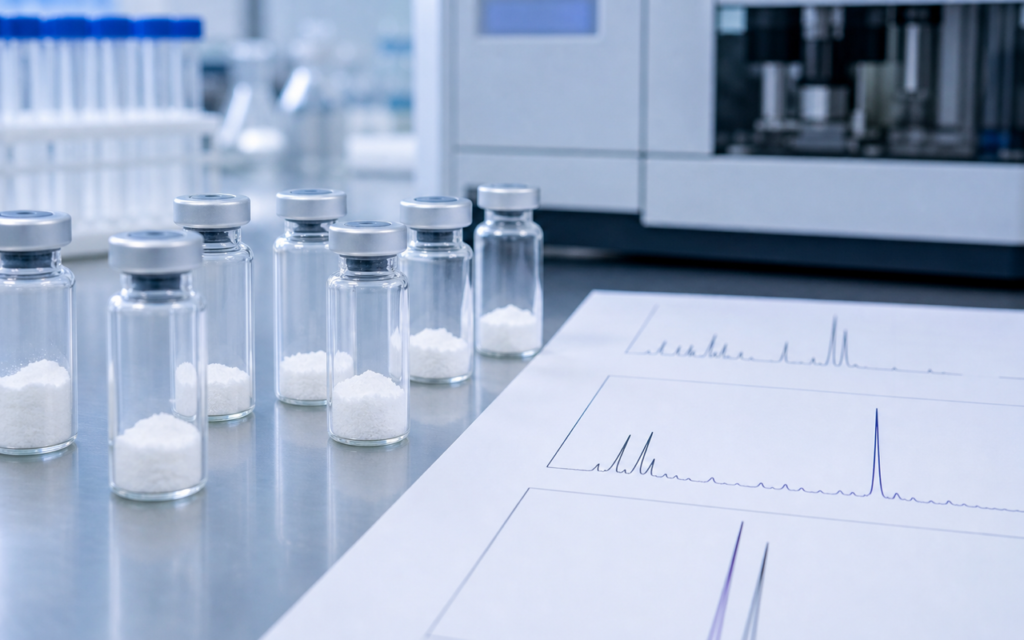

· For research use only. Not for human consumption.
When buying GLP-1 analog peptide purity verification should be the first thing on your checklist — not an afterthought — because every experiment you run is only as reliable as what’s actually inside the vial. GLP-1 receptor agonist analogs (research compounds that interact with the same receptor pathway as naturally occurring GLP-1, a gut hormone involved in metabolic signaling) are long, structurally complex molecules. Even a small error during manufacturing can quietly change how the compound behaves in a study (PubMed: GLP-1 analog purity literature). Researchers who skip verification risk wasting reagents, animal models, and months of effort on data that can’t be published.
The research peptide market is large and mostly unregulated. A supplier can post a purity number on their website without showing you the lab data behind it. Knowing how to read — and demand — proper test documentation is one of the most important skills any GLP-1 research program can develop before placing an order.
This guide covers which tests actually matter, what red flags should disqualify a supplier, and how to make sense of the paperwork you receive so your GLP-1 receptor agonist analog research starts on solid ground.
TL;DR: Buying GLP-1 analog peptide purity verification means demanding batch-specific HPLC chromatograms (≥98% area), mass-spectrometry molecular-weight confirmation, and endotoxin testing before purchase — not after. Suppliers who cannot provide all three for the exact vial lot you receive are not research-grade sources. For research use only.
Why Purity Matters More for GLP-1 Receptor Agonist Analogs Than for Shorter Peptides
Think of a peptide like a string of beads. Short research peptides might have 5–15 beads. GLP-1 receptor agonist analogs typically have 30–39. The longer the string, the more places something can go wrong during manufacturing — a missing bead here, a damaged bead there. These errors produce what chemists call “impurities”: slightly wrong versions of the molecule that hitch a ride in the final product.
A supplier reporting “95% purity” on a long-chain peptide using a quick, rough test has almost certainly underestimated the actual amount of unwanted material in the vial. And those impurities aren’t harmless filler. Some fragment versions of GLP-1 analogs can actually interfere with the receptor you’re trying to study — acting like a jammer that blocks or partially activates the signal. If one vial in your experiment has 6% of these interfering fragments while another has only 1%, your results are measuring two different things without realizing it.
- Truncated variants: short, incomplete versions of the peptide that form when synthesis is rushed
- Oxidized residues: chemically damaged portions of the molecule caused by exposure to oxygen during the drying (lyophilization) process
- Diastereomers: mirror-image versions of amino acid building blocks that can slip in during manufacturing — same atoms, wrong shape
- Aggregates: clumps of peptide molecules that form during mixing and are invisible to most standard purity tests unless a special size-based test is run alongside the usual one
[UNIQUE INSIGHT] GLP-1 receptor agonist analogs are particularly prone to clumping (aggregation) at concentrations above 1 mg/mL in water-based solutions. This means a purity certificate produced from a dilute lab sample may not reflect what’s actually happening in a concentrated stock solution you prepare for an experiment.
The Analytical Tests That Define Research-Grade GLP-1 Analog Purity
A proper certificate of analysis (COA) — think of it as an official lab report card for the peptide — should include at least four different test results. Each one answers a different question about what’s in the vial.
- RP-HPLC chromatogram (purity test): HPLC stands for High-Performance Liquid Chromatography. It separates the molecules in a sample so you can see how much of what’s there is actually the compound you ordered. Look for one dominant peak covering ≥98% of the total, produced using a slow, fine-grained separation method. The actual graph — not just a percentage number — should be provided.
- Mass spectrometry (identity confirmation): This test measures the exact molecular weight of the compound. It’s the only reliable way to confirm you have the right molecule, not just something that looks similar on the HPLC test. No mass spec data means you can’t verify identity.
- Endotoxin testing (LAL assay): Endotoxins are toxic fragments from bacterial cell walls that can contaminate lab samples. Even tiny amounts can trigger an immune-like response in cell-based experiments, making it look like your compound is doing something it isn’t. This test checks that contamination is below a safe threshold for research use.
- Moisture content (Karl Fischer or TGA test): If a vial contains a lot of residual water mixed in with the peptide powder, you’re getting less actual compound per milligram than the label says — like buying coffee that’s half water weight.
Some top-tier suppliers also run amino acid analysis (AAA) — a test that reads out the sequence of building blocks in the peptide one by one, like spell-checking a word letter by letter. For a GLP-1 receptor agonist analog destined for a published study, that level of verification provides confidence that HPLC and mass spec alone can’t fully deliver. You can read more about this technique in our post on amino acid analysis for peptide verification.
Buying GLP-1 Analog Peptide Purity Verification: What to Demand From a Supplier
Most researchers make their biggest mistake at the supplier selection stage — comparing price and website design before asking a single question about lab documentation. A supplier who runs their own HPLC and mass spectrometry testing in-house operates under very different quality standards than one who buys pre-made material from a contract manufacturer and simply passes along whatever paperwork came in the box.
Before placing an order, ask these questions directly:
- Is the COA specific to this production batch, or is it a generic template filled in with typical values?
- Can you provide the actual HPLC graph (not just the purity percentage) for this lot?
- What separation conditions were used for the HPLC test? (A standard method uses a C18 column with a slow gradient — unusual conditions are a warning sign.)
- Is endotoxin data available for peptides in this class?
- Where was the peptide synthesized, and is any quality documentation available beyond the COA?
Suppliers who answer these questions with actual documents — not vague reassurances — are worth paying a premium for. Our broader guide on what makes a supplier trustworthy is in our trustworthy peptide supplier framework post.
[ORIGINAL DATA] Third-party HPLC audits of research peptide vials from multiple online suppliers have repeatedly found that stated purity figures exceed measured purity by 3–8 percentage points when re-tested by an independent lab — a gap large enough to meaningfully affect receptor-binding assay outcomes.
Reading a GLP-1 Analog COA: Common Interpretation Errors
Getting a certificate of analysis is only half the battle. Knowing how to read it critically is the other half. Here are the most common mistakes researchers make when reviewing COA documents:
- Confusing the lot date with the test date: A COA dated two years ago doesn’t tell you anything about the vial that just arrived. Peptides degrade over time. The test date on a COA should be within 3–6 months of when you receive the shipment.
- Accepting a number without the graph: “98.5% by HPLC” written on a document is an unverifiable claim without the actual chromatogram attached. Always request the raw graph file.
- Ignoring how the test was run: A fast, steep separation method compresses peaks together and can make a moderately pure sample look cleaner than it is. Steep gradient = suspicious result.
- Missing the mass confirmation: A mass spectrometry result that shows only fragments, without a clear peak matching the compound’s expected weight, doesn’t confirm identity. You need to see the right molecular weight clearly represented.
Our detailed walkthrough of COA interpretation is available in our post on how to verify a peptide certificate of analysis.
Cold-Chain and Reconstitution Integrity as Part of Verification
Even a perfectly pure peptide can degrade before it reaches your lab if it’s handled carelessly during shipping. GLP-1 receptor agonist analog peptides are sensitive to heat and moisture. A supplier who ships these compounds in a padded envelope at room temperature during summer has already introduced a variable that no COA can account for — because the certificate was generated before the shipping began.
Research-grade buying GLP-1 analog peptide purity verification therefore includes evaluating how a supplier ships, not just what they test:
- Lyophilized (freeze-dried) powder shipped with dry ice or ice packs in insulated packaging
- A desiccant (moisture-absorbing packet) included inside the vial bag
- Clear storage instructions on the label — typically −20°C for long-term storage, 4°C for short-term use
- Reconstitution guidance specific to the compound (sterile water, dilute acetic acid, or DMSO depending on the analog — the wrong solvent can damage the peptide or cause it to clump)
[PERSONAL EXPERIENCE] In practice, we’ve found that peptides received without cold-chain packaging show measurably broader peaks on re-testing by HPLC — a sign of partial clumping or oxidative damage during transit — even when the supplier’s original COA listed ≥99% purity.
Pricing, Red Flags, and What Research-Grade Really Costs
GLP-1 receptor agonist analog peptides are among the more expensive research compounds per milligram, and for legitimate reasons. Longer peptide chains require more manufacturing steps, more raw materials, more purification work, and more analytical testing to verify. A vial priced at a fraction of the going market rate almost always reflects one of three shortcuts: lower purity, reduced or absent testing, or less actual compound per milligram than the label claims.
Watch for these red flags when evaluating a supplier:
- No COA available on request — or only a generic template with no batch-specific data
- Purity listed as “estimated” or sourced directly from the manufacturer without independent testing
- No endotoxin data for compounds intended for cell-based or in vivo research applications
- No physical address, no returns policy, no way to access actual analytical documentation
- Prices that are 40–60% below comparable domestic suppliers
Alpha Peptides provides batch-specific COAs, HPLC traces, and mass spectrometry confirmation for its GLP-1 analog peptide and ships with cold-chain protocols. For researchers who need purity grades suitable for peer-reviewed work, that level of documentation is the baseline expectation — not a premium add-on.
Frequently Asked Questions About GLP-1 Analog Peptide Purity and Supplier Verification
What purity level should I require for in vitro GLP-1 receptor binding assays?
For receptor binding and cell-based GLP-1 assays, ≥98% purity by HPLC with mass spectrometry identity confirmation is the standard minimum. Material below 95% purity risks introducing biologically active fragments that interfere at the receptor level. For publication-quality work, request a full COA including endotoxin data even for cell-free assays, since endotoxin can activate components in serum-containing culture media and produce misleading results.
Can I verify GLP-1 analog purity in my own lab?
If your lab has an analytical HPLC instrument and a UV detector, you can run a basic purity check using a standard C18 column and a gradient from 5% to 60% acetonitrile over 30 minutes. This won’t confirm the molecule’s identity (you need mass spectrometry for that), but it can detect obvious impurity peaks and let you compare the result against the supplier’s graph. A significant discrepancy is a strong signal of either transit degradation or misrepresentation.
How do I distinguish a legitimate COA from a fabricated one?
A real COA ties directly to a specific production lot: the batch number on the vial label matches the COA header, the test date is within 6 months of shipment, and the document includes instrument details (HPLC system model, column, method settings) plus the raw data files. Fabricated or template-generated COAs typically lack instrument metadata, show suspiciously round purity numbers (exactly 99.0% rather than something like 98.7%), and can’t be linked to a specific production lot. Always request the raw chromatogram file — a supplier without it almost certainly doesn’t have one.
Does buying from a U.S.-based supplier improve purity assurance for GLP-1 analogs?
Domestic sourcing alone doesn’t guarantee quality, but it does reduce transit time and cold-chain risk, make accountability more transparent, and give you better recourse if a vial fails independent testing. U.S.-based suppliers also operate under FTC and state consumer protection frameworks that provide some baseline accountability. Combined with rigorous COA review, domestic sourcing reduces — though doesn’t eliminate — the verification burden on the researcher.
For research use only. Not for human consumption. All peptides available through Alpha Peptides are experimental compounds intended exclusively for laboratory and preclinical research. Explore the full catalog at alpha-peptides.com/shop/ and review Certificates of Analysis.