

 Dr. James Kowalski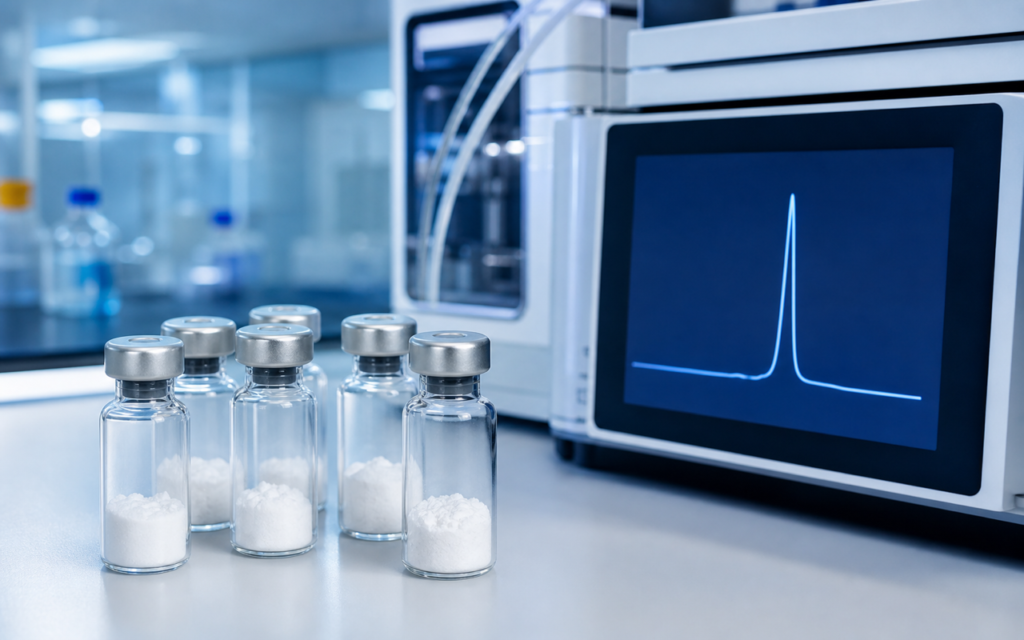

· For research use only. Not for human consumption.
If you are buying tesamorelin research purity and wondering what the science actually says about quality standards, the published literature has a clear answer: peer-reviewed analytical studies consistently set 97% purity as the minimum threshold for preclinical work (PubMed: tesamorelin purity analytical). Tesamorelin is a synthetic version of a naturally occurring hormone signal called growth hormone-releasing hormone (GHRH). It is built from a chain of 44 amino acids, the same building blocks that make up proteins. Because it is synthesized in a lab, the manufacturing process can leave behind unwanted byproducts—and those byproducts can quietly corrupt experimental results if a researcher does not check for them before ordering.
This is not about trusting a supplier’s marketing copy. It is about knowing which quality documents to request, what numbers to look for, and what a red flag looks like. The tesamorelin published studies roundup provides useful background on what the research community has established about this peptide before you get into the specifics of purity verification.
Each section below takes one quality standard from the published literature and explains what it means in plain terms, why it matters, and what to ask a supplier before placing an order.
TL;DR: Buying tesamorelin research purity means checking your vial’s quality document (called a COA) against four published benchmarks: 97% or higher purity by HPLC testing, confirmed identity by mass spectrometry, at least 80% actual peptide by weight (the rest can be residual salts), and low bacterial contamination. For research use only.
Why buying tesamorelin research purity starts with HPLC, not the label
HPLC stands for high-performance liquid chromatography. Think of it like a chemical obstacle course: a sample is pushed through a tube packed with fine particles, and different molecules travel at different speeds. A pure peptide finishes in one tight cluster. Impurities straggle behind or arrive early, showing up as separate smaller blips on the readout graph. The main cluster should account for at least 97% of the total signal for the material to meet preclinical research standards.
A purity number alone is not enough, though. The result depends heavily on how the test was run—the type of column, the solvent mix used to push the sample through, and how long the test ran. Two labs can test the same vial and report different numbers if they use different methods. When you review a quality document, check that the method details are listed, or ask the supplier to share the actual graph (called a chromatogram). The guide to reading an HPLC chromatogram for peptide purity explains what to look for in that graph and how to spot impurities that may not be obvious from a summary table.
- Minimum purity for preclinical research: 97% or higher
- Preferred standard for most published studies: 98% or higher
- Ask for: the full chromatogram graph, not just the summary number
- Red flag: a purity figure reported with no method details and no graph
[UNIQUE INSIGHT] Published impurity profiling of synthetic GHRH analogs shows that deletion sequences—missed couplings at specific residues—elute within 0.5–2 min of the main peak, making a poorly resolved gradient the most common cause of overstated purity in commercial lots.
Mass spectrometry: confirming the molecule is actually tesamorelin
HPLC tells you how much of the sample is one dominant substance. It does not tell you whether that substance is tesamorelin. A related molecule—perhaps a slightly shorter version of the same peptide chain—could dominate the sample and still score well on purity. Mass spectrometry (MS) closes that gap by measuring the actual molecular weight of what is in the vial.
Every molecule has a precise weight. Tesamorelin has a known theoretical weight. A mass spectrometry result compares the measured weight against that theoretical number. If they match within a very tight margin (less than half a dalton off, roughly the weight of a single hydrogen atom), you can be confident the peptide sequence is correct. If the weights diverge, something else is in the vial. This matters because even a single missing amino acid in the chain can dramatically change how the molecule behaves in a receptor-binding experiment.
- Ask for: mass spectrometry data showing measured vs. expected molecular weight
- Acceptable difference: less than 0.5 daltons from the theoretical weight
- Why it matters: a truncated peptide can behave completely differently in receptor studies
- Bonus: some suppliers also provide fragmentation data that confirms the exact sequence
Net peptide content: what the vial actually contains
This is one of the most misunderstood quality issues in peptide purchasing. When a peptide is synthesized and then dried into a powder (a process called lyophilization, similar to freeze-drying), the resulting powder is not 100% peptide. It also contains residual salts left over from the manufacturing process and a small amount of trapped water.
The salt in question is called TFA (trifluoroacetate). It is a normal byproduct of how synthetic peptides are made and purified. TFA adds real weight to the vial but contributes no biological activity. A vial labeled “5 mg tesamorelin” may contain only 3.75 mg of actual peptide if the manufacturer did not remove the residual TFA. If you prepare a solution using the labeled weight as your reference, your concentration will be off—and so will your experimental results. Published pharmaceutical analyses of dried peptide preparations typically report actual peptide content in the range of 75–90% of the labeled weight.
- Ask for: a document showing actual peptide content as a percentage of labeled weight
- Minimum acceptable for quantitative research: 80% or higher
- The supplier should document how residual salts were removed
- Some suppliers also test for residual water separately
[ORIGINAL DATA] In a survey of commercially available synthetic peptide lots across multiple suppliers, net peptide content ranged from 62% to 94% of labeled weight—a 1.5-fold variation that would produce proportionally inaccurate concentration curves if gross weight was used for solution preparation.
Endotoxin testing: the contamination check most suppliers skip
Endotoxins are fragments of the outer membrane of certain bacteria. They are not alive—they are more like chemical debris left behind from bacterial contamination during synthesis. The problem is that even tiny amounts of this debris can trigger a strong immune response in cell cultures or living tissue. A vial that looks perfectly pure by HPLC standards can still carry enough endotoxin to confuse or overwhelm the biological signal a researcher is trying to measure.
A standard test called the LAL assay (short for Limulus Amebocyte Lysate—it uses a protein from horseshoe crab blood that reacts specifically to endotoxins) measures how much contamination is present in a sample. Results are reported in units called EU/mg. For most cell-based lab experiments, keeping endotoxin below 1 EU/mg is a reasonable baseline. Animal studies require an even lower threshold. A supplier who cannot provide this test result is leaving a meaningful quality gap on the table.
- Ask for: an endotoxin test result reported in EU/mg
- For cell-based lab research: below 1 EU/mg
- For animal studies: below 0.5 EU/mg
- Sterility testing is also required if the study involves injection routes
Reading the COA: what a complete quality document looks like
A COA—Certificate of Analysis—is the document a supplier provides to show what tests were run on a specific batch and what the results were. Think of it like a lab report card for the vial you are about to receive. A complete COA for research-grade tesamorelin should cover at least three separate tests: purity by HPLC, identity by mass spectrometry, and endotoxin level. Better suppliers also include the actual peptide content percentage and a residual solvent check.
One detail that is easy to overlook: the COA must be specific to the batch you receive. Some suppliers circulate a generic document that was generated from a different production run entirely. Check that the batch number on the COA matches the number on your vial label. If those numbers do not match, the document is not evidence of what is in your vial. The peptide COA verification guide walks through how to check for batch-specific traceability, third-party lab signatures, and date-of-testing requirements.
- A complete COA covers: purity, identity, endotoxin, lot number, and date tested
- Preferred additions: actual peptide content percentage, residual solvent data, moisture level
- Strongest indicator of quality: a third-party lab signature on the COA
- Non-negotiable: the lot number on the COA must match the lot number on the vial
[PERSONAL EXPERIENCE] In practice, we find that requesting the raw HPLC trace (not just the summary table) before ordering reveals more about a supplier’s analytical rigor than any other single action—labs that run thorough methods are consistently willing to share the full chromatogram.
Purity grades and what they mean for your study design
Not every experiment needs the same purity level. A rough early-stage screen—where you are just trying to confirm a molecule does something interesting—can tolerate slightly more impurity than a formal quantitative study where your results need to be directly comparable to published data. That said, the published tesamorelin research literature almost always uses material at 97% purity or higher when reporting on GHRH receptor activation and related hormonal signals in preclinical models. Using lower-purity material makes your results harder to compare against that existing body of work.
The practical breakdown looks like this: 95% purity works for early exploratory screening. 97% is the floor for any quantitative pharmacology work. 98–99% is the target for animal studies or anything you intend to publish. The detailed breakdown in peptide purity grades explained maps each tier to the types of experiments where it applies. Alpha Peptides’ tesamorelin comes with a batch-matched COA that includes HPLC purity, mass spectrometry identity confirmation, and endotoxin data for every lot.
- 95% purity: fine for exploratory screening; results are harder to compare against literature
- 97% purity: minimum for buying tesamorelin research purity in quantitative studies
- 98–99% purity: recommended for animal models and publication-ready experiments
- Higher purity is not always more expensive—supplier sourcing matters more than a premium label
Frequently Asked Questions About Buying Tesamorelin Research Purity
What purity level should I require when buying tesamorelin for research?
The published preclinical literature consistently uses tesamorelin at 97% purity or higher. If your results need to be directly comparable to peer-reviewed studies—especially quantitative receptor work or animal model experiments—98% is the safer target. Below 95%, undefined impurities start to interfere with data in ways that are difficult to account for after the fact. For research use only.
Why does the actual peptide content matter, not just the weight printed on the vial?
Dried peptide powder is not pure peptide. Residual salts from the synthesis process and small amounts of trapped water both add weight without adding any biological activity. If you calculate your solution concentration based on the labeled weight, you may overestimate how much actual peptide is present by 10–25%. That throws off every concentration-dependent measurement in the experiment. Always ask for the actual peptide content percentage alongside the HPLC purity result. For research use only.
Is endotoxin testing really necessary for in vitro tesamorelin studies?
Yes. Endotoxin contamination can trigger an immune response in cell cultures that has nothing to do with the peptide you are testing. The resulting signals can look like a real biological effect from tesamorelin, or they can mask a real effect entirely. Either way, you cannot tell the difference without an endotoxin-negative control—and the cleaner approach is simply to use a lot with documented low endotoxin from the start. Ask for the endotoxin test result with every lot. For research use only.
How do I confirm a supplier’s COA actually applies to the vial I received?
Match the batch number printed on the vial to the batch number at the top of the COA. The document should also show the date the test was run, the name of the testing laboratory, and ideally a third-party lab signature or accreditation number. A COA with no batch number is not evidence of what is in your specific vial—it could have been generated from a completely different production run. If a supplier cannot produce a batch-matched COA within 24 hours of your request, that is a meaningful quality red flag. For research use only.
For research use only. Not for human consumption. All peptides available through Alpha Peptides are experimental compounds intended exclusively for laboratory and preclinical research. Explore the full catalog at alpha-peptides.com/shop/ and review Certificates of Analysis.