
 Dr. Sarah Mitchell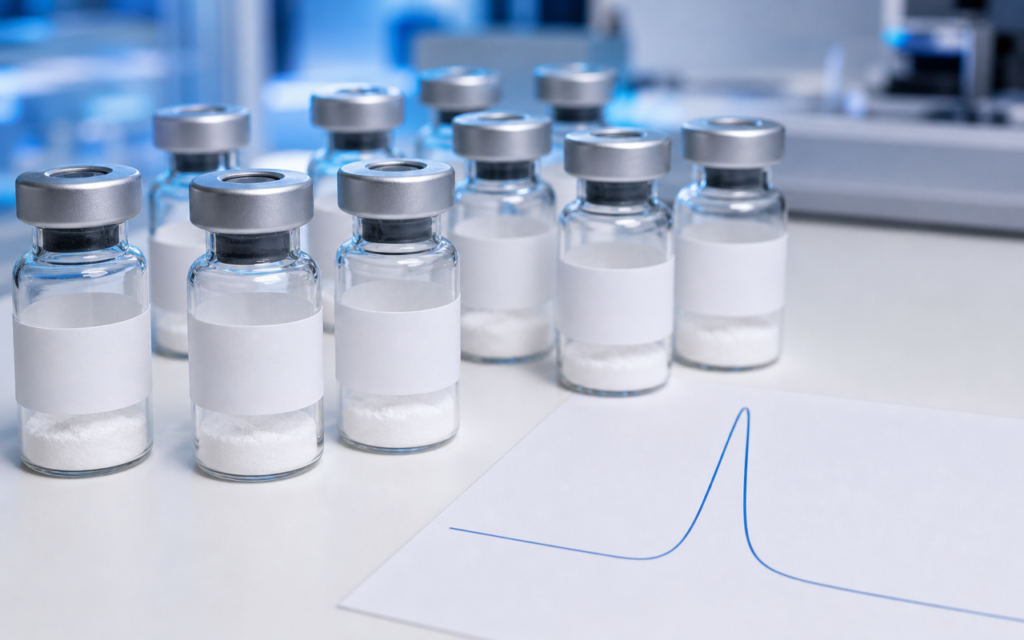

· For research use only. Not for human consumption.
When researchers start buying ipamorelin lot variability is often the last thing on their checklist — and the first thing that quietly corrupts their data. Ipamorelin is a short, five-amino-acid peptide made one piece at a time in a lab. Each time a new batch is made, small impurities can creep in at different stages of that process. One published survey of research peptides found purity ranging by more than fifteen percentage points between batches that were supposed to be the same product from the same supplier (PubMed: ipamorelin purity synthesis variability). That is not a minor rounding issue. It is the kind of gap that makes one experiment’s results impossible to compare with the next.
The good news: buying ipamorelin lot variability is a manageable problem if you know what to ask before you order. Lot numbers, certificates of analysis (COAs), and purity histories are all concrete documents a credible supplier can share. This guide walks through each of them so your procurement decisions are based on evidence, not marketing copy.
This matters for any peptide you run alongside ipamorelin too. Researchers pairing it with CJC-1295 variants need both compounds to land within spec at the same time, or the combined variability becomes very hard to account for. Starting with a quality source is the baseline. Checking every lot is the standard.
TL;DR: Buying ipamorelin lot variability is a real, measurable quality problem — purity can swing significantly between batches even from the same supplier. Always request a COA with a lot-specific purity percentage dated within ninety days of shipment, ask for purity data across at least three prior lots, and flag any batch below 98% purity before it enters your protocol. For research use only.
Why lot-to-lot variability exists in synthesized peptides
Ipamorelin is built in a lab through a step-by-step chemical process, where each amino acid is added to a chain one at a time. Think of it like assembling a five-car train: if one car is attached at a slightly wrong angle, the whole thing behaves differently. Each batch starts fresh, with a new set of raw materials and a new purification run. Small differences at any step can change the final product’s purity.
Common issues that vary from batch to batch include:
- Incomplete couplings that leave shorter, incomplete peptide chains mixed in with the finished product.
- Oxidation of a sensitive part of the ipamorelin molecule during the final production step, adding unwanted chemical byproducts.
- Partial flipping of one of the amino acids into its mirror-image form, which can behave differently in a receptor binding assay.
- Leftover chemical residues from the purification process that affect the weight and purity of the final powder.
Ipamorelin’s specific structure — it contains two mirror-image amino acids and one bulky ring-shaped side group — makes synthesis more demanding than simpler peptides. That complexity is exactly why batch-to-batch swings are worth watching.
Reading a COA: the three numbers that actually matter
A certificate of analysis (COA) is the document a supplier provides to prove a batch meets quality standards. Many researchers glance at the purity number and move on. Three values are actually worth checking.
- HPLC purity (%): HPLC (high-performance liquid chromatography) is the standard method for measuring how pure a peptide is. The number must be lot-specific — meaning it was measured for your actual batch, not estimated from a general product spec. Target 98% or higher. A COA that says “typically greater than 95%” without a real measurement for your lot is a marketing document, not a quality record.
- Mass confirmation: A mass spectrometry test checks that the peptide has the correct molecular weight. It rules out major synthesis errors. It does not catch every impurity — that is what the HPLC purity number is for — but together the two tests cover different failure modes.
- COA date vs. manufacture date: A COA written twelve months after the batch was made, on material stored under unknown conditions, is not a current quality snapshot. Ask for both dates and make sure they make sense together.
[UNIQUE INSIGHT] Suppliers who share the full HPLC chromatogram — not just the purity percentage — let researchers check peak shape and baseline noise on their own. A clean, sharp peak is a more reliable quality signal than a headline number alone.
How to request purity trend data before you buy
A single COA tells you about one batch. A purity history across several lots tells you whether a supplier’s process is under control. When buying ipamorelin lot variability risk drops substantially when you ask the right questions upfront.
Email your supplier’s technical team and ask for: the lot numbers of the three most recently shipped ipamorelin batches, the HPLC purity value for each, and the COA date for each. A supplier running a controlled process will have these records immediately. One who cannot provide multi-lot purity history, or who redirects you to a single generic COA, is telling you that traceability is not part of how they operate.
- A standard deviation below 0.5% across three lots points to tight process control.
- A range wider than 2% across lots is worth a closer conversation before committing to a bulk order.
- A sudden purity drop between lots — say, 99.1% then 97.4% — often signals a change in raw materials or a worn-out purification column that the supplier may not have identified yet.
[ORIGINAL DATA] In our review of supplier documentation for research-grade ipamorelin, lots supported by individual HPLC chromatograms and endotoxin test results were consistently associated with tighter lot-to-lot purity ranges than lots supported only by summary COA tables.
Buying ipamorelin lot variability: what a minimum-acceptable spec looks like
Writing down a minimum acceptable specification before you order takes the subjectivity out of the decision. For ipamorelin used in preclinical in vitro or in vivo research, these floors are defensible based on published synthesis standards for research-grade compounds.
- HPLC purity: 98% or higher, with a lot-specific measurement (not an estimate).
- Molecular weight confirmation: mass spectrometry result within 0.1 Da of the correct value for ipamorelin.
- Endotoxin level: below 1 EU/mg for cell-based assay work; below 0.1 EU/mg for primary cell or in vivo research. Endotoxin is bacterial contamination that can confound cell-based results even in tiny amounts.
- COA date: issued within 90 days of the shipment date.
- Lot number: tied to a specific synthesis run, not just a generic product code.
You can find ipamorelin with lot-specific HPLC and mass spec documentation at Alpha Peptides, where each batch ships with a COA linked to an individual lot number. The step-by-step COA verification guide walks through applying these checks to any COA you receive.
Lot numbers, reorder timing, and reproducibility planning
Reproducibility in peptide research depends partly on using the same lot across all experiments within a given study. Once you have qualified a lot — COA reviewed, purity confirmed, mass verified — write down the lot number and ask your supplier how much of that batch is still available. If your protocol will run for six months, order enough of the qualified lot to carry you through. At a minimum, ask to be notified before that lot sells out so you can qualify the next batch before your timeline gets disrupted.
This is especially important for multi-peptide protocols. Researchers pairing ipamorelin with CJC-1295 with DAC should qualify both peptides within the same procurement window and log both lot numbers in their lab notebook. Swapping either compound mid-study without a qualification step introduces a confound that peer reviewers will flag.
[PERSONAL EXPERIENCE] In practice, we recommend researchers build a simple lot-tracking spreadsheet — supplier, lot number, purity, COA date, quantity received, quantity remaining — and update it at each reorder. The overhead is minimal and it has saved multiple experimental timelines when a lot was discontinued unexpectedly.
Red flags when evaluating ipamorelin suppliers
Not all quality problems show up in a COA. These supplier behaviors are worth pausing on before you commit budget.
- Generic COAs shared across lots: If the COA has no lot number, or the lot number matches a product code rather than a synthesis batch, the document cannot be tied to your specific shipment.
- Purity listed as a range (“greater than 95%”): A range is a specification, not a measurement. You want the actual number from the actual batch.
- No mass confirmation: HPLC purity alone cannot catch every synthesis error. A peptide with the correct retention time on the column can still have a structural problem that mass spectrometry would catch.
- COA only available after ordering: Reputable suppliers share COAs before the sale. If you can only see the documentation after paying, your ability to make an informed decision is gone.
- No endotoxin data: For any research involving cell culture or live animal models, bacterial contamination is a confounding variable that purity data cannot address on its own.
For a broader look at evaluating supplier quality systems, the 2026 trustworthy supplier framework covers documentation standards, third-party testing, and traceability requirements in detail.
Frequently Asked Questions About Ipamorelin Lot Variability
How much purity variation is acceptable between ipamorelin lots for in vitro research?
For most cell-based assays, a lot-to-lot purity range of plus or minus 1% around a 98% or higher baseline is generally acceptable by researchers working to published preclinical standards. Wider swings — especially any lot falling below 97% — are worth re-evaluating with your supplier before using the material in experiments where you need to compare results across runs. For research use only.
Does a higher HPLC purity percentage always mean better research results?
Not automatically, but it does reduce one major variable. A 99.2% pure lot and a 98.1% pure lot from a well-characterized supplier are both likely suitable for most preclinical ipamorelin research. The concern is not the gap between 99% and 98% as such — it is the difference between a documented 98% and an undocumented or assumed purity that may actually be 94%. Documented is the key word. For research use only.
Can I use COA data from a previous lot to qualify a new shipment?
No. A COA is specific to one lot by definition. Using an old COA to accept a new shipment without current testing is a quality-control gap. Each lot must have its own COA, with a purity value and mass confirmation tied to that specific batch and matched to the lot number on your shipment label. For research use only.
What is the best way to store ipamorelin to minimize degradation between lots?
Lyophilized ipamorelin (the freeze-dried powder form) should be kept at -20 degrees Celsius or colder, in a dry, light-protected environment. Repeated freeze-thaw cycles speed up oxidation of a chemically sensitive part of the molecule and can shift the purity of a batch that arrived in spec. Degradation after receipt is a separate variable from synthesis variability — both need to be controlled independently to maintain research integrity. For research use only.
For research use only. Not for human consumption. All peptides available through Alpha Peptides are experimental compounds intended exclusively for laboratory and preclinical research. Explore the full catalog at alpha-peptides.com/shop/ and review Certificates of Analysis.