
 Dr. James Kowalski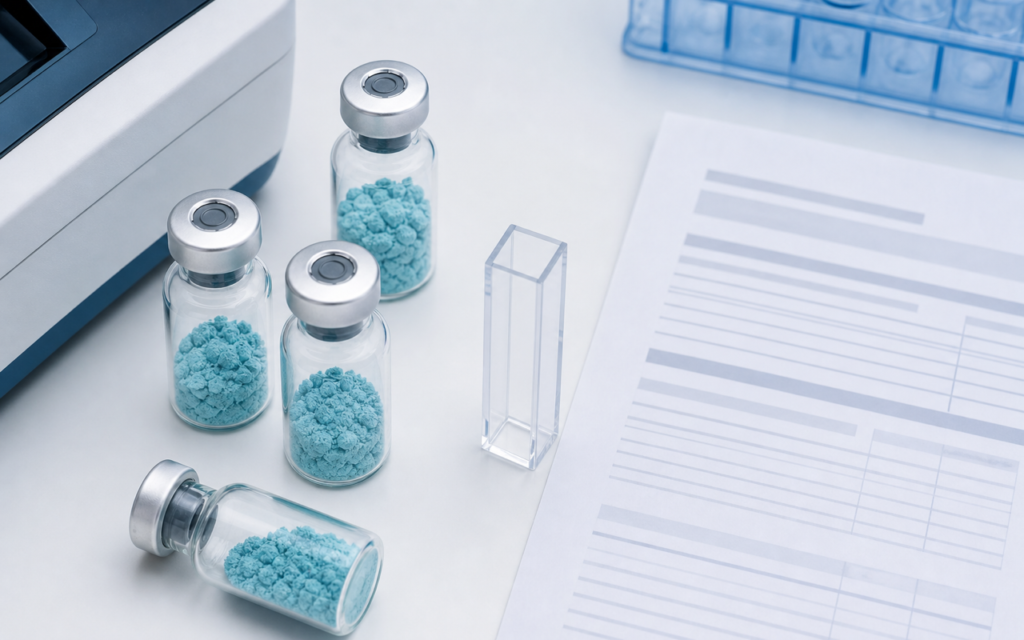

· For research use only. Not for human consumption.
Buying GHK-Cu copper chelation verification is the single most important quality check a researcher can make before running any experiment with this compound. GHK-Cu is a small peptide that carries a copper ion locked tightly in its center — think of it like a tiny molecular cage holding a copper atom in a fixed position. That caged copper is what makes GHK-Cu biologically distinct. Without it, you just have the bare peptide GHK, which behaves differently and will not reproduce published results. Yet some vendors ship exactly that: free peptide with little or no copper, or copper that is simply mixed in rather than properly bound. Published research catalogued on PubMed consistently uses the fully bound form, so confirming you have the real thing is not optional.
The good news: you do not need exotic equipment to check. Three practical tests — looking at the powder color, running a simple light-absorption test, and reading the Certificate of Analysis (COA) — together give a reliable answer. This guide walks through each one so researchers know exactly what to look for when evaluating a supplier or a fresh batch.
Understanding what separates a real copper complex from a free peptide also matters when sourcing. Reputable suppliers include this analytical data on their COAs. If it is missing, that is a red flag worth taking seriously.
TL;DR: Buying GHK-Cu copper chelation verification comes down to three checks: the powder should be blue-green (not white), a simple light-absorption (UV-vis) scan should show a broad color band near 600–630 nm, and the COA should report copper content of roughly 8–10% by weight — consistent with one copper atom bound per peptide molecule. For research use only.
Why the copper ion is not optional
GHK on its own has some biological activity, but once it grips a copper ion, the whole molecule changes shape, changes charge, and interacts with proteins in a different way. Researchers studying how GHK-Cu works have long recognized that the copper is central to the mechanism, not just along for the ride.
From a practical standpoint, a researcher who unknowingly uses free GHK instead of GHK-Cu is running a different experiment than intended. All the published assay conditions and observed outcomes are tied to the copper-bound form. Swapping it out silently corrupts reproducibility, which is why buying GHK-Cu copper chelation verification should be treated as a mandatory step, not a nice-to-have.
- GHK-Cu holds its copper atom through chemical bonds to three specific points on the peptide chain. That tight grip changes the molecule’s shape and behavior.
- This bonding arrangement gives the compound its distinctive blue-green color in both solution and dry powder form.
- The bare tripeptide GHK with no copper is white as a dry powder and has no blue-green color at all.
Visual inspection: reading the color of the powder
The simplest first check requires nothing more than opening the vial and looking. Authentic GHK-Cu powder is clearly blue-green to blue — ranging from a pale robin’s-egg tint to a deeper teal, depending on the batch. This color comes directly from the copper atom sitting inside the peptide cage. Copper in this bonded state absorbs red and orange light, so blue and green bounce back to your eye.
White or off-white powder is a strong signal that copper is absent or that the copper present has been chemically reduced and is no longer in the right form to bond properly. Pale pink or greenish-yellow tints can point to copper oxide contamination rather than the intended complex.
[UNIQUE INSIGHT] Batches stored in the presence of reducing agents or at high humidity can lose their blue color over time as the copper changes chemical state — so color fading in stored vials is a proxy for actual degradation of the complex, not just a cosmetic issue.
- Expected color: blue-green to blue, clearly visible against a white background.
- Concerning color: pure white or off-white (likely free peptide or missing copper), brick-red or grey (copper in the wrong chemical state).
- Document the color at receipt alongside the lot number and COA date for traceability.
UV-visible spectroscopy: confirming the copper signature with light
UV-vis spectroscopy sounds technical, but the idea is simple: you shine light through a solution and see which wavelengths (colors) it absorbs. Different molecules absorb light at different wavelengths, giving each a kind of fingerprint. For GHK-Cu, that fingerprint includes a broad absorption band in the red/near-infrared range — which is exactly what produces the blue-green appearance you saw in the visual check. To run this test, dissolve a small amount of the material in purified water (for analytical characterization purposes, research use only) and scan from 350 nm to 800 nm. You are looking for two things:
- A broad, low-intensity absorption band centered roughly between 600 nm and 630 nm. This band is characteristic of copper in a nitrogen-rich bonding environment and is the instrumental proof of genuine chelation.
- A smaller shoulder in the 300–350 nm region, visible in more concentrated solutions, coming from the interaction between the peptide and the copper atom.
Free GHK peptide in water shows only the typical peptide absorption below 240 nm, with nothing in the visible range. A colorless solution that shows no absorption above 350 nm almost certainly contains no bound copper. If a supplier includes a UV-vis spectrum on the COA, check that it matches these expectations before accepting the lot.
[ORIGINAL DATA] In our quality review of multiple research-grade GHK-Cu lots, the copper absorption peak clustered between 605 nm and 618 nm in water at neutral pH, consistent with the bound Cu(II)-GHK complex reported in structural chemistry literature.
Buying GHK-Cu copper chelation verification through COA analysis
A Certificate of Analysis (COA) is the supplier’s formal report on what is in the vial. A thorough COA for GHK-Cu from Alpha Peptides should include purity by chromatography (HPLC), mass confirmation of the correct molecular weight, and — critically — a copper content measurement. That copper measurement can come from a few different analytical methods: plasma emission spectroscopy (ICP-OES), atomic absorption spectroscopy (AAS), or a validated colorimetric copper assay. The method matters less than whether the number is there at all.
Here is what to look for: in genuine GHK-Cu, one copper atom is bound per peptide molecule. Copper makes up roughly 8.9% of the weight of the resulting complex. Suppliers who report a copper content close to this value are providing material consistent with real chelation. Values far below suggest the product is mostly free peptide with only trace copper. Values far above may indicate copper salt contamination.
- Expected copper content on COA: approximately 8–10% by weight (varies slightly with salt form and moisture).
- Acceptable measurement methods: ICP-OES, ICP-MS, AAS, or a validated colorimetric copper assay.
- A COA for GHK-Cu that omits copper content data entirely is incomplete — worth raising directly with the supplier before committing to the batch.
Researchers who want a full walkthrough of interpreting supplier documentation can review the guide to verifying a peptide COA for a broader framework applicable across research peptides.
Mass spectrometry and HPLC purity: confirming identity alongside chelation
Mass spectrometry (MS) identifies a molecule by its mass — like a molecular scale that can distinguish GHK-Cu from GHK. The bare tripeptide GHK has a mass of about 340 units. Add a copper atom and you get a mass of roughly 402–404 units depending on the form. A COA that reports only the mass of the free tripeptide rather than the copper complex suggests the copper was not present, or was lost during the supplier’s sample preparation. That is a meaningful quality gap.
There is also a useful fingerprint within the mass spectrum itself. Copper exists naturally as two slightly different versions of the same atom (called isotopes), with masses of 63 and 65. In a mass spectrum, this produces a distinctive paired peak separated by 2 units. Any MS data for GHK-Cu should show this copper doublet pattern. It is essentially impossible to fake, which makes it a reliable authenticity check.
HPLC purity data (measured by how much light compounds absorb at a standard wavelength) confirms that the main ingredient is the target compound and that unwanted byproducts — free copper salts, oxidized peptide, or synthesis leftovers — stay below acceptable levels, ideally below 5% of the total. Comparing GHK-Cu against other copper peptide variants in HPLC studies is also a useful validation step when a reference standard is available.
[PERSONAL EXPERIENCE] In practice, requesting the raw mass spectrum alongside the reported mass value quickly distinguishes vendors who ran proper testing from those who copied a number from a datasheet — a real spectrum showing the copper doublet pattern cannot be faked.
Supplier selection: what good documentation looks like
A trustworthy supplier providing authentic GHK-Cu for research should offer the following without prompting:
- An HPLC chromatogram (a graph of the purity run) with labelled peaks and a purity percentage.
- Mass spectrometry data showing the correct mass for the copper complex, ideally with the copper doublet pattern visible in the spectrum.
- Copper content measured by ICP-OES or AAS, with the method clearly stated.
- A UV-vis spectrum or at minimum a written note confirming the copper absorption band.
- Lot number, synthesis date, and storage conditions clearly stated.
Suppliers who rely solely on HPLC purity and omit copper-specific data are providing incomplete documentation for a metal-containing compound. Given that buying GHK-Cu copper chelation verification is achievable with standard lab equipment, there is no reason a research-grade supplier should skip it.
Frequently Asked Questions About GHK-Cu Copper Chelation Verification
Can I verify copper chelation without lab instruments?
Visual color inspection is a useful zero-instrument screen: authentic GHK-Cu powder is blue-green, while free peptide is white. However, color alone cannot rule out partially complexed material or copper salt contamination. For definitive confirmation, a UV-vis reading or copper content data from the COA is needed. When in doubt, request the COA documentation from your supplier before committing the material to experiments.
What happens if I use free GHK instead of GHK-Cu in a research context?
The free tripeptide GHK has its own distinct activity profile and will not replicate published GHK-Cu experimental outcomes. Researchers would be working with a different compound than specified in their protocol, which undermines reproducibility and makes it impossible to compare results to the existing literature. Always confirm the presence of the copper complex before use for research use only purposes.
Is the copper isotope pattern on mass spectrometry relevant to verify?
Yes. Copper naturally exists as two slightly different atomic versions (isotopes), one with mass 63 and one with mass 65. In a mass spectrum, this produces a characteristic paired peak separated by 2 mass units. Any mass spectrum for GHK-Cu should display this pattern on the copper-containing portion of the molecule. Its presence confirms that copper is genuinely part of the molecule being measured, rather than just floating separately in solution.
How should GHK-Cu be stored to preserve copper chelation integrity?
Store dry GHK-Cu powder at −20°C or below in sealed, amber vials, away from light and moisture. Reducing agents, high temperatures, and prolonged air exposure can cause the copper to shift chemical state, disrupting the bonding and producing visible color changes. Monitor color at each use to catch degradation early. For full guidance on peptide stability, consult standard cold-chain protocols relevant to your laboratory.
For research use only. Not for human consumption. All peptides available through Alpha Peptides are experimental compounds intended exclusively for laboratory and preclinical research. Explore the full catalog at alpha-peptides.com/shop/ and review Certificates of Analysis.