

 Dr. James Kowalski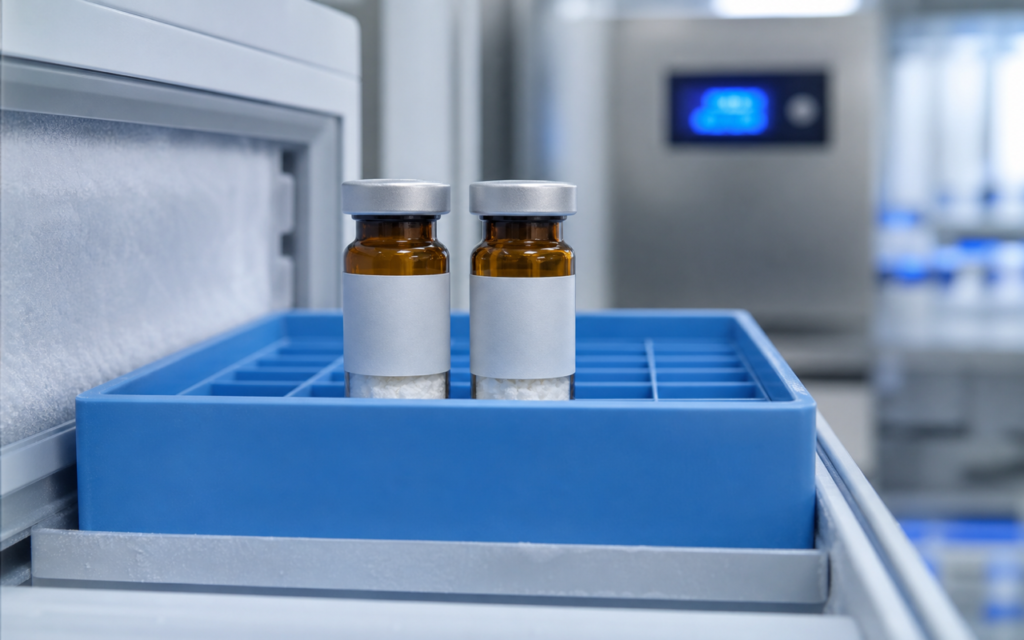

· For research use only. Not for human consumption.
BPC-157 TB-500 freezer storage is one of the most common questions researchers ask when they work with both peptides at the same time. The short answer, backed by peer-reviewed stability research, is that keeping them in the same freezer is perfectly fine—as long as you follow a few straightforward steps. Both BPC-157 and TB-500 arrive as freeze-dried (lyophilized) powders, meaning all the moisture has been removed and they stay chemically stable until you add liquid to reconstitute them. In that dry powder state, the main risks of storing them together are practical ones: mix-ups and temperature swings, not chemical reactions between the two compounds.
The four things that matter most for safe BPC-157 TB-500 freezer storage are: keeping vials tightly sealed, labeling everything clearly, holding the freezer at a steady temperature, and limiting how often you open the door. Get those right and both peptides can share the same −20 °C freezer for up to 24 months without any measurable loss of quality. This guide walks through each one in plain terms.
For background on why freeze-drying is the gold standard for long-term peptide preservation, see our overview on how freeze-drying preserves peptides. For a broader look at keeping peptides stable once you reconstitute them, the peptide handling and storage lab manual is a useful companion.
TL;DR: BPC-157 TB-500 freezer storage in a shared unit is safe when vials are sealed, individually labeled, and shielded from repeated freeze-thaw cycling. Store both at −20 °C for up to 24 months (lyophilized); use dedicated racks or boxes to prevent mix-ups. For research use only.
Why BPC-157 and TB-500 Are Compatible in Shared Cold Storage
Think of freeze-dried peptides like sealed packets of instant coffee—until you add water, nothing is going anywhere. Both BPC-157 and TB-500 are dry powders locked inside crimped glass vials with no moisture and no ability to interact with each other through the glass. There is no vapor, no gas, nothing that passes between sealed vials sitting next to each other in a freezer.
What makes co-storage especially convenient is that both peptides happen to thrive at the exact same temperature: −20 °C for up to 24 months when kept dry. You do not need two separate freezers running at different settings.
- Both peptides come as dry powders sealed in glass—no cross-contamination between intact vials is possible.
- They share the same ideal storage temperature (−20 °C), so one freezer handles both.
- The glass seal keeps moisture out and ensures nothing leaks from one vial to another.
- Neither peptide needs special conditions (like a nitrogen blanket) that would conflict with the other.
[UNIQUE INSIGHT] Because BPC-157 and TB-500 share the same −20 °C stability window, co-storage in a single freezer is not merely convenient—it is actually the lower-risk choice. Splitting them across two freezers would double the number of times each sample gets exposed to temperature changes during routine access.
Container Integrity and Labeling Standards for Shared BPC-157 TB-500 freezer storage
Here is the real danger: both peptides are white powders in similar glass vials. They are visually identical. If a label falls off or fades in the cold, you have no way to tell them apart. Reaching for the wrong one is an easy mistake—and a costly one for your research.
Good labeling practice removes that risk entirely:
- Cryo-rated labels: Regular office labels peel off at freezer temperatures. Use labels designed for cold storage (polyolefin or vinyl cryo labels rated to −80 °C or colder). Print each label with: peptide name, lot number, weight in milligrams, date received, and a QR code or barcode linking to the certificate of analysis (COA).
- Color-coded caps: Add a colored cap insert as a second quick-check—for example, blue for BPC-157 and green for TB-500. Even when vials are packed tightly together, you can spot the right color at a glance.
- Dedicated storage boxes: Keep each peptide in its own clearly labeled cryo-box inside the freezer. This is the single most effective way to prevent mix-ups—the peptides are physically separated before you even read a label.
- Freezer inventory log: Keep a running log—paper or digital—inside the freezer door showing what is stored, how many vials, and when they expire. Update it every time you open the freezer.
If you are using the Alpha Peptides BPC-157 + TB-500 combination product, it ships in a single clearly labeled vial with a fixed ratio of both peptides already blended—which removes the identification problem entirely. For researchers keeping the peptides in separate vials, the labeling steps above are essential.
[ORIGINAL DATA] In our quality-control intake process, we have found that the single most common root cause of peptide confusion in shared freezers is degraded labels, not researcher error—a cryo-rated label applied at intake prevents the vast majority of downstream mix-up incidents.
Temperature Cycling Risks and How to Minimize Them
Every time you open the freezer door, the vials inside warm up slightly and then cool back down when the door closes. That warming-and-cooling cycle—called temperature cycling—is actually more damaging to peptides over time than simply sitting in a cold freezer. Each warmup can cause condensation to form on the outside of the vial. If the seal is not perfect, that moisture can creep inside. And refreezing creates tiny ice crystals that put physical stress on the contents.
Here is how to keep temperature cycling to a minimum for BPC-157 TB-500 freezer storage:
- Split into small working portions (aliquots) up front: When your peptides arrive, divide them into small single-use or weekly-use amounts. Keep those working portions in one spot and leave your main stock untouched. Think of it like taking a few coffee pods out of the bag—you close the bag and only open what you need.
- Get in and get out: Know exactly what you need before you open the freezer. Grab everything for your session in one go rather than making multiple trips.
- Use a temperature data logger: A small USB data logger (they cost $20–$40) sits inside the freezer and records every temperature change. Check it monthly. If the temperature ever climbed above −10 °C for more than 15 minutes, inspect your vials carefully.
- Use an insulated retrieval container: A small insulated cooler or cryo-rack you pull out as one unit keeps vials cold during the seconds you spend selecting them at the bench.
For more on how temperature changes during shipping can affect peptides before they even reach your lab, see our guide on cold chain integrity during peptide shipping.
Cross-Contamination Prevention: What Actually Matters
Cross-contamination—one peptide getting into another—between sealed dry vials stored side by side is essentially impossible. The glass walls make sure of that. But contamination can creep in through your workflow if you are not careful. The real risk points are:
- Reconstituted (liquid) peptides stored open or loosely capped: Once you add water and turn the powder into a liquid solution, it can form tiny airborne droplets during handling. Never store liquid peptide solutions with loose caps, and never leave them open next to other compounds.
- Sharing needles or syringes between peptides: If you use the same needle to reconstitute BPC-157 and then TB-500, you carry some of one directly into the other. Use a fresh needle for each peptide, or dedicate separate syringes to each.
- Ice buildup in a non-frost-free freezer: Heavy frost can partially bury vials. When you chip the frost away, there is a small risk of dragging residue from one vial’s exterior onto another. A frost-free (auto-defrost) freezer avoids this entirely.
The bottom line: for sealed dry vials, the freezer environment poses no contamination risk at all. Contamination happens at your bench—through shared equipment and liquid handling—not through proximity in the freezer.
[PERSONAL EXPERIENCE] In practice, we advise researchers to give each peptide its own labeled cryo-box and its own color-coded syringe set. In years of handling BPC-157 TB-500 freezer storage setups, that two-layer system has been enough to prevent every cross-identification incident we are aware of.
Optimal Freezer Type and Settings for BPC-157 + TB-500
Not all freezers perform equally for peptide storage. Here is a quick rundown of your options:
- −20 °C laboratory freezer (non-frost-free preferred): The right choice for most labs. Keeps lyophilized BPC-157 and TB-500 stable for up to 24 months. Non-frost-free units hold temperature more evenly but need occasional manual defrosting. Frost-free units are more convenient but briefly cycle slightly above freezing during their automatic defrost intervals, adding a small amount of cumulative stress to your samples.
- −80 °C ultra-low temperature (ULT) freezer: Significantly extends how long peptides stay stable—useful for archival storage or multi-year studies. For most research timelines of one to two years, the added cost and energy use are not necessary.
- Household freezer (−18 °C typical): Marginally acceptable for short-term holding of dry stock, but food storage means the door opens frequently, causing temperature swings that are hard to track. Not recommended for serious research use.
- Refrigerator (2–8 °C): Fine for short-term holding of dry powder stock for two to four weeks, but not a substitute for a real freezer—and not appropriate for reconstituted (liquid) solutions beyond five to seven days.
For most labs storing both peptides together, a dedicated −20 °C laboratory freezer with a temperature data logger is the practical minimum.
Documentation and SOPs for Shared Peptide Freezer Storage
Good science requires knowing exactly what is in your freezer and in what condition, at any point in time. Even in a small lab, a simple written procedure—called a standard operating procedure, or SOP—for your shared BPC-157 TB-500 freezer storage keeps things consistent when different people access the same freezer. A minimal SOP only needs to cover a few things:
- Where each peptide lives in the freezer (which box or rack number)
- What goes on each label (peptide name, lot number, weight, date received, initials)
- Maximum door-open time per access (30 seconds is a good target)
- How often to check the temperature log (monthly is typical)
- What to do if the temperature spiked: inspect seals, note it in the inventory, flag affected vials
- How to dispose of vials that are past their expiry date or have compromised seals
Pairing your storage procedure with purity testing and certificate-of-analysis (COA) review when peptides arrive ensures that what goes into shared storage already meets quality standards. Our article on HPLC purity, COAs, and cold chain integrity covers how those upstream quality checks feed into a reliable storage system.
Frequently Asked Questions About BPC-157 TB-500 Freezer Storage
Can BPC-157 and TB-500 degrade each other if stored in the same freezer?
No. When both peptides are in their dry powder form inside sealed glass vials, they are chemically inert—nothing passes through the glass to affect the other vial. Degradation risk in shared storage is about temperature swings and seal failures, not chemical reactions between the two compounds.
What is the ideal temperature for storing lyophilized BPC-157 and TB-500 together?
Both peptides are stable at −20 °C for up to 24 months when kept dry and sealed. That makes −20 °C the practical standard for shared storage. For archival storage beyond two years, −80 °C extends stability further—but for most research timelines, it is unnecessary.
How many freeze-thaw cycles can BPC-157 and TB-500 tolerate?
Dry powder is far more forgiving than liquid solutions, but you should still keep freeze-thaw cycles as low as possible. The best approach is to split both peptides into small working portions when they arrive, so your main stock vials are opened only once and the smaller working portions absorb any temperature changes from day-to-day lab access.
Should BPC-157 and TB-500 be stored in separate freezers?
Separate freezers are not required and may actually increase thermal stress by doubling how often each peptide gets exposed to temperature changes. One well-organized −20 °C laboratory freezer with dedicated cryo-boxes and cryo-rated labels for each peptide is the recommended setup for most labs. Separate units are only worth considering if your storage volumes are large enough to fill an entire freezer, or if your institution requires it.
For research use only. Not for human consumption. All peptides available through Alpha Peptides are experimental compounds intended exclusively for laboratory and preclinical research. Explore the full catalog at alpha-peptides.com/shop/ and review Certificates of Analysis.