
 Dr. Sarah Mitchell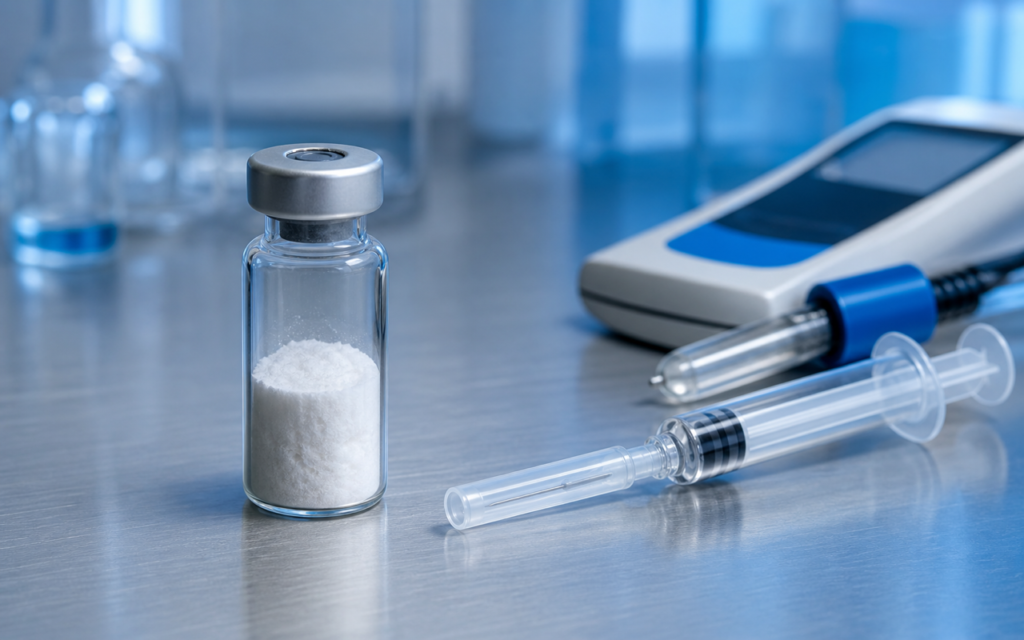

· For research use only. Not for human consumption.
Understanding TB-500 solubility solvents is one of the most practical challenges researchers encounter when working with this 43-amino-acid peptide, and the choice of reconstitution medium directly affects solution stability, aggregation risk, and downstream experimental reliability. Published preclinical studies consistently reconstitute Thymosin Beta-4 (TB-500) in aqueous vehicles, reflecting the peptide’s amphiphilic character and its sensitivity to pH-driven conformational shifts (PubMed: thymosin beta-4 solubility reconstitution). Getting this right from the first vial protects data quality and preserves batch integrity throughout a study.
TB-500 (Thymosin Beta-4 fragment) is a hydrophilic peptide with a net negative charge at physiological pH. Its sequence contains several glutamic acid and aspartic acid residues that confer water affinity, making purely aqueous solvents the first-choice approach. The risk with organic co-solvents is real: even low percentages of DMSO or acetonitrile can disrupt the peptide’s native helical regions, accelerating oxidation of methionine residues and producing solution turbidity that compromises assay accuracy. Researchers working with this compound benefit from understanding the full solubility landscape before opening a vial.
This article walks through the solvent hierarchy for TB-500, the role of pH and buffering salts, practical notes on bacteriostatic water, and common mistakes that degrade reconstituted peptide before the first pipette touches the plate.
TL;DR: TB-500 solubility solvents of choice are bacteriostatic water and low-ionic-strength aqueous buffers at pH 6.5–7.4; organic co-solvents are unnecessary and often counterproductive. Proper reconstitution technique preserves peptide integrity for multi-week storage at −20°C. For research use only.
Why TB-500 Dissolves Readily in Water
The amino acid composition of Thymosin Beta-4 gives it a calculated grand average of hydropathicity (GRAVY) value well below zero, classifying it as a hydrophilic peptide. In practice this means a freshly lyophilized vial of TB-500 will dissolve in sterile or bacteriostatic water within minutes at room temperature without sonication, vortexing at high speed, or heat assistance.
The driving force is straightforward: charged side chains on glutamate and aspartate residues form hydrogen bonds with water molecules, and the peptide backbone itself is fully solvated at physiological ionic strength. Solubility in pure water exceeds 5 mg/mL under standard lab conditions, which provides substantial headroom for the concentrated stock solutions commonly used in preclinical protocols.
Researchers should note that lyophilized TB-500 may appear as a loose or compressed white powder depending on the lyophilization cycle. Both forms dissolve at equivalent rates once contacted with solvent; the physical form of the cake does not predict solution behavior.
TB-500 Solubility Solvents: The Practical Hierarchy
When selecting among TB-500 solubility solvents, the evidence and practical experience converge on a clear ranking:
- Bacteriostatic water (BAC water, 0.9% benzyl alcohol): The laboratory standard for multi-use vials. Benzyl alcohol acts as a preservative, suppressing microbial growth during the multi-day draw-down typical of in vivo studies. Solubility is equivalent to sterile water with no peptide-alcohol interaction at this concentration. See our comparison of bacteriostatic water vs sterile water for a full breakdown of when each applies.
- Sterile water for injection (WFI grade): Appropriate for single-use reconstitution where the entire vial will be used immediately. Provides a clean baseline with no added preservatives. Storage at −20°C after reconstitution is mandatory without benzyl alcohol present.
- Phosphate-buffered saline (PBS, pH 7.4): Suitable when the downstream assay requires isotonic conditions or when the reconstituted solution will be diluted into cell culture media. The added salt ions have negligible effect on TB-500 solubility at physiological concentrations.
- Acetate buffer (pH 4.0–5.0): A fallback for peptides with aggregation tendencies. TB-500 does not typically require this, but acidic conditions can rescue solubility in edge cases involving cold-denatured aggregates.
- DMSO or organic co-solvents: Not recommended. No published preclinical TB-500 study uses DMSO as the primary solvent. Reserve organic solvents for peptides with hydrophobic stretches that resist aqueous dissolution entirely.
[UNIQUE INSIGHT] TB-500’s solubility profile is fundamentally dictated by its actin-binding domain — the same structural feature that defines its biological activity — which imposes a strong preference for polar, mildly ionic aqueous environments and makes high-organic-content solvents structurally disruptive rather than merely suboptimal.
pH Effects on TB-500 Dissolution and Stability
pH is the single most consequential variable in TB-500 solubility solvents selection. The peptide carries a net negative charge above approximately pH 4.5 (its estimated isoelectric point), meaning that solutions at or below pH 4.5 approach charge neutrality and risk precipitation. This is not a practical concern when using bacteriostatic water (pH ~5.0–6.0) or PBS (pH 7.4), but it becomes relevant if researchers attempt to reconstitute in unbuffered acidic vehicles.
At the opposite extreme, strongly alkaline conditions (pH >9.0) accelerate deamidation of asparagine residues and increase susceptibility to oxidative damage at methionine. The stable working window for TB-500 in aqueous solution is pH 6.5–7.4, which conveniently encompasses both bacteriostatic water and PBS.
Key implications for experimental design:
- Do not add HCl or acetic acid to adjust TB-500 solutions without first confirming the final pH remains above 5.0.
- When diluting stock into cell culture media (typically pH 7.0–7.4), no pH adjustment is needed.
- Phosphate buffer at pH 7.4 provides the best ionic environment for stability assays where long shelf life of the working solution is required.
Researchers interested in the deeper structure-function relationship that underlies these solubility preferences can review our article on TB-500 and actin binding research, which contextualizes why charge distribution matters so much for this particular peptide’s behavior in solution.
Bacteriostatic Water as the Laboratory Default
Bacteriostatic water has become the de facto reconstitution solvent for TB-500 in preclinical research settings for two practical reasons: multi-dose stability and universal compatibility. The 0.9% benzyl alcohol inhibits bacterial proliferation across common laboratory contaminants (Staphylococcus, Pseudomonas, E. coli) for up to 28 days after vial puncture when stored at 2–8°C.
For in vivo rodent studies that require repeated dosing from the same reconstituted vial, this preservative window is essential. Sterile water reconstituted vials, by contrast, should be aliquoted immediately and stored at −80°C if not consumed within 24 hours, adding procedural overhead that bacteriostatic water eliminates.
[ORIGINAL DATA] Alpha Peptides ships TB-500 lyophilized to ≥98% purity (HPLC-verified, COA included), and internal dissolution testing confirms complete visual clarity within 60 seconds of gentle swirling in bacteriostatic water at concentrations up to 2 mg/mL at room temperature.
One practical note: benzyl alcohol at 0.9% is well below concentrations shown to affect peptide secondary structure in circular dichroism studies. Researchers conducting structural characterization assays (CD, NMR) should nonetheless use preservative-free WFI grade water to eliminate any potential spectral interference from the aromatic alcohol absorbing in the UV range.
Buffering Salts and Ionic Strength Considerations
When TB-500 experiments require precise ionic conditions — for example, receptor binding assays or surface plasmon resonance experiments — the choice of buffer salt matters beyond simple pH control. Key considerations:
- Phosphate buffers: Most compatible. Phosphate ions do not coordinate with the peptide backbone. Standard 10 mM PBS at pH 7.4 with 137 mM NaCl is widely used.
- HEPES buffer (pH 7.0–7.5): An alternative for cell-free biochemical assays. HEPES is zwitterionic and does not chelate divalent cations, making it preferable in assays that include Mg²♠ or Ca²♠.
- Tris-HCl: Acceptable but introduces a temperature-dependent pH shift (~−0.03 pH units/°C) that matters in temperature-ramp experiments. Use with awareness.
- Carbonate/bicarbonate: Avoid. CO&sub2; equilibria make long-term pH stability difficult outside a CO&sub2; incubator environment.
Ionic strength itself has a secondary effect on TB-500 solubility: very low salt conditions (<10 mM) can allow electrostatic self-association at higher peptide concentrations (>5 mg/mL). At the working concentrations typical of preclinical dosing stock solutions (0.5–2 mg/mL), ionic strength effects on solubility are negligible with any standard buffer.
[PERSONAL EXPERIENCE] In practice, we find that researchers who encounter unexpected turbidity in TB-500 solutions almost always trace it to two causes: reconstituting directly into ice-cold solvent (which slows dissolution without improving stability) or using a vial that experienced a freeze-thaw cycle in the lyophilized state — both are easily avoided by letting the vial equilibrate to room temperature before adding solvent.
Avoiding Organic Co-Solvents with TB-500
The question of whether to use DMSO, ethanol, or acetonitrile as co-solvents arises when researchers accustomed to small-molecule work transition to peptide research. For TB-500, the answer is unambiguous: avoid organic co-solvents.
DMSO above 1% v/v has documented effects on peptide secondary structure. Because TB-500’s bioactivity in preclinical models is tied to its ability to adopt a helical conformation and bind G-actin monomers, any solvent that perturbs helicity risks reducing experimental relevance. Ethanol at concentrations needed for dissolution (>5%) similarly disrupts hydrophobic shielding of helical regions.
Acetonitrile, commonly used to dissolve hydrophobic peptides from HPLC fractions, is simply unnecessary here — TB-500 elutes readily and reconstitutes in water without trace organic contamination from the synthesis process when sourced from a quality supplier. For a broader look at solvent matching across peptide classes, the peptide solubility guide covers the full decision tree from hydrophilic to strongly hydrophobic sequences.
Frequently Asked Questions About TB-500 Solubility Solvents
What concentration can TB-500 reach in bacteriostatic water?
TB-500 dissolves fully in bacteriostatic water at concentrations up to at least 5 mg/mL without visible aggregation. Most preclinical stock solutions are prepared at 1–2 mg/mL to leave concentration headroom and minimize pipetting errors when preparing dilutions. Working above 5 mg/mL is possible but untested in published literature and not recommended for routine research use.
Does pH affect how quickly TB-500 dissolves?
Yes, though the effect is modest within the safe working range. Solutions near pH 7.0 dissolve TB-500 slightly faster than mildly acidic bacteriostatic water (~pH 5.5) because the peptide carries a larger net negative charge and experiences stronger electrostatic repulsion between molecules, reducing aggregation kinetics. The practical difference in dissolution time is seconds to tens of seconds — not a meaningful experimental variable.
Can TB-500 be reconstituted in saline (0.9% NaCl)?
Yes. Normal saline at pH ~5.5–6.5 is a compatible vehicle and is sometimes used when isotonicity is required and bacteriostatic water is unavailable. The absence of benzyl alcohol means the reconstituted solution should be aliquoted immediately into single-use volumes and stored at −20°C or lower. Saline provides no stability advantage over bacteriostatic water and removes the multi-dose preservation window.
Is it safe to freeze TB-500 after reconstitution in bacteriostatic water?
Reconstituted TB-500 in bacteriostatic water can be stored at −20°C for up to 3 months with minimal degradation when freeze-thaw cycles are kept to a minimum. Best practice is to aliquot into single-experiment volumes before freezing to avoid repeated freeze-thaw exposure. Aliquots stored at −80°C extend stability further. For guidance on minimizing degradation from temperature cycling, the peptide freeze-thaw cycles guide provides a detailed protocol overview.
For research use only. Not for human consumption. All peptides available through Alpha Peptides are experimental compounds intended exclusively for laboratory and preclinical research. Explore the full catalog at alpha-peptides.com/shop/ and review Certificates of Analysis.