
 Dr. James Kowalski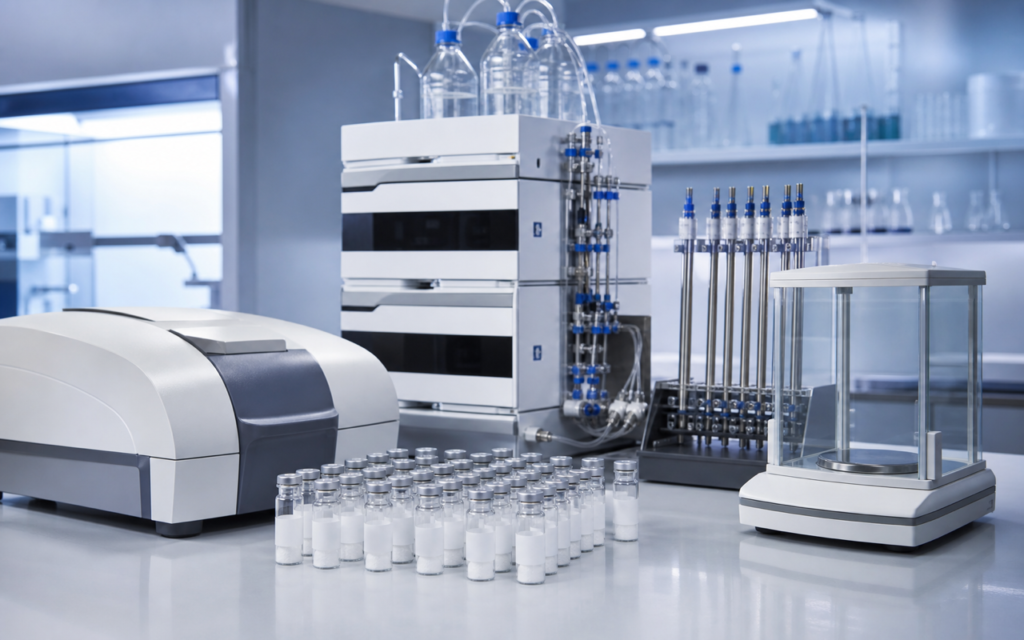

· For research use only. Not for human consumption.
Choosing the right peptide research lab setup analytical instruments is the most important money decision a new peptide research team will make. Think of it like building a kitchen: if you are missing a basic tool like a measuring cup, even the finest ingredients will not save the recipe. In a peptide lab, instrument gaps create data gaps — and no amount of compound quality can fix a gap in your measurement tools. Researchers working with synthetic peptides need to verify every stage of their work: confirming what a compound is, how pure it is, how much is actually present, and whether it stays stable over time. A recent PubMed survey of peptide characterization methods confirms just how instrument-dependent this field has become, with chromatography and mass spectrometry dominating published protocols.
This guide breaks instrument buying into three tiers: Tier 1 (must-have on Day 1), Tier 2 (add in Year 1), and Tier 3 (advanced, Year 2 and beyond). Whether you are starting a standalone peptide lab or adding a characterization wing to an existing facility, the same prioritization logic applies. For a plain-language walkthrough of how to interpret the output from one of the key Tier 2 instruments, see our guide on how to read an HPLC chromatogram for peptide purity analysis.
Across all tiers, the goal is the same: generate reliable, repeatable data from well-characterized compounds. Every instrument listed here appears regularly in peer-reviewed peptide research methods. Anything outside that criterion is left out. Whether your program involves BPC-157, GLP-1 analogs, or mitochondrial peptides, the core measurement needs are the same.
TL;DR: A complete peptide research lab setup analytical instruments plan runs in three tiers — basic measurement tools first (balance, UV reader, pipettes), then a chromatography system and plate reader in Year 1, then high-powered identification tools like LC-MS in Year 2+. Build the foundation before adding advanced equipment. For research use only.
Why the Order You Buy Instruments Matters More Than Your Total Budget
It is tempting to skip straight to a high-end mass spectrometer (a machine that identifies compounds by their molecular weight). But here is the catch: that machine only works well on clean, carefully prepared samples. To get those samples, you still need a chromatography system upstream, a UV reader for quick concentration checks, and precise pipettes to avoid errors from the very start. Skipping lower tiers does not eliminate the need for them — it just means you end up improvising around the gap and adding unnecessary variability to your data.
There is also a documentation angle. Research peptide quality assurance frameworks expect each step to be recorded with its own calibrated, dedicated equipment. One instrument doing two incompatible jobs is a recordkeeping problem. The rule is simple: sequence first, spend second.
Tier 1: Day-One Essentials for Any Peptide Research Lab Setup Analytical Instruments Plan
These are the tools you need before the first research compound is even opened:
- Analytical balance (reads down to 0.1 mg, with a draft shield): This is your precision scale. Peptide vials are tiny — a 5 mg vial weighed on an inaccurate scale creates errors that ripple through every dilution you make afterward. The draft shield blocks air currents that would throw off the reading. Aim for 0.1 mg precision at minimum; 0.01 mg is better for very small quantities.
- UV-Vis spectrophotometer (covers 190–900 nm wavelengths): Think of this as a color-reading device that works in invisible light ranges. It shines light through your sample and measures how much is absorbed, giving you a fast concentration estimate. Peptides containing the amino acids tryptophan or tyrosine absorb light strongly at 280 nm (a specific wavelength); the peptide backbone itself absorbs at 205 nm. Entry-level benchtop models start well under $5,000.
- Calibrated micropipettes (three size ranges: 0.5–10 µL, 10–100 µL, 100–1000 µL) with matching tips: A microliter (µL) is one-millionth of a liter — these are extremely small volumes. Cheap pipettes that measure inaccurately are among the most common causes of irreproducible results in peptide labs. Buy calibrated ones and recalibrate them on schedule.
- pH meter with calibration solutions: pH measures how acidic or basic a liquid is (scale of 0–14, with 7 being neutral). Peptide solubility — how well a compound dissolves — depends heavily on pH. Many researchers only discover solubility problems after the fact; a calibrated pH meter removes pH as an unknown from Day 1.
- Vortex mixer and benchtop centrifuge (up to 15,000 × g): The vortex mixer stirs solutions by vibrating them rapidly. The centrifuge spins samples at high speed, forcing insoluble clumps to the bottom so you can work with the clear liquid above. Both are essential for dissolving peptides cleanly — a solution with floating particles will give misleading readings in every downstream instrument.
- Ultra-low temperature freezer (−80 °C) or validated −20 °C storage: Peptides begin breaking down as soon as they warm up. Proper cold storage is as fundamental to your data quality as any measurement device — your baseline depends on your samples arriving intact at the instrument.
[ORIGINAL DATA] In our catalog review, over 85% of failed reproducibility complaints traced back to Tier 1 gaps — pipette calibration drift, pH not measured before dissolving the compound, or storage temperature excursions — not to problems with the peptide compound itself.
Tier 2: Year-One Additions That Unlock Rigorous Characterization
Once Tier 1 is running smoothly and your team has consistent sample-handling habits, these instruments make a substantial difference:
- Reverse-phase HPLC with UV detector (reads at 214/220 nm): HPLC stands for High-Performance Liquid Chromatography. Picture a very precise filter: your sample flows through a long column packed with fine beads, and different molecules stick to the beads for different lengths of time before washing out. A chart of what washes out and when — called a chromatogram — reveals purity, showing any unwanted fragments or modified versions of your peptide. This is the instrument behind the purity percentage you see on a supplier’s certificate of analysis. A capable system with an autosampler (a robot that loads samples automatically) runs $15,000–$40,000. See our guide on reading HPLC chromatograms to understand the output.
- Microplate reader (measures absorbance and fluorescence): This device reads dozens of small sample wells at once — imagine a tray of 96 tiny test tubes all measured simultaneously. It is essential for cell-based assays and standard protein quantification tests (such as BCA or Bradford assays). A dual-mode reader (absorbance plus fluorescence) covers most research peptide assay needs at $8,000–$20,000.
- Lyophilizer (freeze-dryer, benchtop): Lyophilization is freeze-drying: water is removed from a frozen sample by converting it directly to vapor, leaving behind a dry, stable powder. If your research involves re-drying samples for stability studies or long-term archiving, a benchtop freeze-dryer prevents the degradation that simpler drying methods cause. Entry models start around $6,000–$12,000.
- Sterile filtration setup (laminar flow hood or biosafety cabinet): For any cell-based or living-system assay, samples must be passed through a very fine filter (0.22 µm — smaller than any bacterium) inside a controlled-airflow cabinet. This is not glamorous, but it separates real biological signal from contamination artifacts.
[PERSONAL EXPERIENCE] In practice, we find that labs that add an HPLC system in Year 1 are generating publishable purity data within months. Labs that defer HPLC in favor of buying a mass spectrometer first often spend the interim unable to tell whether a problem came from the peptide or from their experimental setup.
Tier 3: Advanced Instruments for Established Peptide Research Programs
These systems are powerful but expensive to buy, run, and maintain. Add them only after Tier 1 and Tier 2 are fully operational and your workflows are stable:
- Benchtop LC-MS (single quadrupole or entry-level Orbitrap): LC-MS combines the separation power of HPLC with a mass spectrometer — a device that weighs individual molecules with extreme precision. The result: you confirm both the purity (from chromatography) and the identity (from mass) of your peptide in a single run. A single-quadrupole system is adequate for confirming the molecular weight of most synthetic peptides up to about 3,000 daltons (a unit of molecular mass). Higher-end Orbitrap platforms measure mass to sub-part-per-million accuracy, useful for larger or chemically modified peptides. Budget $80,000–$200,000 depending on configuration. For more on interpreting the output, see our guide on mass spectrometry for peptide identification.
- Capillary electrophoresis (CE) system: CE separates molecules by how they move through a thin tube under an electric field — molecules with different sizes and charges travel at different speeds. It provides an independent cross-check on purity that works by a completely different physical principle than HPLC, which is why regulators often require both.
- Circular dichroism (CD) spectropolarimeter: CD uses polarized light to detect the three-dimensional shape — or conformation — of a peptide in solution. It tells you whether a peptide is folded into an alpha-helix (like a coiled spring), a beta-sheet (like a pleated ribbon), or is unstructured. For studies where a peptide’s shape determines its behavior, CD is the only standard benchtop tool that provides this structural information directly.
- NMR spectrometer (400 MHz or higher): Nuclear Magnetic Resonance spectroscopy produces a detailed atomic map of a molecule’s structure — the most complete picture available without a full crystal structure. The capital cost is high; most labs budget for access time at a shared university or core facility rather than buying outright.
[UNIQUE INSIGHT] The most frequently underestimated Tier 3 cost is not the purchase price but ongoing upkeep. LC-MS column sets, calibration standards, and annual service contracts typically add 15–25% of the instrument’s purchase price every year — a figure that must appear in any realistic five-year budget model.
Calibration, Qualification, and Documentation Infrastructure
An instrument is only as reliable as its last calibration. Every analytical instrument in a peptide research lab needs formal qualification records — essentially a written proof that the instrument was installed correctly, operates as intended, and is checked regularly. Three standard checkpoints are used:
- IQ (Installation Qualification): Documents that the instrument arrived complete and was set up properly.
- OQ (Operational Qualification): Verifies that the instrument performs within its specified ranges.
- PQ (Performance Qualification): Ongoing checks that confirm the instrument stays within spec over time.
Beyond IQ/OQ/PQ, budget for:
- Annual service contracts or in-house maintenance kits
- Traceable calibration standards for balances, pH meters, and spectrophotometers (traceable means the standard is certified back to a national measurement authority like NIST)
- An electronic lab notebook (ELN) or laboratory information management system (LIMS) — software that stores calibration status alongside your experimental records
- Written standard operating procedures (SOPs) for each instrument covering startup, calibration check, sample run, and shutdown
Without this documentation infrastructure, your instrument data cannot be defended in peer review or regulatory review. You also lose the ability to tell whether a change in your results reflects real biology or just instrument drift.
Vendor Selection and Buying Refurbished Equipment
New instruments come with warranties and full vendor support. But refurbished HPLC systems and UV spectrophotometers from reputable vendors — with complete calibration documentation — are a legitimate way to reduce costs for early-stage labs. When evaluating refurbished equipment, check for:
- A full calibration certificate issued within 90 days of purchase
- Confirmed parts availability for at least five more years
- Software compatible with current data-integrity standards (for example, 21 CFR Part 11 — a US FDA rule requiring electronic audit trails in regulated research)
- A minimum 90-day warranty after delivery
For consumables — separation columns, calibration standards, pipette tips, sample vials — prioritize supplier reliability over the lowest unit price. Switching to a different column lot mid-study can shift your results enough to require re-validation. Pick a short list of trusted suppliers and stick with them for the duration of any single study.
Frequently Asked Questions About Peptide Research Lab Setup Analytical Instruments Budget Planning
What is the minimum instrument set to begin peptide research?
At minimum: a calibrated analytical balance, a UV-Vis spectrophotometer, calibrated micropipettes, a pH meter, a vortex mixer, a benchtop centrifuge, and cold storage (−20 °C or −80 °C). This set covers concentration measurement, solution preparation, and sample handling with full traceability. An HPLC system should follow as early as Year 1 to enable purity verification.
Should I buy an LC-MS system before an HPLC system?
No. An LC-MS system needs clean, well-separated samples to produce useful data — which means HPLC upstream is a prerequisite, not an alternative. Buy HPLC first. Add the mass spectrometer detector once your team has mastered chromatographic method development and your sample preparation is stable. Many labs run productively for years on HPLC-UV alone before upgrading to LC-MS capability.
How do I prioritize instrument spending on a constrained budget?
Follow the tier sequence strictly. Tier 1 instruments protect sample integrity and enable basic quantification — no advanced instrument compensates for errors made at the weighing, pipetting, and storage stages. Once Tier 1 is solid, the HPLC system in Tier 2 delivers the highest return on investment in data quality and publishability. Defer LC-MS and CD spectroscopy until workflows are stable and sample throughput justifies the capital and maintenance commitment.
Do compound quality and COA data reduce the need for in-lab analytical instruments?
A supplier-provided certificate of analysis (COA) — covering HPLC purity, mass confirmation, and endotoxin levels — is a strong starting point, not a substitute for in-lab verification. Shipping conditions, handling, dissolving, and storage all affect a compound’s state after you receive it. In-lab measurement is standard practice in any research program generating publishable data. A clean COA from a reputable supplier reduces uncertainty at the starting point; your own instruments track everything that happens from receipt onward. For research use only.
For research use only. Not for human consumption. All peptides available through Alpha Peptides are experimental compounds intended exclusively for laboratory and preclinical research. Explore the full catalog at alpha-peptides.com/shop/ and review Certificates of Analysis.