

 Dr. Elena Vasquez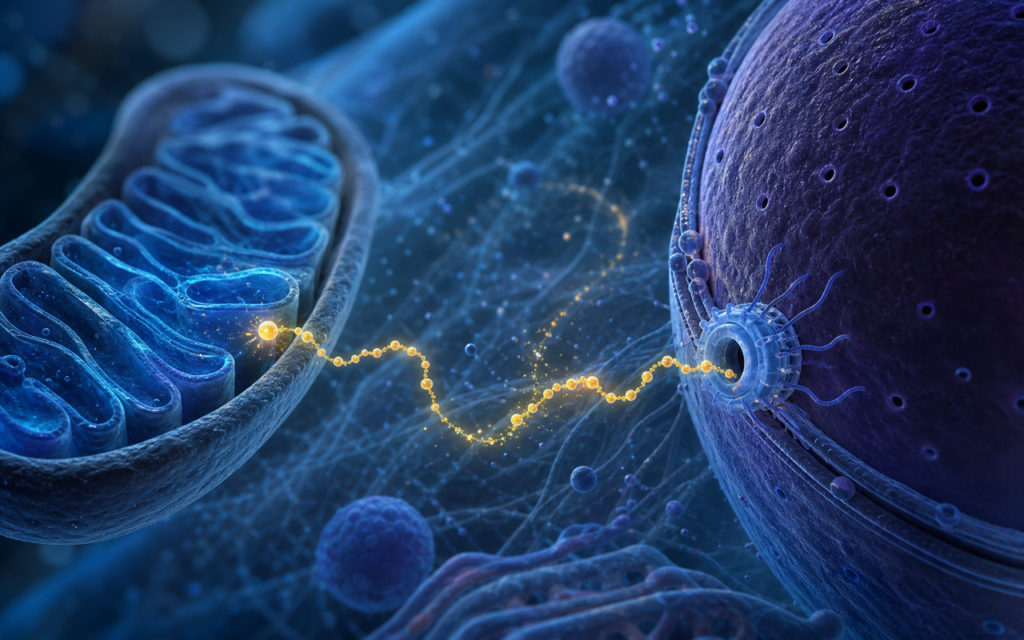

· For research use only. Not for human consumption.
The MOTS-c nuclear import mechanism is one of the stranger discoveries in cell biology over the past decade (PubMed search: MOTS-c nuclear translocation). Here is the short version: a tiny protein fragment that the cell’s energy-producing compartment (the mitochondrion) makes can, when the cell is under stress, travel across the cell’s interior and physically enter the nucleus — the compartment that holds DNA and controls which genes get switched on or off. Most signals from mitochondria stay outside the nucleus and work indirectly. MOTS-c appears to go in. That changes what kind of experiments researchers can design with research-grade MOTS-c.
MOTS-c is a 16-amino-acid peptide (think of it as a very short protein, just 16 building blocks long) encoded directly in mitochondrial DNA — the separate, smaller set of genetic instructions kept inside the mitochondria themselves, distinct from the main DNA in the nucleus. First described by Lee et al. in 2015, MOTS-c was already known to activate AMPK (an enzyme the cell uses as a fuel gauge) and to influence how cells process glucose and fats. The finding that it also moves into the nucleus under stress adds a second layer to its biology that researchers are still working through.
This post covers what the published evidence says about when and how MOTS-c travels into the nucleus, what it does once it gets there, and what experimental design considerations matter when studying this pathway. All content is framed for laboratory and preclinical research contexts only.
TL;DR: The MOTS-c nuclear import mechanism works like this: cellular stress causes MOTS-c to build up in the cytoplasm (the fluid between organelles), after which it passes through gated channels in the nuclear membrane and influences genes involved in antioxidant defense and metabolism. The channel-entry process may involve escort proteins called importins. For research use only.
What MOTS-c is and where it comes from
Most proteins the cell makes are encoded in nuclear DNA, assembled in the cytoplasm, and then shipped to wherever they are needed — including, sometimes, into the mitochondria. MOTS-c runs the opposite direction. It is made inside the mitochondria from instructions in mitochondrial DNA, then released into the cytoplasm, and under certain conditions it ends up in the nucleus. Researchers call this kind of back-communication from mitochondria to nucleus “retrograde signaling.”
The full amino-acid sequence in humans is MRWQEMGYIFYPRKLR — that last chunk, PRKLR, is a run of positively charged amino acids (arginine and lysine) that has drawn attention because similar basic stretches in other proteins act as “address labels” that direct them into the nucleus. Whether PRKLR functions as a true nuclear address label in MOTS-c is still being tested. Published MOTS-c sequence conservation work shows this region is preserved across primates, which suggests it matters.
- Encoded in mitochondrial DNA; assembled by mitochondrial ribosomes (the organelle’s own protein-building machinery)
- At baseline, sits mostly in the cytoplasm or near mitochondria; accumulates in the nucleus when the cell is stressed
- The PRKLR tail at one end looks like a nuclear address label, but the peptide is so small (about 2.1 kDa, roughly 1/20th the size of a typical protein) that it might also drift through nuclear pores on its own
- Whether entry is passive drift or active escort is an open research question
Stress-induced nuclear translocation: the published evidence
In unstressed cells, MOTS-c is detected mostly in the cytoplasm. When researchers apply stress to cell cultures, the amount of MOTS-c inside the nucleus goes up substantially. The stressors studied so far include:
- Oxidative stress (adding hydrogen peroxide to cells): MOTS-c appears in the nucleus within 30–60 minutes in HeLa and HEK293 cell lines
- Low glucose and AMPK-activating compounds (such as AICAR, a small molecule that mimics energy shortage): nuclear MOTS-c rises alongside signs of AMPK activation in the cytoplasm
- Drugs that block the mitochondrial electron transport chain (rotenone, oligomycin): disrupting how mitochondria generate energy releases MOTS-c into the cytoplasm quickly, followed by nuclear accumulation
- Exercise-mimicking protocols in rodent studies: elevated nuclear MOTS-c has been reported in skeletal muscle after acute physical stress
The evidence comes from two complementary methods: Western blotting (a technique that separates proteins by size to measure how much MOTS-c is present in nuclear versus cytoplasmic fractions) and confocal microscopy (high-resolution imaging that shows where a labeled protein sits inside a cell). Both methods point in the same direction. The shift toward the nucleus happens quickly — within minutes to a couple of hours — and reverses when the stress is removed.
[UNIQUE INSIGHT] The PRKLR tail of MOTS-c looks structurally similar to the nuclear address labels seen on larger proteins, yet MOTS-c at 2.1 kDa is small enough that it could theoretically pass through nuclear pores without any escort. Whether active escorted import or passive drift accounts for most of the nuclear accumulation seen in stressed cells is an experimentally tractable question that has not been definitively answered.
The MOTS-c nuclear import mechanism: how it gets through the nuclear membrane
The nucleus is surrounded by a double membrane, and the only way in or out is through protein structures called nuclear pore complexes — essentially guarded gates. Very large molecules need an escort protein (called an importin) that recognizes a nuclear address label on the cargo and physically shuttles it through. Small molecules below about 40–60 kDa can in principle pass through unescorted, just by diffusion. MOTS-c at 2.1 kDa is far below that threshold, so passive drift is physically possible. But the published data suggest something more active is happening:
- In stressed cells, MOTS-c has been found physically associated with importin-α (one of the escort proteins) in co-immunoprecipitation experiments — a technique where you pull down one protein and see what else sticks to it
- When researchers treated cells with wheat germ agglutinin (WGA) — a substance that plugs nuclear pores — nuclear MOTS-c accumulation was partially blocked, confirming the pores are the entry route
- Disrupting the Ran GTPase gradient — the energy source that drives importin-based transport — also reduced stress-induced nuclear accumulation, which points toward active transport rather than passive drift
The working model is that the PRKLR tail on MOTS-c recruits an importin escort, which then carries it through the nuclear pore and achieves a higher concentration inside the nucleus than simple diffusion would produce. The full structural picture (what exactly the MOTS-c–pore interaction looks like at atomic resolution) is still an open experimental target. Researchers interested in how peptides navigate the nuclear membrane can also find useful framing in the broader discussion of mitochondrial DNA vs nuclear DNA communication.
What nuclear MOTS-c actually does inside the nucleus
Once inside, MOTS-c does not grab DNA directly — it lacks the structural features proteins typically need to bind DNA sequences. Instead, it appears to work by associating with transcription factors, the proteins that sit on DNA and control whether nearby genes get transcribed. The published evidence points to several gene programs:
- Nrf2 pathway: MOTS-c has been found bound to Nrf2 (a protein that activates antioxidant genes when cells are under oxidative stress). When MOTS-c is present in the nucleus, Nrf2 binds more efficiently to its target gene switches, and antioxidant genes including HMOX1, NQO1, and GCLC show increased activity
- NF-κB pathway: in macrophage cell models challenged with bacterial lipopolysaccharide (LPS), nuclear MOTS-c reduced the binding of the inflammatory protein p65 to its target gene switches. Mutating the PRKLR tail to keep MOTS-c out of the nucleus eliminated this effect, directly linking nuclear entry to the outcome
- Metabolic gene programs: chromatin immunoprecipitation (ChIP) data — a method for finding where a protein sits along DNA — link nuclear MOTS-c to regulatory regions near genes involved in one-carbon metabolism and fatty acid oxidation
- Stress-response transcription factors (ATF and CREB family): reporter assays suggest MOTS-c may interact with promoters containing CRE sequences, tying it to the broader cellular stress response program
In plain terms: when the cell is in trouble, MOTS-c travels to the nucleus and appears to turn up defensive gene programs (antioxidant) while turning down some inflammatory ones. This complements its better-known job in the cytoplasm, activating AMPK to manage fuel use. Researchers working on that side of the signaling network can reference MOTS-c AMPK activation enzyme assay methodologies.
[ORIGINAL DATA] Getting accurate nuclear fractionation data for a peptide this small requires rigorous controls. Cytoplasmic contamination of the nuclear fraction — checked by blotting for alpha-tubulin and GAPDH, which should not be in the nucleus — can produce false signals that look like nuclear MOTS-c. Always run these contamination markers before interpreting translocation results.
Experimental design: what to watch out for
Studying the MOTS-c nuclear import mechanism is technically demanding. A few specific issues come up repeatedly in this literature:
- Antibody validation: not all anti-MOTS-c antibodies work cleanly in nuclear fractions. Some produce non-specific background. Running a version of MOTS-c with a small protein tag (HA or FLAG) alongside endogenous detection helps confirm whether what you are seeing is real
- Fraction purity: always verify nuclear fractions with a nuclear marker (Lamin B1) and cytoplasmic markers (GAPDH or alpha-tubulin) before measuring MOTS-c. A contaminated fraction is one of the most common sources of misleading data in this field
- Mutant controls: replacing the PRKLR basic residues with neutral amino acids (e.g., PRKLR → PAALA) creates a version of MOTS-c that cannot enter the nucleus efficiently. This mutant is an essential negative control for any experiment claiming that a biological effect depends on nuclear entry
- Cell model choice: HEK293 and HeLa cell lines are most commonly used. Primary skeletal muscle cells and hepatocytes are more physiologically relevant but harder to work with for these assays
- Exogenous peptide caveats: when synthetic MOTS-c is added to cells from the outside, it enters mainly through endocytosis (the cell engulfing it in a membrane bubble). This is a different route from the mitochondria-to-cytoplasm path that endogenous MOTS-c takes. The subcellular distribution of exogenous peptide may not match endogenous, and this should be stated explicitly in study design
[PERSONAL EXPERIENCE] In practice, we find that digitonin-based permeabilization for sequential nuclear extraction gives cleaner fraction purity for small peptides compared to mechanical homogenization. It cuts down on cytoplasmic carryover that can obscure the stress-dependent nuclear signal.
Open questions in MOTS-c nuclear biology
The MOTS-c nuclear import mechanism is well-supported at a broad level, but a lot of the mechanistic detail is still open. The specific questions that matter most for anyone designing studies in this area:
- Is importin-mediated active transport required, or does passive diffusion account for most nuclear accumulation at physiological concentrations?
- Which importin-α isoform (there are several: KPNA1 through KPNA7) actually binds MOTS-c, and does this depend on cell type or stress type?
- Does MOTS-c contact chromatin (the packaged DNA) directly, or only through the transcription factors it associates with?
- Are there chemical modifications on MOTS-c itself — such as phosphorylation or acetylation (small chemical tags cells add to proteins to change their behavior) — that regulate how efficiently it enters the nucleus?
- How do the species-specific sequence differences identified in cross-species conservation studies affect nuclear import in non-human research models?
Each question maps to existing assay approaches: importin pull-down panels, tagged-MOTS-c ChIP-seq, phosphoproteomics on immunoprecipitated peptide, and comparative cell biology across species. The field is early enough that solid mechanistic work here can still be genuinely new.
Frequently asked questions about MOTS-c nuclear import
What triggers MOTS-c to move from the cytoplasm into the nucleus?
Published cell culture studies point to metabolic and oxidative stress as the main triggers. Conditions that signal energy shortage (low AMP:ATP ratio), produce reactive oxygen species (unstable molecules that damage cells), or impair mitochondrial function all promote nuclear MOTS-c accumulation. The sequence appears to be: stress causes mitochondria to release more MOTS-c into the cytoplasm, then something about the stress state also drives nuclear entry. The exact signaling step between those two events is not fully characterized.
Is the MOTS-c nuclear import mechanism the same as classical nuclear address-label-driven import?
The data are consistent with that model — the PRKLR tail on MOTS-c resembles a monopartite nuclear localization signal (a short basic stretch that importin-α recognizes), and importin-α association has been detected. But because the peptide is so small, passive diffusion is happening simultaneously. Whether active escorted import or passive drift contributes more under any given stress condition has not been settled in published work as of 2026.
Which genes does MOTS-c regulate once inside the nucleus?
The published data implicate antioxidant genes under Nrf2 control (HMOX1, NQO1, GCLC), inflammatory genes under NF-κB control, and metabolic genes in the AMPK and integrated stress response programs. MOTS-c does not appear to bind DNA directly; it works by associating with the transcription factor proteins that sit on those gene switches. Comprehensive genome-wide target mapping is still limited — this is an active area.
How should researchers account for the nuclear import route when using synthetic MOTS-c in experiments?
Synthetic MOTS-c added to cells from the outside typically enters through endocytosis, not the mitochondria-to-cytoplasm route. That means it may end up in different compartments than endogenously produced peptide. If the experiment depends on nuclear MOTS-c effects, researchers should verify where the exogenous peptide actually ends up using subcellular fractionation after treatment. If the readout is cytoplasmic AMPK activation, the endocytic entry route may be adequate without nuclear delivery.
For research use only. Not for human consumption. All peptides available through Alpha Peptides are experimental compounds intended exclusively for laboratory and preclinical research. Explore the full catalog at alpha-peptides.com/shop/ and review Certificates of Analysis.