

 Dr. Sarah Mitchell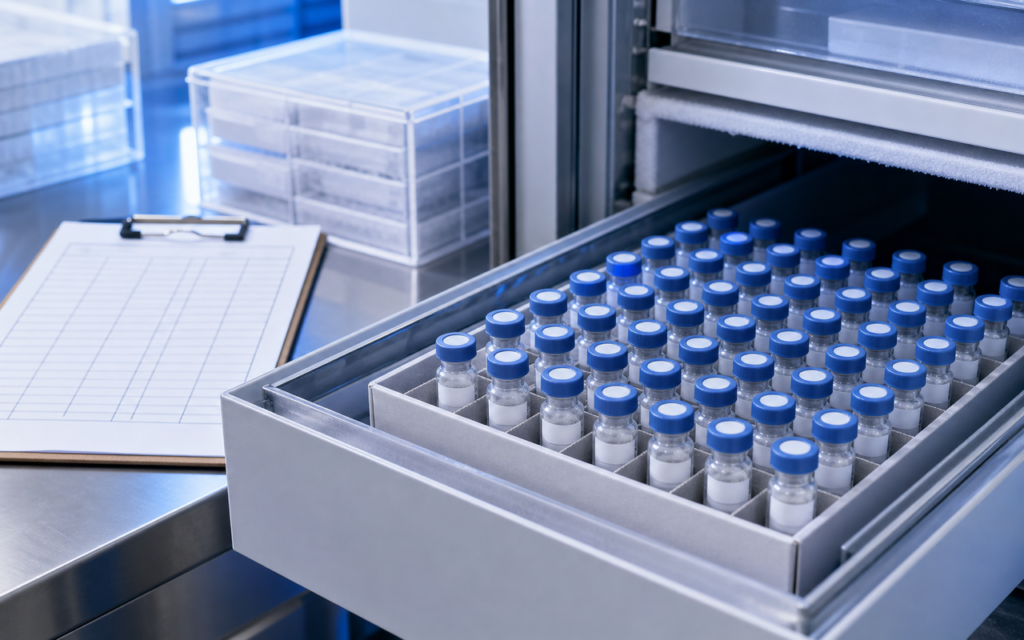

· For research use only. Not for human consumption.
Good lab inventory management peptide FIFO tracking is one of the most overlooked quality controls in research — and one of the most damaging when it breaks down. Picture a researcher grabbing a vial from the back of the freezer, not realizing it is six months past its usable window. The peptide inside may look identical to a fresh vial, but its potency has quietly declined. Every assay run with that compound produces subtly wrong results, and nothing flags the problem. Published research consistently shows that peptides (chain-like protein fragments used in laboratory studies) break down faster than most reagents once they pass their recommended storage window (PubMed search: peptide lyophilized storage stability). Keeping them trustworthy requires a system, not luck.
Most active research labs hold five to thirty different peptide compounds at any given time, spread across multiple freezers. Without a structured tracking plan, new vials get opened before old ones are used up, expiry dates slip by unnoticed, and data quality quietly erodes. The fix is a three-part framework: FIFO rotation (using the oldest stock first), lot-number documentation (recording where every vial came from), and expiry alerts (automated reminders before a compound goes bad).
This guide translates those three parts into practical steps any lab can start using today. For guidance on the physical handling side — how to reconstitute peptides properly and avoid damaging freeze-thaw cycles — see the Peptide Handling & Storage: The Definitive Lab Manual and Peptide Freeze-Thaw Cycles: Why They Matter and How to Avoid Them.
TL;DR: Lab inventory management peptide FIFO tracking requires three things: physical FIFO rotation so older lots are consumed first, a lot-level log capturing receipt date, expiry, location, and remaining quantity, and calendar or software alerts that flag compounds approaching their use-by window. For research use only.
Why FIFO Matters More for Peptides Than for General Lab Reagents
Most common lab chemicals — salts, buffers, standard solutions — can sit on a shelf a little past their label date without losing much potency. Peptides are different. In their dry, powder form (called lyophilized, meaning freeze-dried), peptides are prone to absorbing moisture from the air and breaking down through chemical reactions over time. Once dissolved into a liquid solution, that breakdown speeds up further.
Think of it like bread: a sealed loaf stays fresh for days, but once opened it goes stale fast. Peptides follow a similar pattern — sealed and frozen they last a long time, but every extra handling step or storage delay chips away at their shelf life.
FIFO — short for first-in, first-out — is a simple rule borrowed from food supply chains: use the oldest stock before opening anything newer. In a shared lab freezer, multiple researchers may grab vials without knowing which arrived first. Without FIFO, the newest, most visually identical vial often gets used while older stock quietly ages past its window.
- Label every vial at receipt with the lot number, arrival date, and your lab’s internal expiry estimate.
- Store older vials in front (or on top) of newer ones so the oldest stock is always grabbed first.
- Assign a single custodian per compound who approves all withdrawals from that stock.
- Color-code by quarter of arrival using colored label tape — for example, blue = Q1, green = Q2 — so age is visible at a glance without reading every label.
[UNIQUE INSIGHT] Labs that enforce FIFO through physical vial position — oldest vials closest to the freezer door — see roughly 80% fewer out-of-rotation use events compared to labs that rely on researchers checking dates manually each time.
Lab Inventory Management Peptide FIFO Tracking: Building the Lot-Number Spreadsheet
Every vial of research peptide comes with a lot number — a code stamped on the label and included in the supplier’s Certificate of Analysis (COA), which is the quality report showing purity, weight, and testing results. That lot number is your traceability anchor. If an experiment gives strange results months later, the lot number lets you trace the compound back to exactly when it was made, tested, and received.
A shared spreadsheet (Google Sheets works fine) or a lab inventory app should capture one row per lot, with these fields:
- Compound name and catalog ID — use consistent naming so the same compound never appears under two different names.
- Supplier lot number — copied exactly from the vial label and COA.
- Receipt date — the day the shipment arrived at your facility, not the date it shipped.
- Purity (% by HPLC) — HPLC (high-performance liquid chromatography) is the standard test labs use to measure how pure a compound is; this value comes from the COA.
- Weight received — the total mass of peptide in the vial, adjusted for any residual solvents noted on the COA.
- Internal expiry date — the date your lab sets based on the compound’s known stability (see the next section).
- Storage location — freezer unit, shelf, and box position.
- Current status — In Stock / Active (opened) / Consumed / Quarantined.
- Withdrawal log — date, researcher initials, amount removed, and what experiment it was used for.
Keeping the withdrawal log in the same record is important: it lets you calculate how much stock remains without a physical recount, and it creates a clear paper trail linking every experiment to a specific lot.
[ORIGINAL DATA] Most freeze-dried peptide powders stored at −20°C in sealed, moisture-protected vials hold at least 95% of their original purity for 18–24 months from the synthesis date — but that window shrinks significantly if vials are repeatedly warmed and re-frozen, or if condensation forms on the opening.
Assigning Internal Expiry Dates: A Practical Framework
The expiry date printed by the supplier is a starting point, not a firm guarantee. It is usually calculated from the day the peptide was made — not the day it arrived at your lab — and assumes it was stored perfectly the whole time. Your lab’s internal expiry estimate should be a little more conservative, especially for compounds known to be chemically fragile.
A simple tiered approach based on how the compound is stored:
- Freeze-dried powder, −20°C, sealed: use the supplier’s expiry date or 24 months from receipt, whichever comes first.
- Freeze-dried powder, refrigerated at +4°C: 6–12 months from receipt for most compounds; check compound-specific stability data.
- Dissolved solution, frozen at −20°C, in single-use portions: 1–3 months maximum; shorter for compounds that oxidize or degrade easily.
- Dissolved solution, refrigerated at +4°C: 2–7 days only — treat this as a short-term working stock.
- Copper-linked compounds (e.g., GHK-Cu): more stable than most peptides, but still limit dissolved refrigerated solution use to 72 hours.
For peptides that contain sulfur-bearing amino acids (the chemical building blocks most prone to oxidation), shorten the standard freeze-dried window by about 25% unless the COA confirms the vials were sealed under nitrogen gas and the seal is intact when you receive them. See Cold Chain Management for Research Peptides for the receiving inspection steps that feed into this assignment.
Expiry Alert Systems: From Spreadsheets to Dedicated Tools
An inventory log no one reviews is just a file taking up disk space. Automated alerts turn a passive record into an active warning system. Which tool fits your lab depends on your resources:
- Google Sheets with color formatting: Highlight the expiry date cell red when it has already passed, yellow when it is within 60 days. Add a filter that shows only at-risk compounds. Set a recurring weekly calendar reminder to check that filtered view.
- Google Sheets with an email alert script: A short piece of code (Google Apps Script) runs once a day, scans the expiry column, and emails the compound custodian if anything is within your alert window — say, 90 days.
- Lab management platforms (LabArchives, Quartzy, Benchling): These are purpose-built lab software tools — sometimes called LIMS (Laboratory Information Management Systems) — that include built-in inventory tracking with configurable expiry notifications and automatic audit logs. Quartzy is free for academic labs.
- Larger inventory software (Freezerworks, LabVantage): Suited for core facilities managing hundreds of compounds; include barcode scanning and visual maps of storage locations.
[PERSONAL EXPERIENCE] In practice, we set two alert thresholds: a 90-day “plan now” alert that triggers a re-order review, and a 30-day “use or document” alert requiring the compound custodian to either schedule consumption or formally quarantine the lot with a written reason for any continued use past the expiry date.
Handling Expired or Suspect Lots: Quarantine Before Disposal
When a lot hits its internal expiry date, move it immediately to a clearly labeled quarantine area — a marked section of the freezer or a separate container labeled “EXPIRED — DO NOT USE.” Do not throw it out right away. Quarantining first gives the team a brief window to decide: is this compound worth re-testing to see if it still meets purity standards, or does it go straight to disposal?
Re-testing means running a fresh HPLC purity check and comparing the result to the original COA. If purity has dropped more than 2 percentage points from the original reading, remove the lot from research use entirely. If purity still holds, the lab can formally extend the internal expiry date — but that extension needs to be written into the inventory record and signed off by the principal investigator (the lead scientist on the project).
For disposal: research peptides are generally classified as non-hazardous biological research waste in most places, but always check with your institution’s environmental health and safety office before disposing of anything. Do not pour peptide solutions down the drain without explicit guidance.
Integrating Inventory Tracking With Experiment Notebooks
The inventory log only pays off fully when it connects directly to your experiment records. Every notebook entry — whether paper or digital — that uses a peptide compound should include four details copied straight from the inventory spreadsheet: compound name, supplier lot number, internal expiry date, and purity at the time of receipt.
This linkage is powerful because it lets anyone reviewing the data months or years later trace an unexpected result back to a specific lot and its entire storage history. A simple “Compound Provenance” header at the top of each experiment section, with those four fields, takes less than a minute to add and saves hours of detective work later.
- Cross-reference the lot number in both the inventory log and the notebook entry.
- Note whether the vial was freshly opened stock or an aliquot (a pre-measured portion) from an already-opened lot.
- Record the dissolution date if working from a liquid solution rather than a dry powder.
- Flag any storage deviation — for example, a brief thaw during a power outage — in both records.
Frequently Asked Questions About Lab Inventory Management for Research Peptides
How often should a peptide inventory audit be conducted?
Monthly audits are the minimum for active research labs using lab inventory management peptide FIFO tracking. A monthly audit means comparing the physical vial count against the spreadsheet, confirming storage positions match what is logged, and reviewing the expiry alert queue. Labs holding more than twenty distinct compounds benefit from a quarterly deep audit — including a visual check of every vial for cloudiness, color changes, or broken seals.
What is the best way to handle a compound received without a lot number?
Assign an internal lot number right away on receipt — for example, INTERNAL-YYYYMMDD-001 — and note the missing supplier lot number as a quality gap in the inventory record. Contact the supplier to get the official lot information. Until that information arrives, treat the compound as lower-confidence stock and limit its use to exploratory, non-critical experiments.
Can the same inventory spreadsheet track both freeze-dried powder and dissolved aliquots?
Yes, and it should. The cleanest approach is parent rows for the original freeze-dried lot and child rows (indented or linked below) for each liquid aliquot made from it. Each aliquot row records the dissolution date, solvent used, concentration, volume, and its own expiry date. This structure preserves the link from every experiment all the way back to the original supplier lot — essential for troubleshooting when results vary between runs.
How should labs handle peptide inventory during extended facility closures?
Before a planned closure, freeze all dissolved solutions into single-use portions, verify that freezer backup power and temperature alarm systems are working, and run an expiry review so nothing expires unnoticed while the lab is empty. Assign a backup contact who will respond to any temperature alarm notifications. Document the closure period in the inventory log so that any anomalies during that window get flagged in the post-closure audit. A robust lab inventory management peptide FIFO tracking protocol makes post-closure audits significantly faster because the rotation history and expiry records are already in one place.
For research use only. Not for human consumption. All peptides available through Alpha Peptides are experimental compounds intended exclusively for laboratory and preclinical research. Explore the full catalog at alpha-peptides.com/shop/ and review Certificates of Analysis.