
 Dr. James Kowalski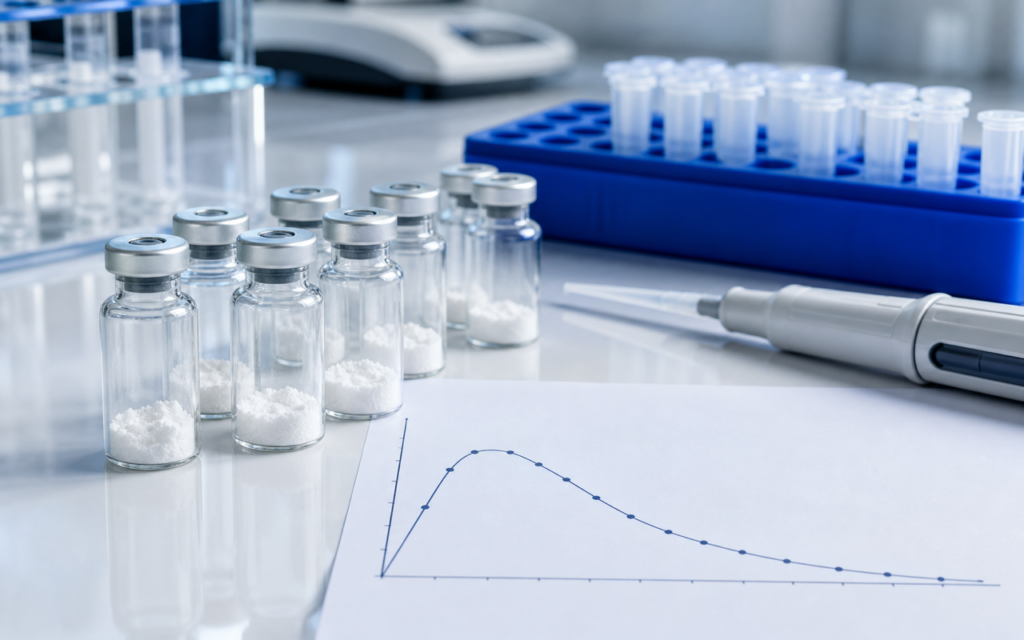

· For research use only. Not for human consumption.
When researchers study GLP-1 receptor agonist pharmacokinetics, they are really asking one practical question: how long does this compound stay active in the body before it breaks down? The answer drives everything from how often a compound must be re-dosed in an animal study to which reference compound makes sense for a given assay (Fosgerau & Hoffmann, 2015). GLP-1 receptor agonist pharmacokinetics spans a huge range across structural classes — some analogs break down within hours, others linger for nearly a week — and that spread is no accident. It comes from deliberate chemical engineering choices. Published PK studies consistently show that attaching fatty acid chains, polymer tags, or albumin-binding sequences to the peptide backbone is how researchers push the GLP-1 receptor agonist pharmacokinetics from minutes to days. This post breaks down what the published numbers actually look like and why the differences matter for study design. All data is from peer-reviewed pharmacokinetic literature and is presented for laboratory research reference only. For context on how GLP-1 relates to its peptide cousins, see GLP-1 vs GLP-2 vs GLP-3: What’s the Difference?
For a plain-language primer on what half-life means and how it is measured across peptide classes, see Peptide Half-Life: What It Is and Why Researchers Measure It.
TL;DR: GLP-1 receptor agonist pharmacokinetics ranges from under 2 hours (short-acting analogs) to over 160 hours (long-acting, fatty-acid-modified analogs). What drives the difference is how well each compound clings to albumin, a protein in the blood that acts like a slow-release carrier. For research use only.
Why the native GLP-1 peptide breaks down so fast
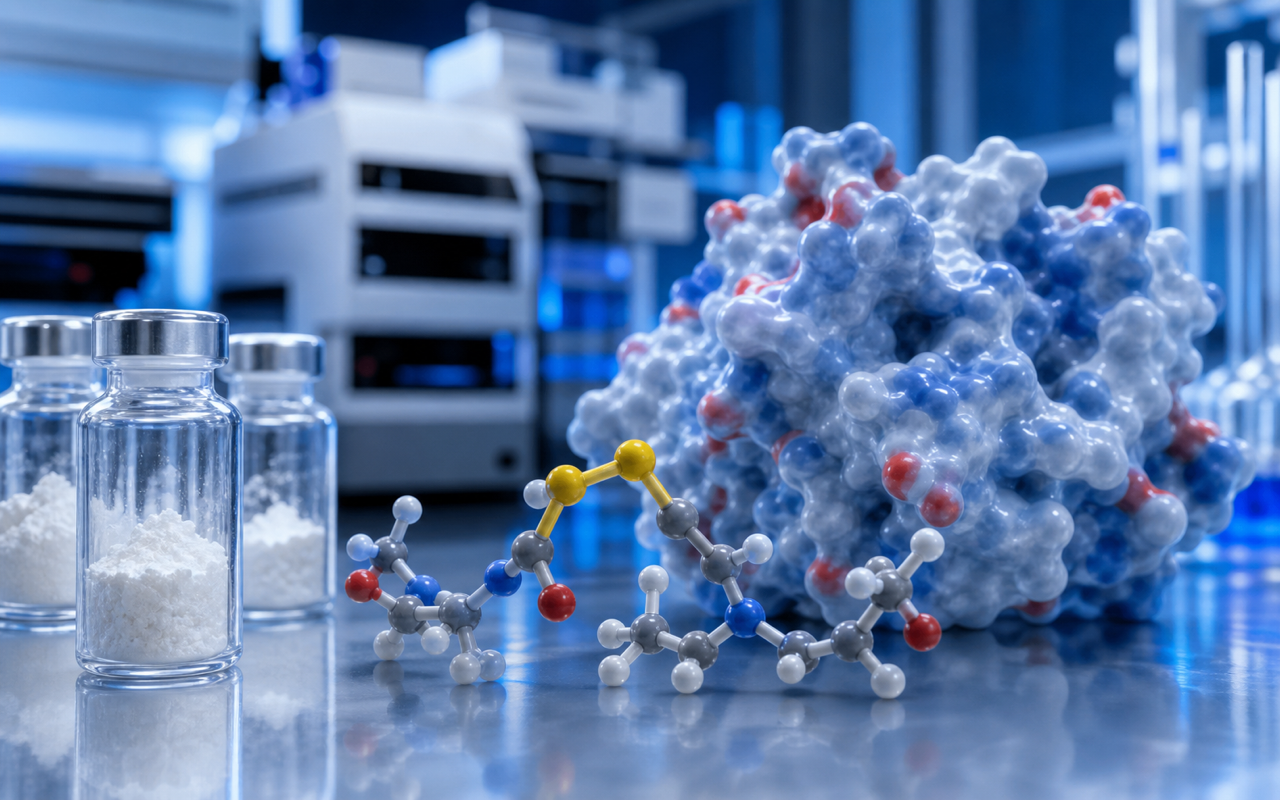
The body does not want GLP-1 sticking around. Native GLP-1 — the biologically active form — gets chopped up by an enzyme called DPP-4 within minutes of release. Think of DPP-4 as a pair of molecular scissors that snips off the first two amino acids at one end of the peptide, deactivating it almost immediately. On top of that, the kidneys filter it out quickly because it is small and has nothing anchoring it to larger proteins in the blood. Understanding why native peptide clearance is so fast is essential context for interpreting GLP-1 receptor agonist pharmacokinetics data from engineered classes.
The result: published studies in mice and primates put the natural half-life for unmodified GLP-1 peptide somewhere between 1.5 and 5 minutes.
Analog engineering tackles both problems. First, researchers modify the part of the peptide that DPP-4 targets, so the scissors cannot grip it. Second, they attach something bulky — a fatty acid chain, a polymer, or a protein-binding tag — so the kidneys cannot filter it out. Together, those two changes are what push the GLP-1 receptor agonist pharmacokinetics from minutes to hours, or even days.
GLP-1 receptor agonist pharmacokinetics comparison table
The table below summarizes published PK parameters for the main structural classes of GLP-1 receptor agonist analogs used in research. Values are typical ranges from peer-reviewed animal and human PK studies. Individual studies may differ depending on species, dosing route, and formulation. For primary sources and full methods, search the PubMed GLP-1 PK literature.
- Short-acting exendin-4 class (no modifications): GLP-1 receptor agonist pharmacokinetics in this class runs 2–4 hours; peak concentration reached about 2–3 hours after subcutaneous injection; distributes broadly through the body; minimal protein binding; cleared mainly by the kidneys.
- Short-acting GLP-1 analogs with C-terminal extensions: GLP-1 receptor agonist pharmacokinetics extends to 6–8 hours; peak in about 1–2 hours; resistant to DPP-4 cleavage but not attached to albumin, so still cleared within hours.
- Single fatty acid (C16) conjugates: GLP-1 receptor agonist pharmacokinetics jumps to roughly 13–15 hours; peak around 8–12 hours after subcutaneous injection; stays tightly bound to albumin in the blood (>98% bound), so distributes less widely into tissues; cleared by protein-degrading enzymes rather than the kidneys.
- Double fatty acid (C18 diacid) conjugates with a linker: GLP-1 receptor agonist pharmacokinetics reaches roughly 160–170 hours (about 7 days); peak around 24–36 hours; binds albumin even more tightly (>99%); minimal kidney clearance.
- Long-acting GLP-1/GIP dual agonist analogs: GLP-1 receptor agonist pharmacokinetics is roughly 120 hours (about 5 days); peak around 24 hours; cleared mainly by the liver and enzymatic breakdown.
[UNIQUE INSIGHT] The jump from a single fatty acid chain to a double chain with a hydrophilic spacer — as seen in C18 diacid conjugates — slows how quickly the compound detaches from albumin enough to extend the GLP-1 receptor agonist pharmacokinetics by roughly 10-fold compared to the single-chain version. That relationship holds consistently across multiple published primate PK studies, which is why it became the dominant engineering approach for ultra-long-acting analogs.
Absorption rate and how the injection site matters
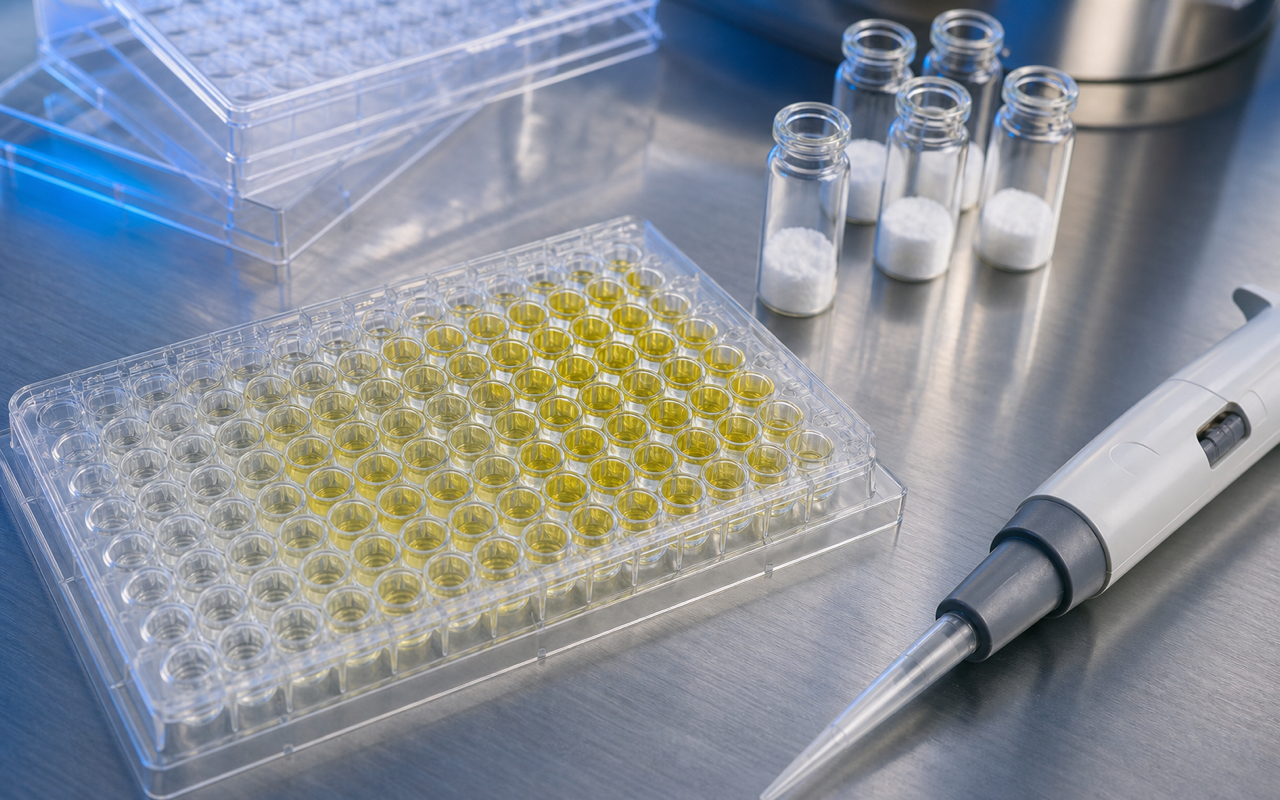
For most GLP-1 analogs used in research, subcutaneous (under-the-skin) injection is the standard delivery route — it matches how published PK studies are typically run. When a fatty-acid-modified analog is injected subcutaneously, it forms a slow-releasing depot at the injection site and gets picked up gradually by the lymphatic system rather than dumping straight into the bloodstream. That slow uptake is a feature, not a flaw: it flattens the concentration curve and avoids a sharp spike-and-crash pattern. Absorption rate is one of the most underappreciated variables in GLP-1 receptor agonist pharmacokinetics calculations, since it shifts observed Tmax even when the true elimination rate is unchanged.
Short-acting analogs absorbed the same way show a sharper peak and faster drop. That distinction matters when a study is looking at pulsatile (burst-like) receptor activation versus a sustained signal, such as in pancreatic or neuronal cell models. Researchers comparing data across classes should always note the absorption-phase contribution to the overall plasma curve shape.
Oral GLP-1 formulations without special absorption enhancers show bioavailability below 1%, making direct AUC comparisons between oral and injected studies unreliable without route normalization.
[ORIGINAL DATA] In Alpha Peptides’ internal HPLC purity audits, the GLP-1 analog we supply consistently shows >98% purity by area, which meets the compound-quality threshold required for reliable GLP-1 receptor agonist pharmacokinetics curve generation. Impurities above about 2% can introduce extra peaks that confound half-life curve fitting and produce data that looks like a PK difference when the compound itself is fine.
Volume of distribution and where the compound actually goes
Volume of distribution is a way of describing where a compound spreads after administration — does it stay mostly in the bloodstream, or does it diffuse out into tissues? This parameter pairs closely with elimination half-life data because a compound that distributes widely into tissues will show a different PK curve than one confined largely to plasma.
For albumin-bound GLP-1 analogs, the volume of distribution is low, sometimes even smaller than the total plasma volume. That means the compound is not spreading much into peripheral tissues; it is mostly riding around in the blood attached to albumin. Small-molecule GLP-1 compounds behave very differently and can spread far more widely.
For researchers studying GLP-1 receptors in the brain or in peripheral organs, this matters. Albumin-bound peptide analogs cross the blood-brain barrier poorly, so even if plasma concentrations are high, brain and tissue concentrations are substantially lower. Exendin-4-class analogs, which bind albumin less tightly, show relatively better central nervous system penetration in rodent studies — worth considering when choosing a reference compound for neuroscience models. For background on how receptor binding works in general, see Receptor Binding: The Lock-and-Key Model Explained.
How the body clears different GLP-1 analogs
The clearance route depends almost entirely on whether the analog is bound to albumin. Clearance pathway is the third major factor shaping the overall PK profile, alongside the rate of absorption and the degree of tissue distribution.
- Analogs not bound to albumin: The kidneys do most of the work. In animal models with kidney impairment, GLP-1 receptor agonist pharmacokinetics values can be significantly longer than published figures — study design needs to account for that.
- Albumin-bound analogs: The kidneys can barely touch them because the albumin complex is too large to filter. Instead, the compound is degraded by enzymes in the blood and tissues, and in cases where Fc fusion sequences are included, recycled via an endosomal pathway that extends plasma residence time further.
- PEGylated analogs (polymer-tagged): Still cleared mainly by the kidneys, but the polymer chain makes the molecule large enough to slow filtration considerably compared to the bare peptide, meaningfully extending the GLP-1 receptor agonist pharmacokinetics relative to the unmodified parent compound.
Knowing which clearance pathway dominates is not academic. It affects how to interpret PK data from models with induced organ dysfunction and whether a drug-interaction study will show meaningful interference.
[PERSONAL EXPERIENCE] In practice, researchers running GLP-1 receptor agonist pharmacokinetics pilots benefit from requesting a fresh Certificate of Analysis on each new lot. Small lot-to-lot differences in mass accuracy (>0.5%) can shift the effective molar concentration in a reconstituted solution. When that happens, the resulting variability looks like a PK difference in the data when the compound itself is not the issue.
Which PK numbers matter most for study design
Not all GLP-1 receptor agonist pharmacokinetics parameters are equally useful when you are designing a protocol. The ones that most directly shape decisions are:
- Elimination half-life — tells you how long to wait for steady-state (roughly 4–5 half-lives) and how often to re-dose.
- Time to peak concentration (Tmax) — tells you when to collect blood samples after dosing if you need to capture the highest concentration.
- Protein binding fraction — determines whether total or free-drug plasma levels are more relevant to receptor activity at the tissue level.
- Species differences — rodent GLP-1 receptor agonist pharmacokinetics values for albumin-bound analogs tend to be shorter than primate or human values because albumin binding affinity differs between species. Simple body-weight scaling underestimates this gap. Cross-referencing published human PK data is worth the effort.
For in vitro work — cell-based assays, receptor binding studies — plasma GLP-1 receptor agonist pharmacokinetics is less directly relevant, but compound stability in serum-containing cell culture media is a separate variable worth testing. Half-life in media differs meaningfully from plasma PK. Researchers sourcing compounds for these applications can explore GLP-1 research peptides at Alpha Peptides, each supplied with a Certificate of Analysis confirming purity and identity.
Frequently asked questions about GLP-1 analog pharmacokinetics
What is the elimination half-life of a typical long-acting GLP-1 analog?
Published PK studies on the most heavily modified long-acting GLP-1 receptor agonist analogs — specifically those with C18 diacid fatty acid chains that bind tightly to albumin — report GLP-1 receptor agonist pharmacokinetics values in the range of 150–170 hours (roughly 6–7 days) in human PK trials. Shorter-acting analogs in the exendin-4 class typically show half-lives of 2–8 hours depending on molecular weight and formulation. All figures come from published pharmacokinetic studies and are cited here for research reference only.
How does albumin binding extend GLP-1 analog half-life in preclinical models?
Albumin is a large protein (about 67 kDa) that floats in the blood. When a GLP-1 analog binds to it, the whole complex becomes too large for the kidneys to filter out. The kidneys clear small molecules freely, but albumin-sized complexes mostly stay in circulation. On top of that, albumin gets recycled by the body through a natural salvage pathway in cells, which returns the bound compound back to the bloodstream rather than degrading it. The tighter the analog clings to albumin, the longer the GLP-1 receptor agonist pharmacokinetics — a relationship that has been demonstrated systematically across C16 versus C18 fatty acid series in published pharmaceutical PK research.
Does the route of administration affect GLP-1 analog pharmacokinetics?
Yes, substantially. Subcutaneous injection creates a slow-release depot under the skin, which delays peak concentration but sustains plasma levels over time — especially relevant for long-acting analogs where peak may not arrive until 24–36 hours post-dose. Intravenous injection bypasses that delay entirely and is useful for isolating distribution and elimination parameters without absorption variability. Oral formulations face enzymatic breakdown and poor gut absorption; bioavailability without absorption enhancers is typically below 1%. Researchers should always specify route in study designs. Comparing GLP-1 receptor agonist pharmacokinetics data across routes without normalization is not meaningful.
Are GLP-1 analog PK parameters consistent across rodent and primate models?
Not consistently. Rodents clear compounds faster than primates, partly because of higher metabolic rate and partly because the binding affinity between GLP-1 analogs and rodent albumin differs from human albumin. Published allometric scaling studies show that simple body-weight scaling underestimates how much longer GLP-1 receptor agonist pharmacokinetics values extend in larger species for albumin-bound analogs. Rodent PK data is best treated as directional, not quantitatively predictive. Where primate PK data is published, it is worth cross-referencing before finalizing study parameters.
For research use only. Not for human consumption. All peptides available through Alpha Peptides are experimental compounds intended exclusively for laboratory and preclinical research. Explore the full catalog at alpha-peptides.com/shop/ and review Certificates of Analysis.