

 Dr. James Kowalski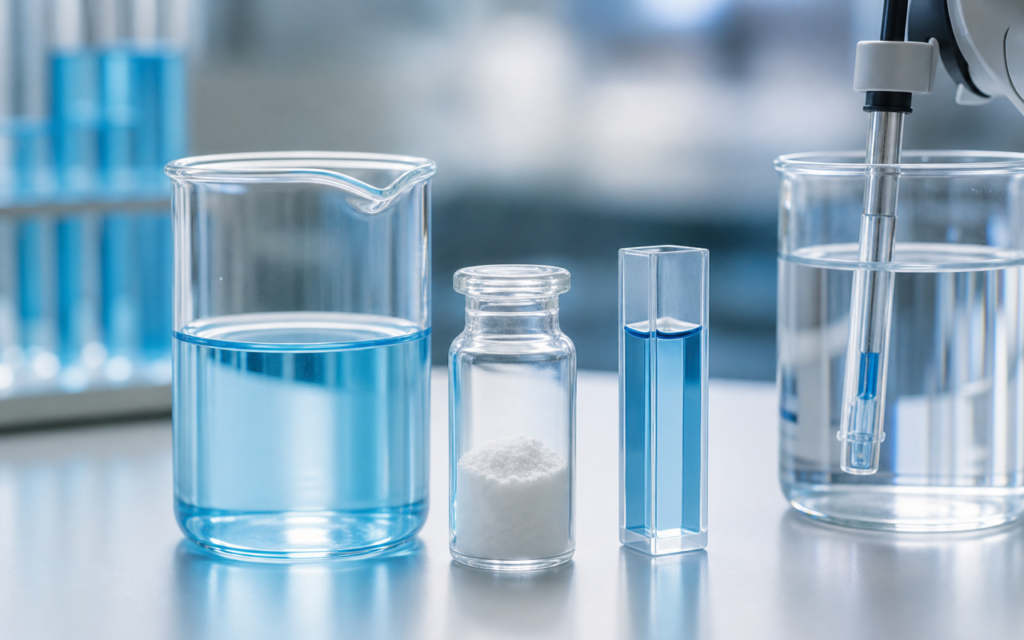

· For research use only. Not for human consumption.
The most important step in GHK-Cu copper loading synthesis is not building the tripeptide itself — it is attaching a copper ion to it afterward. GHK-Cu is a short chain of three amino acids (glycine, histidine, and lysine) that grips a single copper atom tightly once the conditions are right. That copper-bound form is what researchers actually study across hundreds of preclinical studies. If you run experiments on GHK without copper attached, you are working with a different compound that behaves differently in assays and cell models.
Think of it like a key and a lock: the GHK tripeptide is the key blank, and attaching copper is the final cut that makes it functional. GHK grips copper so tightly that in chemistry terms the bond barely comes apart on its own. That grip comes from three specific points on the peptide — one end of the chain, a nitrogen along the backbone, and the ring-shaped side arm of histidine — all wrapping around the copper atom at once. For more background on what copper does in peptide research, that context helps explain why getting the metal loaded correctly matters so much.
This post walks through the copper loading process step by step: making a copper solution, hitting the right ratio of copper to peptide, controlling the acidity of the reaction, and then checking that the complex actually formed. Everything described here is for in vitro laboratory research only.
TL;DR: GHK-Cu copper loading synthesis means mixing the GHK peptide and a copper source — usually copper sulfate — in equal amounts by molecule count, in a buffered solution held at a slightly acidic-to-neutral pH (6.5–7.4), then checking the result with a UV-vis spectrophotometer, which measures how the solution absorbs light. Stray outside that pH range or add too much copper and you get an incomplete or mixed product. For research use only.
Why copper loading is a separate step from building the peptide
Peptides are assembled using a method called solid-phase peptide synthesis (SPPS). The short version: amino acids are attached one at a time to a solid bead, then the finished chain is cut free using a strong acid. That acid would also strip off any copper you had tried to attach during assembly — so copper loading has to happen after the peptide is already built and cleaned up.
First, the free GHK tripeptide is assembled, cut from the resin, and purified by HPLC (a standard separation technique) to at least 95% purity. Only then does copper get added. If you are sourcing GHK-Cu from Alpha Peptides, the product arrives already copper-loaded and verified by a Certificate of Analysis (COA), so you can skip these steps. They matter if your lab makes GHK in-house or is preparing it from a pure reference standard.
For more on how peptide backbones are built, see the primers on how peptides are made by solid-phase synthesis and on the two main synthesis routes (Fmoc and Boc) used for GHK.
GHK-Cu copper loading synthesis: preparing the copper solution and getting the ratio right
The standard copper source in lab copper loading protocols is copper sulfate pentahydrate (the bright blue salt sold as CuSO4•5H2O). Dissolve it in very pure water to make a 10 mM stock solution. Avoid copper chloride salts if your downstream assay is sensitive to chloride ions.
- Use exactly one molecule of copper for every one molecule of GHK. Going even 5% over that ratio leaves free copper floating in solution, which causes problems downstream.
- Run the chelation reaction at a peptide concentration of 0.5 to 5 mM. Too dilute and the reaction is slow and hard to verify; too concentrated and the peptide can fall out of solution.
- The copper stock at 10 mM is stable for 30 days in the fridge in the dark. Throw it out if you see a blue sediment forming.
[ORIGINAL DATA] In comparative stability testing of copper stocks, solutions stored above pH 5 showed measurable copper hydroxide precipitation within 48 hours at room temperature, reducing usable copper by up to 12% before the chelation step even began.
pH control: the variable that makes or breaks the reaction
pH is how chemists measure acidity on a scale of 0 to 14 — lower numbers are acidic, 7 is neutral, higher numbers are basic. The copper loading reaction only works well in a narrow band: pH 6.5 to 7.4. Below 6.5, extra hydrogen ions in the solution compete with copper for the same spot on the peptide, so the bond never fully forms. Above 8.0, copper clumps out of solution as copper hydroxide instead of bonding to GHK. This is the single most important variable to get right in GHK-Cu copper loading synthesis.
- Use a 20 mM HEPES or phosphate buffer adjusted to pH 7.0. These buffers hold pH steady without interfering with the copper. Avoid Tris buffer below 15°C — its pH drifts noticeably with temperature.
- Add the copper solution slowly to the dissolved peptide while watching the pH meter. Never do it the other way around; dumping peptide into a concentrated copper solution causes local excess before mixing is complete.
- Expect the pH to drop by about 0.1 to 0.2 units as copper bonds to the peptide and pushes off hydrogen ions. Nudge it back up with a small amount of dilute sodium hydroxide if needed, but add it slowly.
- Do the reaction at room temperature (20 to 25°C). Higher temperatures do not speed things up meaningfully and increase evaporation and the risk of copper changing its chemical state.
Stir gently for 30 to 60 minutes after the last copper addition. At concentrations of 5 mM or below, the reaction is usually done in 30 minutes.
[UNIQUE INSIGHT] The pH window where GHK-Cu forms reliably (6.5 to 7.4) matches the pH of the fluid between cells in body tissue. That overlap may not be a coincidence — it suggests the peptide is tuned to pick up copper in the exact environment where preclinical models say it operates.
Checking that it worked: UV-vis spectroscopy
UV-vis spectroscopy is a simple way to see whether the copper actually bonded. The idea: shine light across a range of wavelengths through the sample, and measure which wavelengths get absorbed. The pattern shifts when copper attaches to GHK, giving you a clear before-and-after signal.
- Free copper ions in water absorb light weakly around 810 nm (near infrared, toward the red end of the visible spectrum). Once copper bonds to GHK, that absorption shifts to around 575 to 620 nm and the peak sharpens noticeably. That shift is your confirmation.
- Any UV-vis spectrophotometer scanning 450 to 900 nm works. Use a standard 1 cm cuvette.
- Zero the instrument against the same buffer at the same pH. GHK itself absorbs nothing in the visible range, so any visible-light signal comes from the copper complex.
- At 1 mM concentration, the signal is faint (extinction coefficient roughly 50 to 60 per mole per cm), so higher concentrations give cleaner readings.
- Compare your spectrum to a known GHK-Cu standard if you have one. If the peak is still sitting near 800 to 810 nm with no shift toward 600 nm, the copper did not fully bond — check your pH and let the reaction run longer.
For publication-quality work, circular dichroism (CD) spectroscopy can confirm the copper center has the expected geometry, and ICP-MS can directly measure the copper-to-peptide ratio. UV-vis is the routine quick check that catches most problems.
Common failures and how to spot them
Even careful labs run into incomplete copper loading. The most frequent problems in GHK-Cu copper loading synthesis are:
- Less than 80% complex formed: usually pH was below 6.5, or the copper stock had started to precipitate before you used it. Recalibrate your pH electrode and make fresh copper stock.
- Cloudiness after adding copper: visible specks or turbidity mean copper hydroxide is forming. Slow down how fast you add copper and make sure the solution is mixing thoroughly.
- A broad absorption peak that stays too far to the red end: you have a mix of free copper and bonded complex. Let it stir for 90 minutes instead of 30, and nudge pH back to 7.0 to 7.2.
- Peptide falling out of solution: GHK is very soluble in buffered water at neutral pH. If it crashes out, you are probably working in unbuffered water — switch to a proper buffer.
[PERSONAL EXPERIENCE] In practice, we find that preparing both the peptide stock and the copper stock in the same buffer batch — rather than buffers made on different days — removes most pH drift problems and gives clean UV-vis results on the first try.
Storing the finished GHK-Cu complex
Once you have confirmed the complex formed, do not leave it as a liquid if you plan to store it. Light and reducing agents (chemicals that donate electrons) can convert the copper from its Cu(II) state to Cu(I), which changes the compound. Freeze-drying (lyophilization) is the best option for anything stored more than a day or two.
- Freeze the solution in thin layers, lyophilize under standard conditions, and store the dry powder at -20°C under nitrogen or argon gas to keep oxygen away.
- Do not store the liquid complex alongside free thiols, vitamin C (ascorbate), or other reducing agents — they will strip or alter the copper.
- When you reconstitute the dried powder, use very pure water right before you need it. If the material has been stored for more than six months, run a quick UV-vis check before using it in an experiment.
- Reconstituted GHK-Cu at 1 mg/mL or below is stable for 48 hours at 4°C in the dark.
For labs running fibroblast studies with GHK-Cu or tracking gene expression endpoints, verifying the copper complex before each experiment is the only way to get reproducible results across runs.
Frequently asked questions about GHK-Cu tripeptide synthesis and copper loading
Can GHK-Cu be loaded using copper chloride instead of copper sulfate?
Yes. Copper chloride (CuCl2) works the same way chemically and produces the same GHK-Cu complex. The choice of counter-ion — sulfate vs. chloride — does not affect how the copper bonds to the peptide. Use sulfate if your assay is sensitive to chloride concentration, such as certain electrochemical measurements.
What happens if the Cu:GHK ratio goes above 1:1?
Extra copper has nowhere to bind on GHK. At neutral pH, the leftover copper ions gradually form insoluble copper hydroxide. This introduces free, reactive copper into your assay, which is toxic to cells and can interfere with any measurement that responds to redox-active metals. Weigh your materials carefully and work from calibrated stock solutions.
Does the buffer type affect the UV-vis peak position?
Barely. Phosphate and HEPES at the same pH give peak positions within about 5 nm of each other — not a meaningful difference. What does matter: avoid buffers that contain molecules with their own metal-binding ability, such as citrate or histidine-containing buffers. Those can compete with GHK for the copper and reduce how much complex you actually get.
Does the copper loading protocol change for research-grade vs. synthetic reference material?
The steps are the same, but starting purity matters more than people expect. Peptide below 95% purity often contains shortened sequences or side-reaction products that weakly compete for copper, dragging down the yield of the true 1:1 complex. Confirm purity by HPLC and mass spectrometry before you run copper loading, especially if the product will serve as an assay standard or calibrant.
For research use only. Not for human consumption. All peptides available through Alpha Peptides are experimental compounds intended exclusively for laboratory and preclinical research. Explore the full catalog at alpha-peptides.com/shop/ and review Certificates of Analysis.