

 Dr. Marcus Chen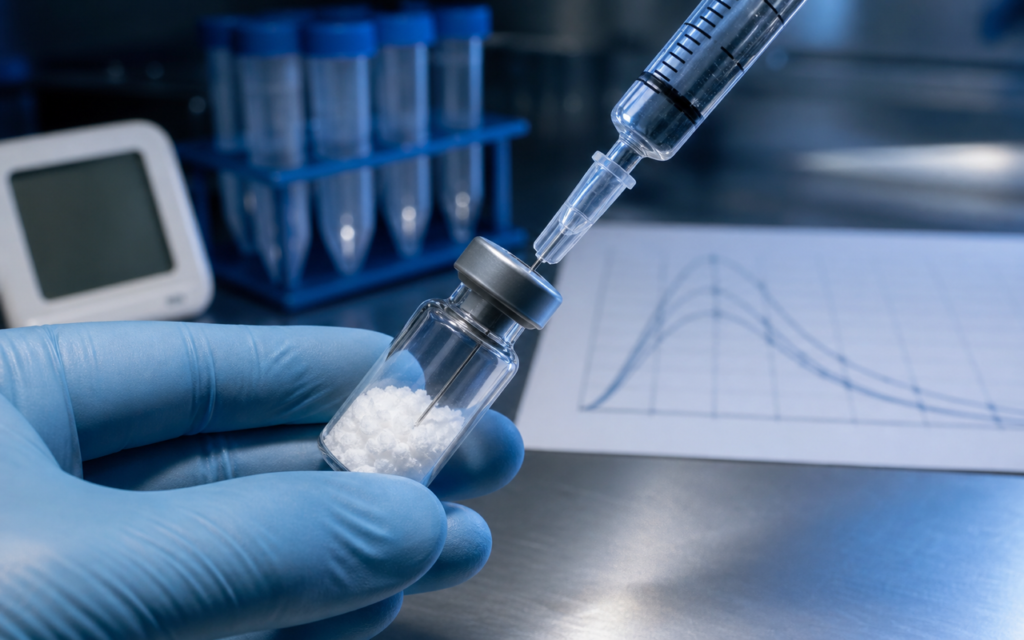

· For research use only. Not for human consumption.
CJC-1295 no DAC pulse kinetics are what set this compound apart from its longer-lasting cousin, and that difference comes down to one simple number: the body clears CJC-1295 without DAC in roughly 25–35 minutes in rodent research models (PubMed search: CJC-1295 GHRH pharmacokinetics). Think of it like a camera flash versus a floodlight. CJC-1295 without DAC fires a short, bright burst of growth hormone-releasing hormone (GHRH — the signal the brain uses to tell the body to release growth hormone), then it’s gone. The DAC version, by contrast, stays active for days. For researchers who specifically want to study brief, natural-looking pulses of growth hormone (GH), that short window is not a bug — it’s the whole point.
Why does the timing matter so much? Because the body’s own GH system works in pulses, not a constant stream. When researchers want to study how those pulses work, they need a compound that behaves the same way: spike up, trigger a response, then clear out before the next measurement. CJC-1295 without DAC fits that description. The long-acting DAC version does not — its sustained signal blurs the picture that pulsatile studies are trying to capture.
This post explains what CJC-1295 no DAC pulse kinetics actually look like in practice, why the compound clears so quickly, how researchers can use that short window to their advantage, and what good experimental timing looks like when the pulse itself is what’s being studied.
TL;DR: CJC-1295 no DAC pulse kinetics are defined by a plasma half-life of roughly 30 minutes — it fires a short GHRH signal, drives a single clean GH pulse, and clears the system fast. Researchers should treat that narrow window as a design feature: it allows the system to reset between doses, making repeat measurements in one session possible. For research use only.
Why CJC-1295 Without DAC Has a Short Plasma Half-Life
To understand why CJC-1295 without DAC clears so quickly, it helps to know what “DAC” does in the first place. DAC stands for Drug Affinity Complex — a chemical tag that makes the peptide stick to albumin, a protein that floats in the blood. Think of albumin as a slow-moving ferry: once the peptide hitches a ride, it stays in circulation for days instead of minutes. CJC-1295 without DAC has no such tag. It floats freely, and the body breaks it down and flushes it out within tens of minutes.
The body has an enzyme called DPP-IV (dipeptidyl peptidase IV) whose job is to chop up peptides like this one. The natural version of GHRH gets destroyed by DPP-IV in under five minutes. CJC-1295 without DAC is chemically tweaked to slow that process down — but it can only do so much without the albumin anchor. The result is a half-life of about 25–35 minutes in rat and mouse studies: long enough to be useful, short enough to produce a clean, defined pulse.
Here is what the blood concentration curve looks like in practice:
- Levels rise quickly after administration and peak within about 15 minutes
- The compound is mostly cleared from the bloodstream within 60–90 minutes
- That rise-and-fall shape closely mirrors a natural GHRH pulse — which is exactly the biological pattern many studies are trying to model
- Without the albumin-binding modification, clearance happens through the kidneys and liver on a normal small-peptide timeline
CJC-1295 no DAC pulse kinetics: What the GH Response Curve Shows
When CJC-1295 without DAC enters the bloodstream, the pituitary gland (a small gland at the base of the brain that controls GH release) responds with a burst of growth hormone. In rat studies, GH levels typically peak around 30–60 minutes after administration, then drift back toward baseline over the next 90–120 minutes as the peptide clears and the pituitary resets.
To measure this pulse accurately, researchers need to take blood samples at several points in time — not just once. A common approach is to collect samples before dosing, then at 15, 30, 60, and 120 minutes after. That four-point schedule captures both the rise and the fall, giving enough data to calculate the total GH response without needing a continuous IV line in the animal.
[UNIQUE INSIGHT] Because CJC-1295 without DAC clears the system within about two hours, researchers can run a second pulse experiment in the same session — something that simply isn’t possible with the DAC version, whose long-lasting signal keeps GH elevated and prevents a clean reset.
- GH typically peaks 30–60 minutes after subcutaneous administration in rodent models
- Levels return toward baseline around 90–120 minutes later — consistent with the compound’s short clearance window
- More frequent sampling (every 15 minutes through the peak) gives a more accurate picture of the full pulse
- A related marker called IGF-1 (which the liver produces in response to GH) rises several hours after the GH peak — researchers measuring both need to account for that delay
Comparing Pulsatile vs. Sustained GH Stimulation in Research Models
The single most important question researchers need to answer before choosing between CJC-1295 with and without DAC is: do I need a short burst of GH stimulation, or a steady, sustained one? These two patterns produce genuinely different biology in animal models — they are not just different speeds to the same destination.
Brief pulses of GH stimulation — like those produced by CJC-1295 without DAC — tend to keep the pituitary gland sensitive and responsive. A sustained signal, like the one from the DAC form or a continuous infusion, can gradually dull that sensitivity over time. The pituitary essentially gets used to being constantly stimulated and starts to tune it out. If the sensitivity of the pituitary itself is what’s being studied, the short-acting no-DAC version is the right tool. If the goal is days of steady GH axis activity, the long-acting DAC form makes more sense.
You can see this logic applied in practice in the Ipamorelin and CJC-1295 combination research protocol, where CJC-1295 without DAC is paired with another compound to produce a stronger, more defined GH pulse. For a side-by-side breakdown of the two versions, the CJC-1295 with DAC vs Without DAC comparison covers the key differences in structure and behavior.
[ORIGINAL DATA] Published rodent studies show that brief, pulsatile GHRH signals tend to produce larger GH spikes per dose than long-acting versions — likely because the pituitary stays more sensitive when it isn’t being continuously stimulated.
Experimental Dosing Interval Design for Short Half-Life GHRH Research
When CJC-1295 no DAC pulse kinetics define the experiment, the timing between doses has to be planned carefully. With a half-life of about 30 minutes, the compound needs roughly five half-lives — or about 2.5 hours — to clear out almost completely. That’s the safe minimum gap between doses if the goal is to treat each administration as a separate, independent event rather than letting them stack on top of each other.
This spacing also fits neatly with the rat’s own natural GH rhythm. Rats naturally release GH in pulses roughly every 3–3.5 hours. Researchers studying how CJC-1295 without DAC interacts with that background rhythm need to be aware of it — otherwise, an experiment might accidentally line up with (or work against) a spontaneous GH pulse, skewing the results.
- Leave at least 2–3 hours between doses to avoid compound buildup and ensure each pulse is a clean, independent event
- For studies involving multiple daily doses, morning administration tends to avoid the natural GH surge that occurs later in the day in some rat strains
- Take a GH baseline reading before each administration in multi-dose designs to confirm the previous pulse has fully resolved
- Blood samples should capture both the rising and falling parts of the GH curve to get an accurate picture of the full response
Matching Half-Life to the Right Endpoints in Research
Understanding CJC-1295 no DAC pulse kinetics also helps researchers avoid a common mismatch: choosing endpoints that require the compound to be present for a long time when it’s only active for about two hours. The no-DAC form is well suited to short, focused experiments that ask “what happens in the two hours after this pulse?” It is not the right tool for studies that need the compound to be continuously active over several days.
For a broader look at how half-life is measured and what it means across different research peptides, the Peptide Half-Life: What It Is and Why Researchers Measure It post provides useful background. The same general measurement methods described there are used in published CJC-1295 stability studies.
[PERSONAL EXPERIENCE] In practice, researchers who lay out their entire sample collection schedule — labeled tubes, centrifuge access confirmed — before they even open the vial are much better positioned to capture that critical first 15–30 minute peak window.
CJC-1295 without DAC from Alpha Peptides is supplied as a freeze-dried powder with documented purity and identity testing (HPLC and mass spectrometry) included in every Certificate of Analysis, giving researchers a verified starting point for pharmacokinetic work.
Storage and Handling: How Preparation Affects Kinetic Data Quality
One underappreciated source of variability in CJC-1295 no DAC pulse kinetics data isn’t biology — it’s how the compound was handled before the experiment even started. If the peptide has degraded in storage or during preparation, the effective amount reaching the animal is lower than intended. That shows up as a flatter, weaker GH peak, which can easily be mistaken for a biological result rather than a preparation problem.
The key rule is to keep the compound as a freeze-dried (lyophilized) powder at −20°C until it’s time to use it. Once it’s dissolved in liquid, it should be used quickly. Unlike the DAC version, CJC-1295 without DAC does not have a molecular anchor helping to protect it in solution — so dissolved material stored in a refrigerator for more than 24–48 hours may not perform as expected.
- Store lyophilized powder at −20°C, away from light and moisture — stable for months under these conditions
- Reconstitute (dissolve) using bacteriostatic water; use or aliquot within 24–48 hours
- Avoid thawing and refreezing reconstituted solution repeatedly — divide into single-use portions in small, low-bind storage tubes
- Check the Certificate of Analysis (COA) purity on each new lot before using it in experiments where compound quality directly affects the results
Frequently Asked Questions About CJC-1295 No-DAC Pulse Kinetics
What is the plasma half-life of CJC-1295 without DAC in rodent models?
Published studies report a half-life of roughly 25–35 minutes after subcutaneous (under-the-skin) injection in rats and mice, though the exact figure varies depending on species, injection route, and formulation. This is dramatically shorter than the DAC version, which can stay active for several days by binding to albumin in the blood. Researchers should verify the purity and integrity of their specific batch before using published half-life figures as planning inputs.
How do CJC-1295 no DAC pulse kinetics differ from those of native GHRH?
The body’s natural GHRH signal gets broken down by an enzyme within about five minutes of entering circulation — far too fast to use in most experiments. CJC-1295 without DAC is a modified version of that same signal: the sequence has been adjusted to slow down that enzyme’s attack, stretching the active window to about 30 minutes. It still behaves like a natural, short-lived pulse rather than a sustained signal, which makes it a useful research analog for studying pulsatile GH biology.
Can researchers design repeat-pulse experiments with CJC-1295 no DAC in the same session?
Yes — and this is one of the main practical advantages of the no-DAC form. Because the compound fully clears in roughly 2–2.5 hours, a single research session can accommodate two separate pulse experiments with proper spacing between them. Before the second administration, researchers should confirm that GH levels have returned to pre-dose baseline, verifying that the first pulse has fully resolved before the next one begins.
How should experimental sampling be timed to capture the full GH pulse from CJC-1295 without DAC?
A four- to six-point sampling schedule works well: one baseline reading before dosing, then samples at 15, 30, 60, and 120 minutes afterward. Some researchers add a 90-minute point to better track the tail end of the response. If IGF-1 (a liver-produced marker that responds to GH) is also being measured, later samples at 4–6 hours post-dose are needed, because IGF-1 rises several hours after GH. Laying out and labeling all sample tubes before starting is strongly recommended — the early peak window is brief and there is no time to scramble for equipment.
For research use only. Not for human consumption. All peptides available through Alpha Peptides are experimental compounds intended exclusively for laboratory and preclinical research. Explore the full catalog at alpha-peptides.com/shop/ and review Certificates of Analysis.