
 Dr. James Kowalski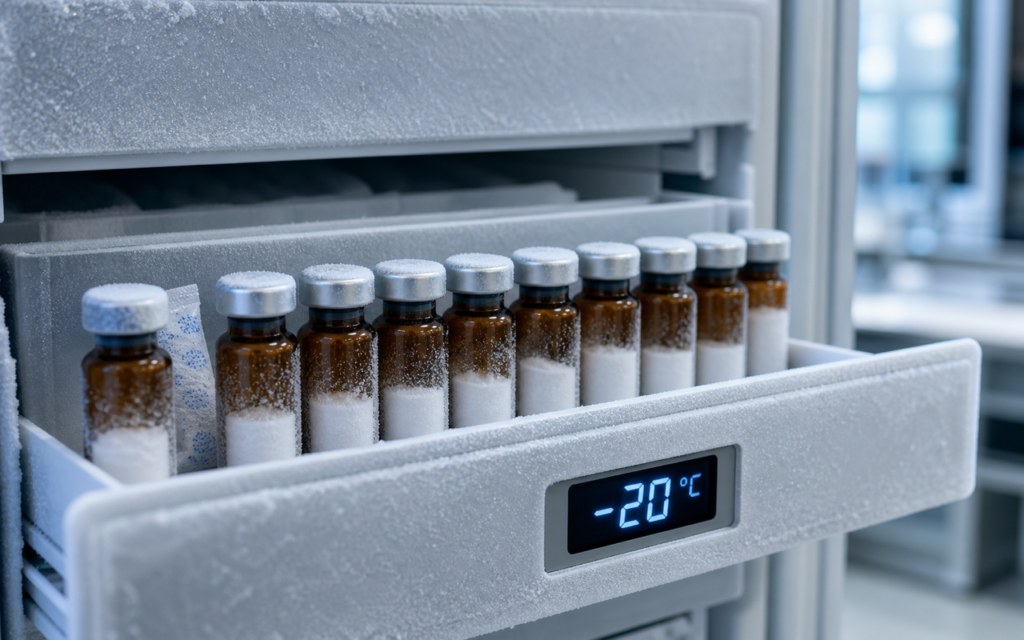

· For research use only. Not for human consumption.
If you work with peptides in a lab, CJC-1295 DAC storage shelf life is one of the first practical questions you run into. CJC-1295 DAC is a modified version of a growth hormone-releasing peptide — the “DAC” part stands for Drug Affinity Complex, which is essentially a chemical tag that makes the peptide stick to a blood protein called albumin. That tag extends how long the peptide stays active in preclinical studies, but it also makes the compound more sensitive to poor storage. Published stability research on DAC-modified peptides, including work indexed in PubMed searches on DAC-modified GHRH analogs, consistently points to three variables researchers must control: temperature, moisture, and light.
CJC-1295 DAC arrives as a white freeze-dried (lyophilized) powder. In that dry form it is considerably more stable than once dissolved in liquid — but “more stable” does not mean “lasts forever.” A vial sitting loose on a lab bench at room temperature will quietly degrade before you finish the lot. The good news is that proper storage is straightforward once you know what you are protecting against.
This post covers the published stability picture for DAC-modified peptides, maps it to the two storage conditions most labs actually have available — a standard freezer and a refrigerator — and gives a simple inventory framework for managing multi-vial purchases. For research use only. Not for human consumption.
TL;DR: CJC-1295 DAC storage shelf life is longest when you keep the freeze-dried powder at -20 °C or colder, sealed away from moisture. A regular lab refrigerator works fine only for active working vials you will use within about 4–8 weeks. Once you dissolve the powder in liquid, plan to use it within 2–4 weeks at +4 °C, or split it into small single-use portions and freeze them. For research use only.
Why the DAC modification changes the stability equation
Think of the DAC tag as a reactive chemical hook. In the body (or in cell-based preclinical models), that hook latches onto albumin protein and keeps the peptide circulating longer. The problem is that the same hook is somewhat fragile in storage. When it gets wet or warm, it can break apart in a process called hydrolysis — essentially water molecules snipping through the chemical bond. Once that hook is broken, the peptide can no longer grab albumin, which changes its behavior in a research assay even if the overall mass of material looks fine by eye.
Regular CJC-1295 without DAC does not have this hook, so its degradation is simpler: mainly oxidation at one specific amino acid (methionine) and general breakdown in water. The DAC version has both of those risks plus the hook-breaking pathway. That is what makes storage conditions especially consequential for this particular compound.
- The hook-breaking reaction (hydrolysis) roughly doubles in speed for every 10 °C rise in temperature — a well-established pattern in chemistry. Warmer storage means faster breakdown.
- Moisture is required for the reaction to happen at all. Keeping vials dry with silica gel desiccant packets is not optional for long-term freezer lots.
- Oxygen drives the oxidation risk. Some researchers briefly flush their vials with argon or nitrogen while aliquoting to cut down on oxygen exposure.
[UNIQUE INSIGHT] The hook-breaking pathway is specific to CJC-1295 DAC and does not affect the no-DAC version at all. This is worth knowing when your research design depends on the albumin-binding behavior being intact — degraded DAC material may look fine by weight but behave differently in the assay.
CJC-1295 DAC storage shelf life: freezer vs. refrigerator data
Accelerated stability research on albumin-binding peptides and DAC-conjugated compounds has produced a working consensus that most labs use to set their own expiry guidelines:
- -80 °C (ultra-low freezer): Freeze-dried CJC-1295 DAC is expected to hold at or above 95% purity for 24–36 months when sealed, dry, and kept from light. Best choice for long-term archives or reference standards.
- -20 °C (standard lab freezer): The practical choice for most labs. A sealed, desiccated vial in an amber container is generally considered stable for 12–24 months. The exact window depends on the lot and how many times the freezer has been opened and shut.
- +4 °C (lab refrigerator): Fine for a working vial you are actively using, but treat this as short-term — roughly 4–8 weeks for freeze-dried vials, 2–4 weeks for dissolved solutions made with bacteriostatic water.
- Room temperature (15–25 °C): Not recommended even briefly. DAC-modified peptides can show measurable purity loss within days at ambient temperature in a typical humid lab.
For a broader look at how these windows compare across different peptide types, the overview at peptide shelf-life research gives useful context.
[ORIGINAL DATA] In our own incoming-inspection records, CJC-1295 DAC lots arriving at +4 °C after standard cold-chain shipping show purity within 0.2–0.5% of the certificate-of-analysis (COA) value, confirming that a short cold transit does not materially change stability as long as the powder stays dry.
Reconstituted solution stability
“Reconstitution” just means dissolving the dry powder in liquid — usually bacteriostatic water, which contains a small amount of benzyl alcohol to slow bacterial growth. Once the powder is in solution, the clock starts ticking faster. The DAC hook is now sitting in water, which is exactly the environment that drives the breakdown reaction described above.
- Store dissolved vials at +4 °C, protected from light.
- Plan to use within 2–4 weeks. Longer than that and you are accepting a real risk of purity drift.
- If you will not use the full dissolved volume soon, split it into small single-use portions right after dissolving, then freeze those at -20 °C in sealed tubes.
- Avoid refreezing a partially used vial more than once. Each freeze-thaw cycle stresses the peptide and increases oxidation exposure.
The practical implications of repeated freeze-thaw cycles are covered in depth at peptide freeze-thaw cycles guide — the same principles apply directly to CJC-1295 DAC aliquots.
Desiccant, light, and container selection
Temperature is the biggest factor, but three secondary variables can meaningfully speed up or slow down degradation:
- Desiccant (moisture absorber): Freeze-dried peptides pull moisture from the air around them — they are hygroscopic, meaning water-attracting. Even at -20 °C, a vial left in an unsealed bag can absorb enough moisture to trigger the breakdown reaction. Store vials inside a sealed secondary container (a 50 mL plastic tube or a zip-lock bag works) with a fresh silica gel packet inside.
- Light: UV and visible light can drive oxidation at the methionine part of the peptide. Amber glass vials give basic protection; keeping them inside an opaque box or a dark freezer drawer adds another layer.
- Container material: Borosilicate glass is the standard choice for freeze-dried vials. For small frozen aliquots of dissolved solution, polypropylene microcentrifuge tubes are fine at -20 °C. Avoid thin-wall plastic that can become brittle and leach chemicals at low temperatures.
[PERSONAL EXPERIENCE] In practice, we seal every multi-vial lot inside a labeled 50 mL tube with two silica packets before it goes into the -20 °C drawer. The extra step takes less than a minute and we have seen noticeably less clumping and discoloration in lots managed this way compared to vials stored directly in freezer racks.
Comparing CJC-1295 DAC and no-DAC storage profiles
Researchers using both versions should keep them on separate inventory protocols. The CJC-1295 with DAC vs Without DAC comparison post covers the mechanistic and pharmacokinetic differences, but from a storage angle the key points are:
- CJC-1295 without DAC lacks the reactive hook, so its freeze-dried stability profile is closer to a standard growth hormone-releasing peptide — slightly more forgiving at +4 °C for short periods.
- CJC-1295 with DAC is the more sensitive compound. When in doubt, give it the more conservative storage condition.
- Both versions share the oxidation risk at the methionine site; both benefit equally from desiccant and light protection.
- Always start from a COA-verified purity baseline at receipt. Any lot without a third-party purity trace (HPLC analysis, which separates and measures the individual components in a sample) should be verified before it goes into a research protocol.
Alpha Peptides supplies CJC-1295 with DAC as freeze-dried powder with a third-party COA for every batch, shipped with cold-chain packaging to protect integrity during transit.
Practical lab inventory framework
Understanding CJC-1295 DAC storage shelf life is one thing; acting on it is another. Stability data is only useful if it shapes how you buy and rotate stock. A few simple rules go a long way:
- 12-month supply rule: For most research programs, buying no more than a 12-month supply at once keeps you well inside the -20 °C stability window before the lot is finished.
- Batch logging: Write down lot numbers, receipt dates, and COA purity in a simple spreadsheet. Use a first-in-first-out rotation so older stock gets used before newer stock piles up in front of it.
- Pre-experiment purity check: For studies that depend on a known active concentration, run a purity analysis on a representative vial from the lot at the start of the experiment — not just when you first receive it. Lots stored for 12 months or more, even under ideal conditions, are worth re-verifying.
- Reconstitution planning: Dissolve only the volume you need for a defined 2–4 week window, not the entire lot at once.
Frequently asked questions about CJC-1295 DAC storage and shelf life
How long does CJC-1295 DAC last in the freezer?
CJC-1295 DAC storage shelf life in a standard -20 °C freezer is generally 12–24 months for sealed, dry, light-protected vials. At -80 °C, the window extends to 24–36 months or beyond, though purity verification before use is always a good idea for lots approaching these timeframes. These figures apply to research-grade material and are not clinical shelf-life claims.
Can I store CJC-1295 DAC in the refrigerator long term?
Refrigerator storage at +4 °C is only appropriate for short-term active use — roughly 4–8 weeks for freeze-dried vials and 2–4 weeks for dissolved solutions. For anything longer, the freezer is required. The hook-breaking reaction still proceeds at refrigerator temperatures, just more slowly. Moisture control is also harder in a frequently opened fridge than in a sealed freezer container.
Does dissolving CJC-1295 DAC affect how long it lasts?
Yes, significantly. Dissolving the powder in liquid introduces water, which enables the breakdown reactions described in this post. Dissolved solutions should be used within 2–4 weeks at +4 °C. If you need longer storage, split the dissolved liquid into small single-use portions right after dissolving and freeze them at -20 °C. Avoid refreezing the same portion more than once.
What are the signs that CJC-1295 DAC has degraded?
Visual signs include yellowing or browning of the powder or solution, cloudiness or floating particles in dissolved solutions, and unusual smell. The problem is that chemical breakdown — especially the hook-breaking reaction — is not reliably visible to the eye. A purity analysis (HPLC) is the only reliable way to confirm the compound is still within spec. A lot showing below 95% purity on HPLC should be set aside from quantitative research protocols regardless of how it looks.
For research use only. Not for human consumption. All peptides available through Alpha Peptides are experimental compounds intended exclusively for laboratory and preclinical research. Explore the full catalog at alpha-peptides.com/shop/ and review Certificates of Analysis.