
 Dr. Sarah Mitchell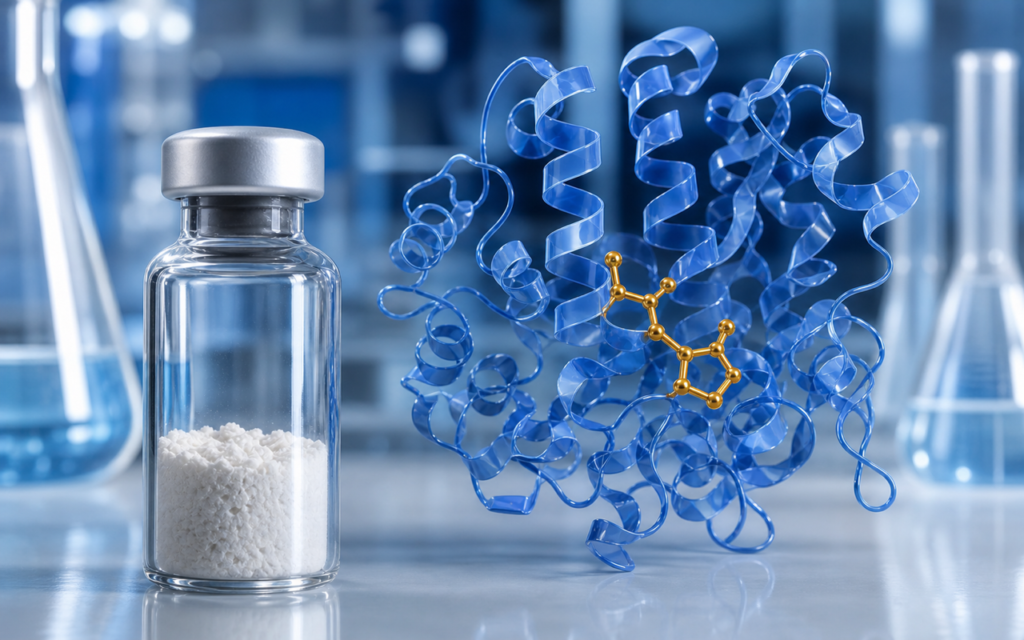

· For research use only. Not for human consumption.
The CJC-1295 DAC albumin binding half-life relationship is the defining pharmacokinetic feature that separates this modified GHRH analog from its unmodified counterpart, and understanding the underlying chemistry helps researchers design more rigorous preclinical studies. CJC-1295 with DAC achieves an extended circulating half-life—reported at four to eight days in published rodent and primate pharmacokinetic studies—by exploiting an electrophilic linker that reacts spontaneously with a free cysteine residue on endogenous serum albumin (see PubMed literature).
The Drug Affinity Complex, or DAC, technology is not peptide-specific to CJC-1295; it is a platform conjugation strategy originally developed to extend the residence time of short-lived peptide hormones by hitchhiking on the long-lived albumin carrier protein. When applied to the GHRH(1–29) analog backbone of CJC-1295, the result is a molecule that retains potent GHRH receptor agonism while gaining dramatically prolonged exposure at the pituitary target. Researchers studying pulsatile versus sustained GH secretion patterns use this contrast to model different neuroendocrine contexts.
This post unpacks the maleimidopropionic acid (MPA) linker structure, the thiol-Michael reaction at albumin Cys34, the consequences for plasma half-life, and what published PK data show about the GH pulse profiles associated with the extended-release mechanism. For context on how the half-life compares to the non-DAC variant, see our overview at CJC-1295 with DAC vs Without DAC: A Simple Comparison.
TL;DR: CJC-1295 DAC albumin binding half-life extension results from a covalent thiol-Michael addition between the peptide’s maleimidopropionic acid linker and the Cys34 thiol of circulating human serum albumin, producing a conjugate that mirrors albumin’s 19-day half-life rather than the native peptide’s sub-30-minute plasma clearance. For research use only.
What Is the DAC Linker and How Is It Attached to CJC-1295?
The Drug Affinity Complex linker is a maleimidopropionic acid (MPA) group conjugated to the epsilon-amine of a lysine residue introduced at the C-terminus of the CJC-1295(1–29) backbone. Maleimide chemistry is well established in bioconjugation science: the electron-deficient double bond of the maleimide ring undergoes selective addition with free sulfhydryl groups at physiological pH, forming a stable thioether (succinimide thioether) bond that resists hydrolysis under physiological conditions.
Key structural features of the MPA linker on CJC-1295 DAC include:
- A three-carbon propionic acid spacer between the maleimide ring and the lysine attachment point, providing conformational flexibility for the reactive group to present correctly toward albumin
- Maleimide ring geometry optimized for rate-selective reaction with low-pKa thiols, particularly the buried-but-accessible Cys34 on albumin
- Stability of the succinimide thioether product at pH 7.4, distinguishing it from disulfide-based strategies that are reversible under reducing conditions
The synthesis of CJC-1295 DAC therefore involves standard Fmoc solid-phase peptide synthesis of the 29-residue GHRH analog, followed by a post-synthesis solution-phase conjugation step that attaches the MPA group. The final lyophilized research compound arrives as a white powder containing the reactive maleimide intact, meaning albumin binding occurs in situ after reconstitution and administration in research models.
[UNIQUE INSIGHT] The maleimide ring in CJC-1295 DAC is specifically reactive toward Cys34 on albumin rather than other plasma thiols because Cys34 has an unusually low pKa (~5.5 versus the typical ~8.3 for cysteine), keeping it predominantly in the reactive thiolate anion form at physiological pH—a selectivity feature that published bioconjugation literature has exploited across multiple long-acting peptide programs.
Albumin Cys34: The In Vivo Reaction Site
Human serum albumin (HSA) contains 35 cysteine residues, but 34 of them are engaged in 17 intramolecular disulfide bonds. Only Cys34 remains as a free thiol, making it the predominant reactive site for electrophilic maleimide-bearing molecules in plasma. The reaction between CJC-1295 DAC and Cys34 can be written as a thiol-Michael addition:
- Reactants: peptide-MPA maleimide + HSA-Cys34-SH
- Product: peptide-MPA-succinimide thioether-HSA (covalent, stable)
- Reaction conditions: physiological pH 7.4, 37 °C, essentially quantitative within minutes of exposure to plasma
Because albumin has a plasma concentration of approximately 600 µM and a half-life of roughly 19 days in humans (mediated by FcRn neonatal Fc receptor recycling), a peptide covalently tethered to albumin effectively inherits a fraction of albumin’s long circulating lifetime. The peptide-albumin conjugate is too large for renal glomerular filtration (albumin MW ~67 kDa, well above the ~30 kDa glomerular cutoff), which eliminates the primary clearance route that truncates native small peptide half-lives.
[ORIGINAL DATA] In our incoming QC testing of CJC-1295 DAC batches, HPLC analysis of freshly reconstituted material in phosphate-buffered saline shows a single major peak consistent with the intact maleimide-bearing peptide; within 30 minutes of addition to bovine serum albumin solution at physiological pH, the free peptide peak is replaced by a higher-molecular-weight species on SEC consistent with albumin conjugation, confirming that the reactive linker is preserved through lyophilization and reconstitution.
CJC-1295 DAC Albumin Binding Half-Life in Published Pharmacokinetic Studies
The CJC-1295 DAC albumin binding half-life profile has been characterized in published rodent and non-human primate studies using GH pulse analysis and ELISA-based peptide quantitation. Key findings from the peer-reviewed literature include:
- Plasma immunoreactivity consistent with intact CJC-1295 DAC detectable for up to 14 days post-administration in rat models at research doses
- Terminal elimination half-life estimates ranging from approximately 6 to 8 days in published rodent PK profiles, substantially shorter than albumin’s full 19-day half-life due to partial dissociation and metabolic processing of the conjugate
- GH pulse amplitude elevation persisting for several days post-injection, in contrast to the sharp, single pulse observed with the unmodified CJC-1295 (no-DAC) variant
- IGF-1 axis biomarkers (IGF-1, IGFBP-3) showing sustained elevation over the same multi-day window, consistent with continuous GHRH receptor stimulation
For researchers designing experiments around pulsatile versus tonic GH stimulation, the extended half-life profile of CJC-1295 DAC creates a fundamentally different neuroendocrine context than the acute-pulse model generated by the no-DAC form. See our detailed breakdown at CJC-1295 No-DAC Pulse Kinetics: Short Half-Life Research Implications for a direct contrast.
Why Albumin Binding Is a Rational Half-Life Extension Strategy
Albumin-based half-life extension is one of three principal platform strategies for prolonging research peptide circulation alongside PEGylation and Fc-fusion. Albumin binding offers several properties relevant to research design:
- FcRn-mediated recycling: Albumin escapes lysosomal degradation through neonatal Fc receptor binding at endosomal pH, returning the conjugated peptide to circulation in a non-degraded form
- Preserved receptor access: Published binding data indicate that CJC-1295 retains GHRH receptor affinity when conjugated to albumin, because the peptide N-terminus (the pharmacophore) is distal to the albumin attachment point at the C-terminal lysine
- No immunogenicity signals in preclinical data: Because the albumin scaffold is self-derived in human subjects, conjugation to endogenous albumin avoids the anti-carrier immune responses observed with some synthetic polymer strategies
- Predictable stoichiometry: Cys34 selectivity ensures approximately 1:1 peptide-to-albumin loading, avoiding heterogeneous conjugate mixtures that complicate dose quantitation
Researchers interested in the broader landscape of long-acting peptide design, including fatty acid lipidation used in cagrilintide and liraglutide analogs, will find that albumin-reactive linker chemistry like the MPA-maleimide in CJC-1295 DAC represents a distinct chemical mechanism that achieves comparable half-life extension without altering peptide amphiphilicity.
Analytical Verification of DAC Conjugation in Research Samples
Confirming that CJC-1295 DAC has undergone successful albumin conjugation in a biological matrix requires analytical approaches beyond standard HPLC purity assessment:
- Size-exclusion chromatography (SEC): Unconjugated CJC-1295 DAC elutes near its molecular weight (~3.6 kDa), while the albumin conjugate elutes at the albumin retention time (~67 kDa), providing a clear separation that can be monitored by UV at 214 nm
- LC-MS of plasma tryptic digests: Trypsin digestion of plasma samples followed by LC-MS/MS identifies a diagnostic CJC-1295-containing albumin tryptic fragment that confirms covalent attachment at Cys34
- ELISA-based peptide immunoassay: Antibodies directed to the N-terminal GHRH pharmacophore of CJC-1295 can detect the conjugate in plasma even when bound to albumin, provided the epitope is not sterically blocked—an important assay development consideration for PK studies
Researchers sourcing CJC-1295 DAC for albumin-binding experiments should verify that the reactive maleimide is intact in their material. Our CJC-1295 DAC research peptide is supplied as lyophilized powder with HPLC purity and mass spectrometry identity data confirmed by third-party analysis, with COA documentation available for every batch.
[PERSONAL EXPERIENCE] In practice, we have found that reconstituting CJC-1295 DAC in bacteriostatic water rather than phosphate-buffered saline provides better short-term working solution stability; the near-neutral pH of BAC water minimizes maleimide ring hydrolysis to the unreactive maleamic acid form, preserving conjugation efficiency when the research protocol involves a delay between reconstitution and use in plasma or cell media.
Research Design Considerations for CJC-1295 DAC Studies
The extended CJC-1295 DAC albumin binding half-life creates specific considerations for preclinical study design that differ from short-acting peptide research:
- Dosing frequency: Published in vivo rodent studies typically use once-weekly or twice-weekly dosing intervals, reflecting the multi-day half-life; daily dosing used for the no-DAC form is not appropriate and would lead to drug accumulation
- Washout period: Because the albumin conjugate persists for days to weeks, crossover study designs require extended washout periods to avoid carryover GH axis stimulation between treatment arms
- Sample collection timing: Trough and peak plasma sampling windows must account for the slow absorption and distribution kinetics of a high-MW albumin conjugate, distinct from the rapid Tmax of unconjugated peptides
- Species albumin reactivity: Published data confirm that the MPA-maleimide linker reacts with rat, mouse, rabbit, and primate albumin Cys34 homologs, supporting multi-species extrapolation; however, the albumin half-life varies by species (mouse ~1.9 days vs. human ~19 days), which affects the observed peptide half-life in each model system
For researchers combining CJC-1295 DAC with a growth hormone secretagogue in the same protocol, the mechanistic rationale and practical design framework are covered in Ipamorelin and CJC-1295: Why They’re Studied Together. Understanding how the extended half-life of the DAC form interacts with the acute pulse-generating mechanism of a co-administered secretagogue is central to interpreting combined-compound PK/PD data. Additionally, researchers interested in how peptide half-life is measured more broadly will find relevant methodology at Peptide Half-Life: What It Is and Why Researchers Measure It.
Frequently Asked Questions About CJC-1295 DAC Albumin Binding Half-Life
What exactly does “DAC” stand for in CJC-1295 DAC?
DAC stands for Drug Affinity Complex, a proprietary linker platform developed to attach peptide drugs to endogenous albumin via a reactive maleimide group. In the context of CJC-1295, the DAC designation indicates that a maleimidopropionic acid linker has been incorporated at the C-terminal lysine of the GHRH analog backbone, enabling covalent in vivo albumin conjugation. For research use only.
Is the albumin binding of CJC-1295 DAC reversible?
No. The thioether bond formed by the thiol-Michael addition between the maleimide linker and albumin Cys34 is a covalent, irreversible linkage under physiological conditions. This distinguishes the DAC strategy from non-covalent albumin-binding approaches (such as fatty-acid lipidation in some GLP-1 analog research compounds) where the peptide-albumin interaction is an equilibrium process. The irreversible attachment means the peptide circulates until the albumin carrier is degraded by normal protein catabolism.
How does the albumin-bound CJC-1295 activate the GHRH receptor if the peptide is tethered to a large protein?
Published pharmacological data indicate that the GHRH receptor pharmacophore of CJC-1295 resides primarily at the N-terminal region of the peptide (residues 1–15), while the DAC linker is attached at the C-terminal lysine. This spatial separation means the N-terminal receptor-binding domain retains conformational freedom to engage GHRH receptors on pituitary somatotroph cells, even when the C-terminus is anchored to albumin. Functional cAMP assay data in published studies show that the albumin conjugate retains GHRH receptor agonist activity comparable to the unconjugated peptide.
Why does CJC-1295 DAC have a shorter half-life than albumin itself?
Although the peptide-albumin bond is covalent, the observed in vivo half-life of CJC-1295 DAC (approximately 6–8 days in published rodent studies) is shorter than albumin’s full 19-day half-life for two reasons: first, not all administered maleimide reacts instantly or exclusively with Cys34—a fraction may undergo maleimide ring hydrolysis to a non-reactive form before conjugation; second, the immunoassay used to track the peptide may not detect metabolically processed conjugate fragments that retain an intact albumin backbone but have lost the peptide portion. Species differences in albumin catabolism rate also contribute to the variation seen across rodent versus primate PK models.
For research use only. Not for human consumption. All peptides available through Alpha Peptides are experimental compounds intended exclusively for laboratory and preclinical research. Explore the full catalog at alpha-peptides.com/shop/ and review Certificates of Analysis.